10 min read
GUIDE / Event Production
How to Plan Production Communications for a Live Event
Plan production communications by separating working discussion, cue execution and issues that need a decision. For each relevant message, agree who sends it, who must receive it, what confirmation is needed and which route they use. Identify decision authority and how unresolved issues are followed up, then rehearse the relevant exchanges and hand over the current plan to affected teams.
On this page
Give each production message the right recipients, an agreed route and a clear next action.
Start with the exchanges the event needs
A contact list identifies people. A communications plan also explains which information they need, what they are expected to do with it and how an unanswered question reaches the person who can resolve it.
Begin with the current programme and working plan. Identify the exchanges needed during preparation, rehearsal, show delivery and handover. A supplier needs the latest requirement before preparing it; a caller needs relevant readiness information before an agreed cue; a programme owner may need an unresolved issue before deciding a change.
Plan around those exchanges rather than assuming that everyone should receive every conversation. Keep the people whose work depends on an answer visible, including people who receive the outcome after the initial discussion.
Separate discussion from execution and decisions
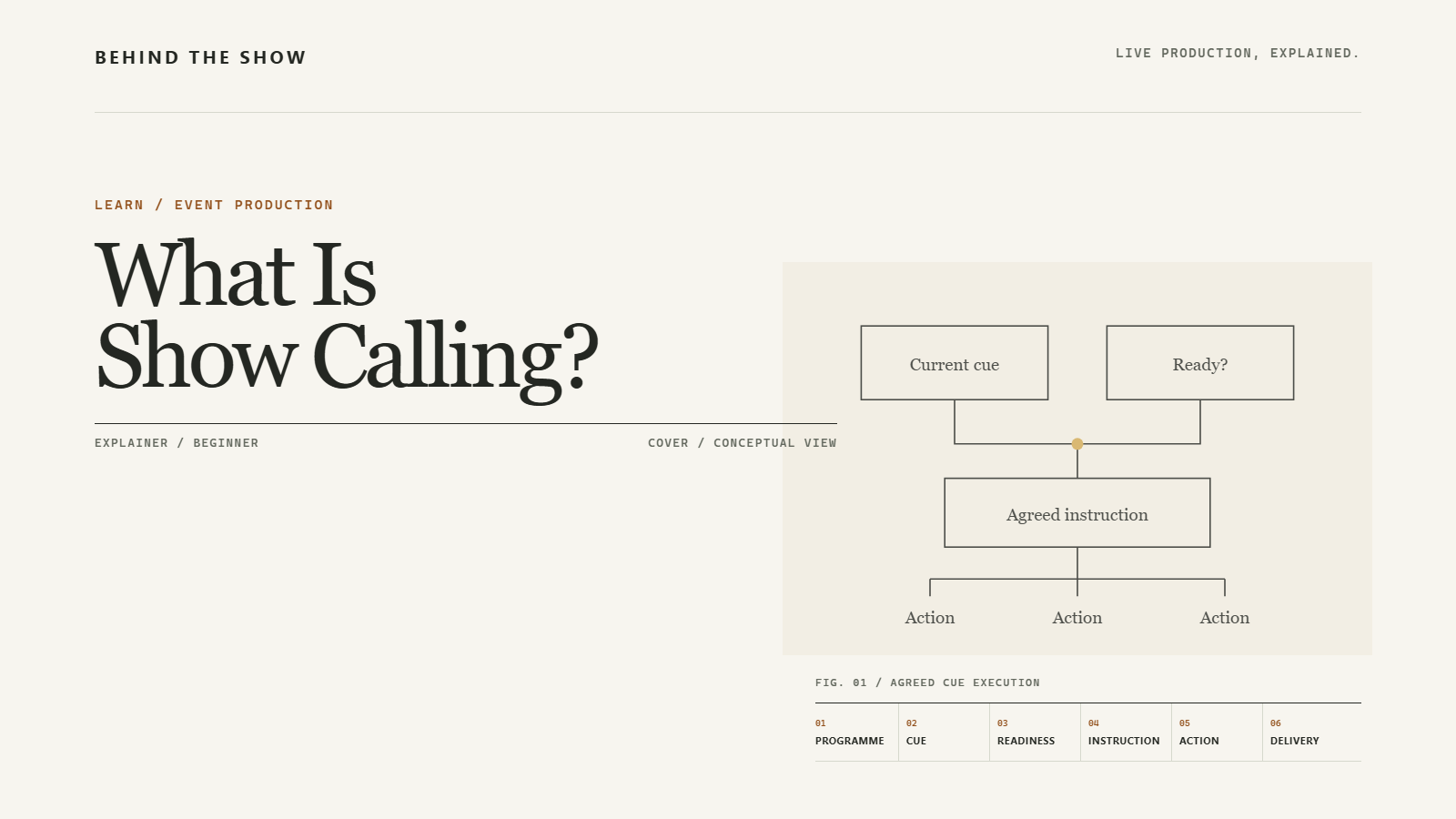
Working discussion clarifies requirements, responsibilities or preparation. A cue instruction coordinates an agreed production action at its trigger. An issue escalation asks the appropriate person to resolve something the sender cannot settle within their scope.
These exchanges can concern the same segment while requiring different recipients and responses. A question about which video version to prepare is not an instruction to play it. A report that a presenter is ready is information for the agreed cue arrangement, not permission for every related action.
| Exchange | What the message needs to establish | Expected response |
|---|---|---|
| Operational discussion | The requirement or question, current reference and affected work | Clarification, an accepted action or an explicitly open item |
| Cue execution | The identified action, relevant readiness and agreed trigger | The response agreed by the caller and operator for that action |
| Issue escalation | The unresolved matter, its consequence and decision needed | A decision within the recipient's authority, or an owned onward action |
Use Show Calling for the calling function. Agree language and responses with the actual team so discussion cannot be mistaken for execution. This guide does not prescribe one set of words for all events.
Identify who must receive and confirm each message
For each important exchange, record the sender, intended recipients and the confirmation needed. A receipt acknowledgement establishes that information arrived. It does not automatically establish agreement, readiness or completion.
Make the confirmation specific to the exchange. A readiness response reports the agreed condition; a completion response identifies the task completed and its current reference. For example, receiving a replacement presentation is different from confirming that the approved version has been prepared for playback. Before doors, the Production Readiness guide shows how those scoped reports and unresolved items support the admission review. Communicate the authorised outcome and any limitations to the people acting on it; acknowledging a report is not permission to admit the audience or execute the first show cue.
For execution instructions, agree whether a verbal reply is needed and how the result will be known. Some arrangements use a readiness acknowledgement before the trigger and execution without a further reply at the trigger. That convention must be agreed with the people using it, not assumed from a different show.
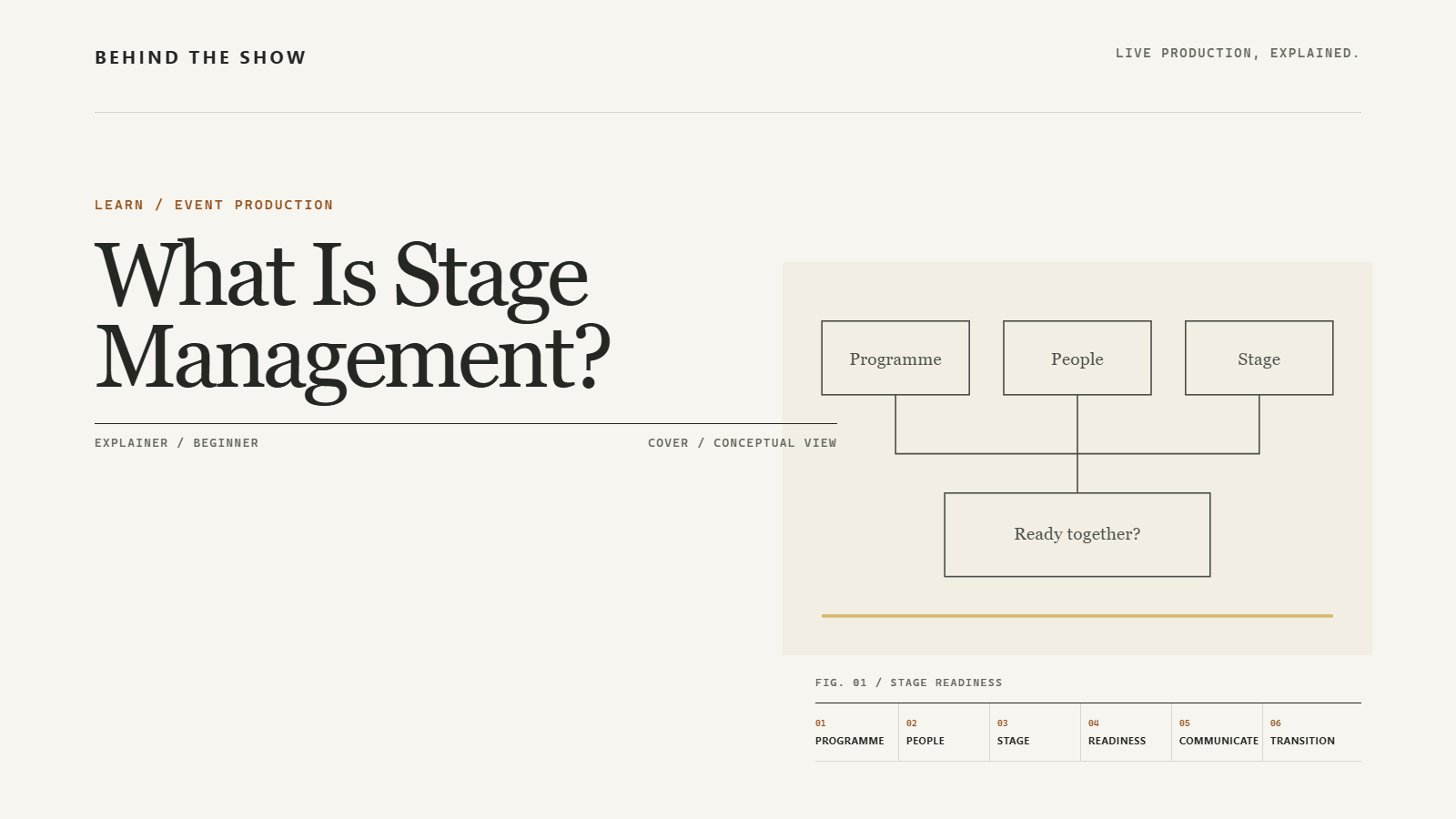
Name the person who reports a condition and the person who uses that report. Where stage management reports performer or stage readiness to a caller, agree what the report covers. Technical teams retain responsibility for their own conditions and work. The Technical Direction explainer explains how checks across technical interfaces are brought together; a coordinated readiness report is not itself a cue instruction or programme approval.
Identify who must hear an execution instruction and who needs only the later outcome. People providing readiness information, calling an action and performing it can be different people. One person may combine functions if that is the agreed arrangement; the plan should describe the functions clearly either way.
Agree routes and decision authority
Record how each exchange reaches its recipients in the actual event arrangement. This might be a shared working record, a scheduled review or an agreed live communication route. The choice needs to work for the people, location and timing involved. Naming a route does not specify its hardware or prove it is available. For remote contributors, the Remote Presenter Participation guide distinguishes the programme exchange from private coordination and explains why the intended receiving destinations must be checked rather than assumed. Where recording or streaming is in scope, the Recording and Live Streaming Requirements guide explains how to brief those audience outputs and their checks separately from crew communications. Private instructions must not be assumed excluded merely because a route is described as private.
For issues that need decisions, identify who can approve the relevant programme, scope, cost, venue or specialist matter. Production leadership may coordinate the discussion without holding all of those authorities. The Production Manager explainer describes that boundary.
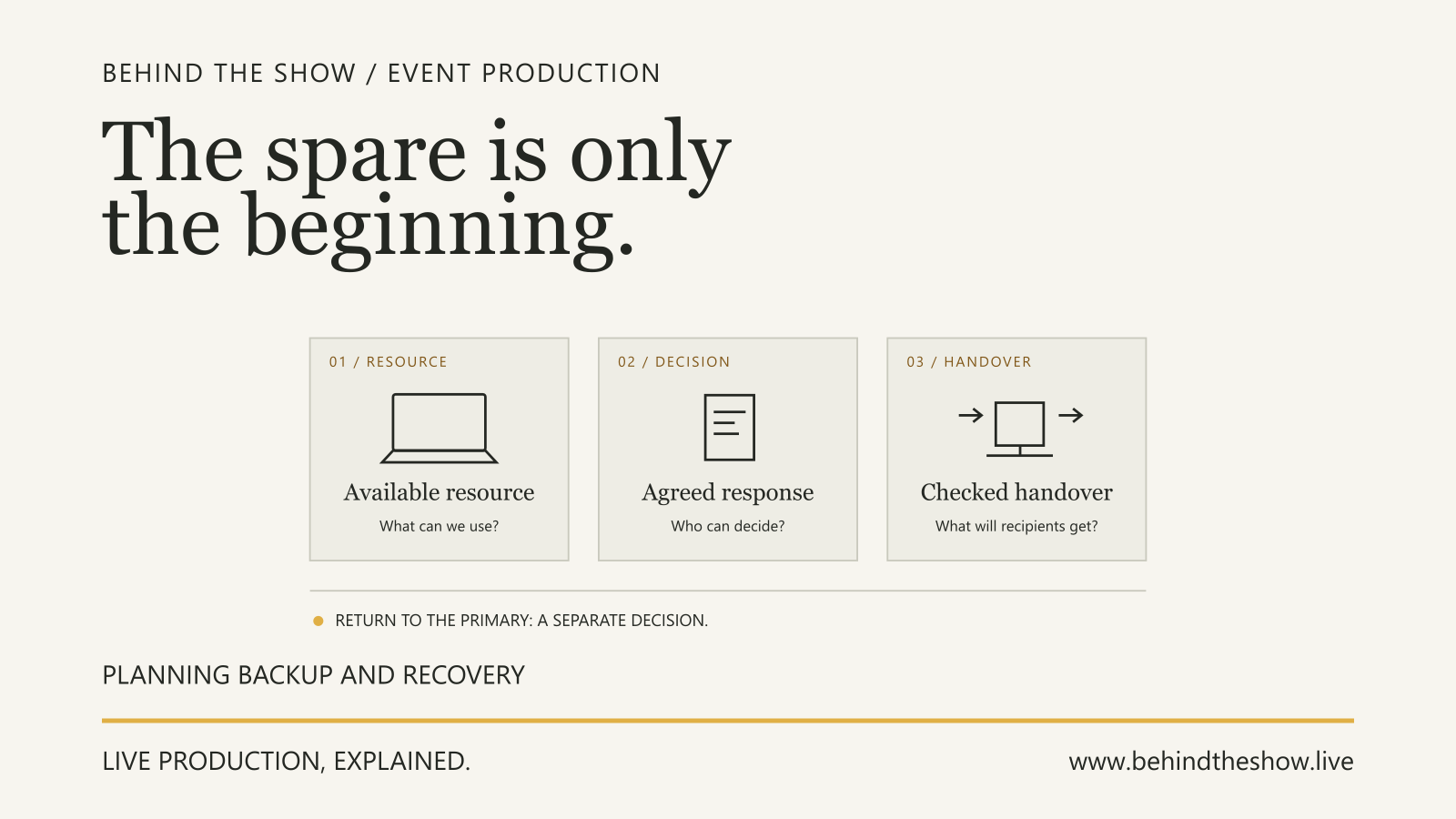
Programme changes also need an instruction handover. If a caller obtains a decision through a separate discussion, record the authorized outcome and communicate the resulting work to affected operators and stage teams. A decision reaching the caller does not mean every recipient has received the revised instruction. The Backup and Recovery guide applies these boundaries to an interrupted production function: who may authorise a switch, which readiness reports it requires and who confirms the receiving result.
Agree what happens when an expected recipient cannot be reached or a required confirmation does not arrive. Identify an alternate authorized contact or a route for obtaining one, with a decision point appropriate to the work. Keep the issue unresolved until the required response is recorded. Do not turn a sent message or silence into approval.
Safety concerns must follow the event's established specialist and venue arrangements. An ordinary production communications plan does not replace them or confer authority to direct emergency actions.
Work through a fictional communications plan
Consider a fictional conference preparing a presentation followed by a panel. Maya coordinates production information, Leena coordinates stage activity, Sam performs the calling function, Arun owns programme decisions and Noor prepares and operates playback. These are teaching roles, not a prescribed staffing structure.
The draft plan distinguishes three exchanges. It leaves the live communication route pending confirmation by the delivery team instead of naming equipment or pretending the route has been tested.
| Exchange and purpose | Sender and required recipients | Confirmation and agreed route |
|---|---|---|
| Clarify which presentation version to prepare | Content owner sends the version reference to Noor and Maya; Sam receives the resulting cue reference | Noor confirms receipt and the preparation action; content owner confirms approved version. Shared content record is the proposed preparation route |
| Report readiness and execute the agreed presentation cue | Leena reports relevant stage readiness to Sam; Noor reports playback readiness to Sam. Sam's execution instruction must reach Noor | Readiness coverage, cue trigger and operator response need agreement. Live route remains pending delivery-team confirmation |
| Resolve an unapproved change to the panel order | Leena reports the issue to Maya; Maya routes the decision to Arun and seeks implications from Sam and Noor | Arun records a programme decision; affected teams confirm their resulting work. Decision record carries the outcome; urgent live contact route remains open |
During preparation, the content owner sends a replacement presentation. Noor acknowledges receipt. Maya records that the new file has arrived but content approval and playback preparation are still outstanding. That receipt is not entered as a readiness report, and it does not authorize Sam to cue the replacement.
Separately, Leena asks whether the panel can move before the presentation. Maya records the request and asks Arun for the programme decision while Sam and Noor identify the affected cue references and preparation. Leena's question remains operational discussion and escalation; it is not a changed delivery instruction.
In this example, Arun declines the proposed order change. Maya records that decision and circulates it to Leena, Sam and Noor. The current order remains presentation then panel. The replacement presentation still needs its own approval and preparation, so declining the order change does not close that item.
The plan also identifies a gap: an alternate programme decision contact has not been agreed if Arun is unavailable. Maya owns obtaining that contact and its authority before the relevant decision point. The team has not rehearsed the live exchanges or confirmed the live route. Those remain open in the handover.
| Handover item | Current state | Next owner and action |
|---|---|---|
| Programme order | Proposed change declined by Arun; current order retained | Maya circulates the decision reference; recipients confirm the effect on their work |
| Replacement presentation | Received; content approval and preparation outstanding | Content owner confirms approval; Noor confirms preparation and relevant checks |
| Live readiness and cue route | Not confirmed or rehearsed | Sam coordinates agreement with Leena and Noor and records the outcome |
| Alternate programme decision contact | Unassigned | Maya obtains an authorized contact and updates the plan |
The team can now see which messages are discussion, which report a condition and which need a decision. It cannot yet claim that the communications arrangement is ready for use. The unresolved route, alternate contact and rehearsal remain visible rather than disappearing behind a distributed contact list.
ILLUSTRATIVE SCENARIO
Rehearse the relevant exchanges
Use a preparation session or rehearsal to check that recipients understand the exchanges their work depends on. Ask the team to walk through the relevant readiness report, execution instruction and unresolved issue. Confirm that discussion is understood as discussion and that the agreed instruction reaches the person expected to act.
Record what was checked and what remains untested. A successful exchange between two people does not establish that every route, recipient or event condition has been checked. Where the plan includes an alternate contact or agreed alternative route, include the relevant exchange in the review rather than assuming it works.
If a rehearsal changes a role, reference or route, update the plan and tell those affected. An earlier acknowledgement should not be treated as acceptance of a revised arrangement.
Hand over the current plan and keep it current
Give recipients the current role/contact information, exchange purposes, agreed routes, required confirmations and decision authorities. Include document versions and open actions. Identify who maintains the plan and how a replacement reaches its users.
For an unresolved discussion, record the owner and decision needed using the production meeting approach. When an answer arrives, communicate its effect to the people delivering the work rather than leaving it only with the original sender.
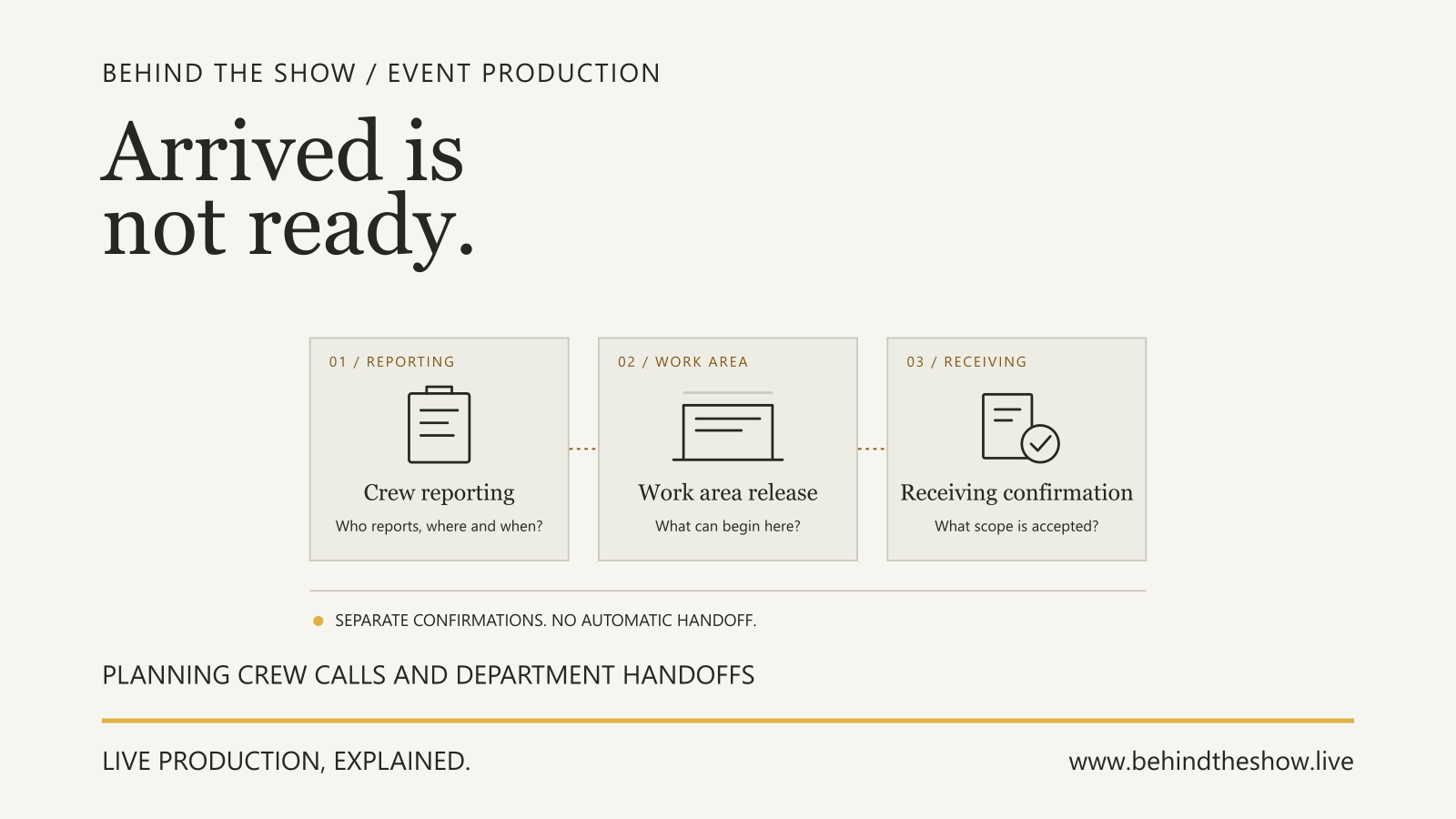
At a personnel handover, confirm who now performs the communication function and what unresolved items they are taking on. Receiving the plan is one step; understanding and accepting the assigned function is another. For the staffing and readiness behind that exchange, the Crew Calls and Department Handoffs guide explains how to confirm coverage, transfer checked results and keep outstanding checks visible when personnel change.
A useful communications plan connects the right people to a defined exchange and response. It keeps questions, execution instructions and decisions distinguishable throughout delivery.
Related questions
What information does a show caller need?
Current programme and cue information, relevant content versions, readiness dependencies, communication routes and agreed change procedures.
What information does a stage manager need?
Current programme information, performer details, stage arrangements, transitions, rehearsal timings, communication paths and agreed responsibilities relevant to the role.
How should production responsibilities be recorded?
Record specific requirements, named participants, delivery and approval functions, dependencies and unresolved work in a shared current plan.
Who approves changes to a live production?
Approval depends on the decision and agreed authority. Identify the relevant client, artist, venue or specialist approver and communicate the result to affected teams.
Put the knowledge to work
Check your understanding
Three questions from this guide, with an explanation after each answer. Optional, untimed and just for you. Answers and scores are not saved.
Continue learning