8 min read
GUIDE / Production Management
How to Run a Production Meeting That Produces Decisions
Prepare a production meeting around the decisions needed and the current information that supports them. Bring the people who can explain constraints, accept work and approve the relevant choices. For each item, record the decision or unresolved disagreement, approval route, follow-up owner, deadline and affected work. Read the record back, then circulate the current version to the people whose preparation depends on it.
On this page
Leave the meeting with a clear decision or an owned question that the affected teams can act on.
Prepare the decision before the meeting
An agenda item such as “discuss rehearsals” leaves the participants to discover the question during the meeting. A more useful item asks whether the proposed rehearsal can proceed with the current access, people and preparation, and what needs to change if it cannot.
Start with the requirement and the decision it needs. Gather the current brief, programme, relevant venue information, supplier scopes and working schedule. Identify the versions you are using and mark missing information. Send the relevant material with the agenda so participants can review the part that affects their work.
For each item, state what is known, what needs a decision and which next task depends on the answer. If the team only needs a fact from one contact, obtain that clarification directly where practical. Use the meeting for questions that need the relevant people to compare constraints or agree how their work fits together.
The production brief gives the requirement its context. The meeting should work from that context rather than create a second, conflicting version of the event.
Bring the relevant authority into the conversation
Identify who can explain the requirement, who can accept the proposed work and who can approve the choice. These may be different people. A supplier representative able to explain an exclusion may still need another person's agreement before accepting additional scope.
Ask participants to clarify the authority they have for the items being discussed. If an approver cannot attend, establish how the decision will reach them and when their answer is needed. Record a recommendation as pending approval until that answer arrives.
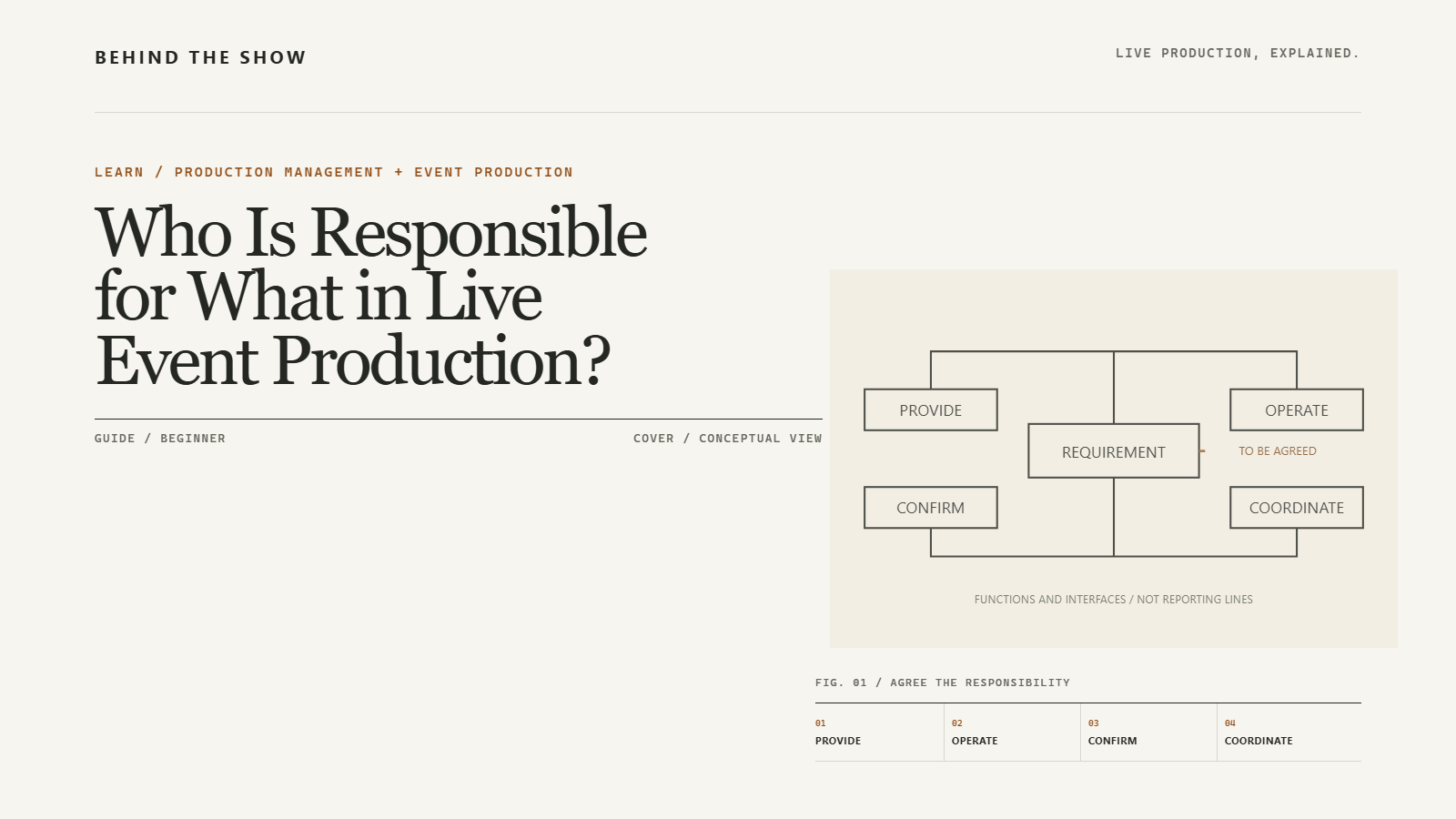
Invite people according to the decisions and dependencies. There is no universal attendance list or meeting frequency. The existing guide to production responsibilities explains the functions to establish without assigning them automatically by job title.
Compare alternatives against the same requirement
Open each item by stating the question and the current facts. Ask the affected participants to explain their constraints before selecting an alternative. If two people are working from different documents, reconcile that difference before treating their answers as a disagreement about delivery.
Compare the options in terms of the work each would require, who would accept it, any approval needed and the effect on preparation. A preference for one option does not establish that its scope, cost or timing has been accepted.
Keep the decision within the authority available. A meeting can coordinate a specialist review and record its outcome when supplied by the responsible person. Attendance or agreement in the room cannot substitute for the specialist assessment or venue approval the work requires.
Record disagreement without forcing an agreement
When the participants disagree, record the point in dispute and the basis for each position. Separate it from facts or actions they have agreed. “Discussed” says too little; “confirmed” says too much if the required acceptance is still missing.
Assign someone to obtain the missing information or take the alternatives to the relevant approver. Owning that follow-up does not make the person responsible for delivering the disputed work. Keep delivery ownership visibly unassigned until an arrangement is accepted.
Agree a deadline against the next affected task in the production schedule. State what remains dependent on the answer and who must receive an update if it does not arrive. An unanswered request remains open when its deadline passes.
Work through a fictional scope disagreement
In this fictional exercise, a client wants an additional rehearsal in Hall B. The programme lists it, but the current venue email does not confirm access for that session. The sound and video suppliers each exclude coordination of the combined rehearsal from their scope. They disagree about which supplier should take it on.
The meeting uses programme version 3, venue email V2 and supplier scopes S2 and V3. Maya is the production coordinator, Arun is the client contact authorised in this example to approve programme and additional budget, and Leena is the venue contact for access confirmation. Each supplier representative must obtain acceptance of any additional delivery scope from their own authorised contact.
The dates below are fictional deadlines agreed by these participants. They are not recommended lead times. The meeting takes place on 8 November; scope planning is due on 10 November and the proposed rehearsal is on 12 November. All times are local to the fictional event.
| Item and current basis | Decision or unresolved position | Authority and follow-up owner | Agreed deadline and dependency |
|---|---|---|---|
| Additional rehearsal in programme version 3 | Arun confirms that the client wants the session. Access and delivery arrangements remain open. | Arun approves the programme requirement within his agreed authority. Maya records it. | Record on 8 November. The programme entry does not confirm readiness. |
| Hall B access for the added session | Venue email V2 does not cover this session. No access confirmation recorded. | Leena will obtain the venue's answer for the exact room and session. Maya follows up. | Answer by 9 November at 12:00, before scope planning on 10 November. |
| Coordination excluded in scopes S2 and V3 | Sound proposes video take the role; video proposes sound. Neither accepts it. Delivery owner remains unassigned. | Maya will collect a defined scope and proposal from each supplier. Their authorised contacts must accept any work; Arun considers any additional budget. | Proposals by 9 November at 16:00. Allocation remains open pending acceptance and budget approval. |
| Review of the rehearsal plan | Agreed action: compare access and supplier responses before issuing a revised rehearsal arrangement. No delivery option selected yet. | Maya brings the responses to Arun and the affected supplier contacts. | Review by 10 November at 10:00. A revised arrangement depends on access, accepted scope and relevant checks. |
The meeting has produced an agreed requirement and follow-up actions, while leaving the supplier disagreement unresolved. Maya's action to collect proposals does not assign her the combined rehearsal delivery. Arun's programme decision does not establish access or technical readiness.
For this exercise, Maya circulates decision record version 1 on 8 November to Arun, Leena, both supplier contacts and the schedule owner. It identifies the rehearsal arrangement as open and asks each action owner to confirm that their action and deadline are recorded accurately. Acknowledging receipt does not mean accepting the disputed delivery scope.
If Leena's access answer or a supplier proposal misses its deadline, Maya reports the open dependency to Arun and the affected teams. They must review the available choices and the consequence for scope planning. The record does not silently convert the proposed rehearsal into a confirmed arrangement.
ILLUSTRATIVE SCENARIO
Read back the record before closing
At the end of each item, read back the choice or open question, its status, who can approve it, who owns the next action and when the answer is needed. Ask the relevant participants to correct errors and confirm the actions they have accepted.
Capture any condition attached to an agreement. If acceptance depends on a venue response, revised scope or later approval, keep that condition beside the item. Record any continuing objection that affects whether the arrangement can proceed.
Before closing the meeting, check that open items have a route to resolution. If an action owner or deadline cannot be agreed, record that gap and identify who will seek the assignment. Ending the meeting does not settle it.
Circulate the outcome and update the working plan
Give the record a version and date, and send it to the people whose work changes, including relevant people who were absent. Point out decisions, pending approvals, open disagreements and the next required responses. Make the current version easy to find and distinguish it from superseded information.
Update the affected brief, supplier scope or schedule when the relevant agreement permits it. Link the change to the decision and its approval so a revised document does not appear to be evidence that everybody accepted new work.
When a response resolves an open item, record what was accepted, by whom and under which conditions. Circulate the revised record to the affected teams. If the response changes the requirement, review the consequences with those teams before treating the item as closed.
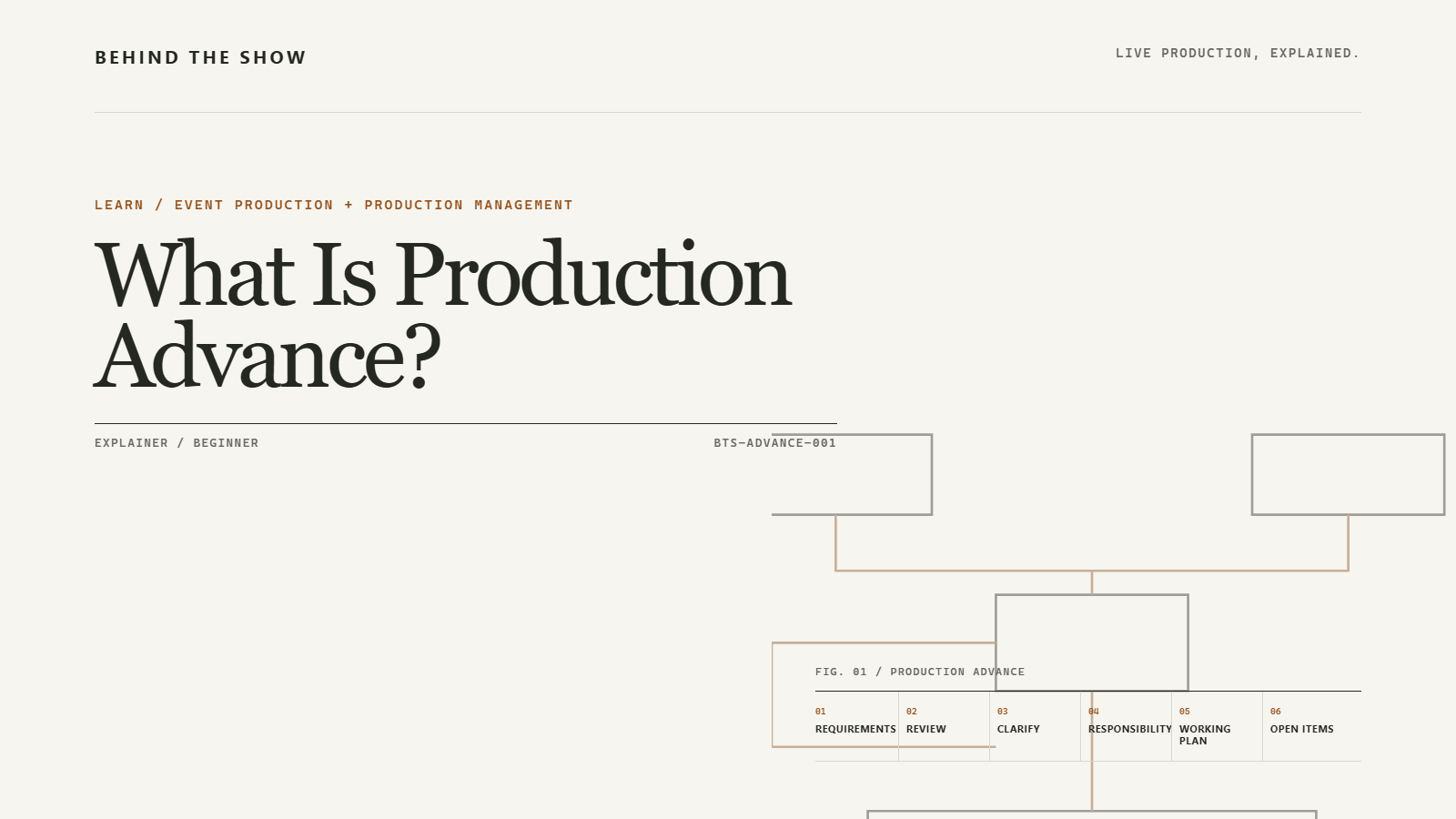
This is part of production advance, which continues through document review, clarification and coordination beyond the meeting itself.
A useful meeting ends with decisions people can trace and open questions people know how to resolve.
Related questions
How should production responsibilities be recorded?
Record specific requirements, named participants, delivery and approval functions, dependencies and unresolved work in a shared current plan.
Who approves changes to a live production?
Approval depends on the decision and agreed authority. Identify the relevant client, artist, venue or specialist approver and communicate the result to affected teams.
Does an exclusion in a production quotation assign responsibility to someone else?
No. It identifies a boundary in that proposal; the excluded requirement still needs an agreed provider or an explicit not-applicable decision.
What should happen when a production responsibility is unassigned?
Make the gap visible, identify who can resolve it and agree the delivery scope and timing rather than assuming another team will take it on.
What happens if information is still missing after the advance?
Keep it visible as an open item with an owner, dependency and decision point. Where appropriate, record an agreed temporary assumption or allowance rather than presenting the information as confirmed.
Is production advance the same as a production meeting?
No. A meeting may support the advance, but the advance is the wider process of reviewing documents, clarifying requirements, coordinating interfaces, recording decisions and maintaining current production information.
Put the knowledge to work
Check your understanding
Three questions from this guide, with an explanation after each answer. Optional, untimed and just for you. Answers and scores are not saved.
Continue learning