11 min read
GUIDE / Event Production
How to Plan Production Crew Calls and Department Handoffs
Plan production crew calls by working back from the tasks and checks the event needs, then agreeing who must report, where, when and for what scope. Confirm access, briefing, upstream readiness, supervision and required availability with the responsible delivery leads. For each department handoff, identify what is being transferred, who checks and accepts it, what remains open and what allows the next activity to begin. Keep crew availability, task completion and permission to proceed as separate confirmations.
On this page
Call people for work that can begin, and make clear what the next team is accepting.
A crew call is a reporting arrangement, not a readiness result
A room can be open while the stage is unavailable. An audio crew can be present while its work area is still occupied. A department can finish installation while the checks needed by the next team remain incomplete.
For this guide, a crew call means an agreed reporting arrangement for assigned production work: who reports, where and when, with what duties and expected availability. It is not a cue to execute a show action, and terminology varies between productions.
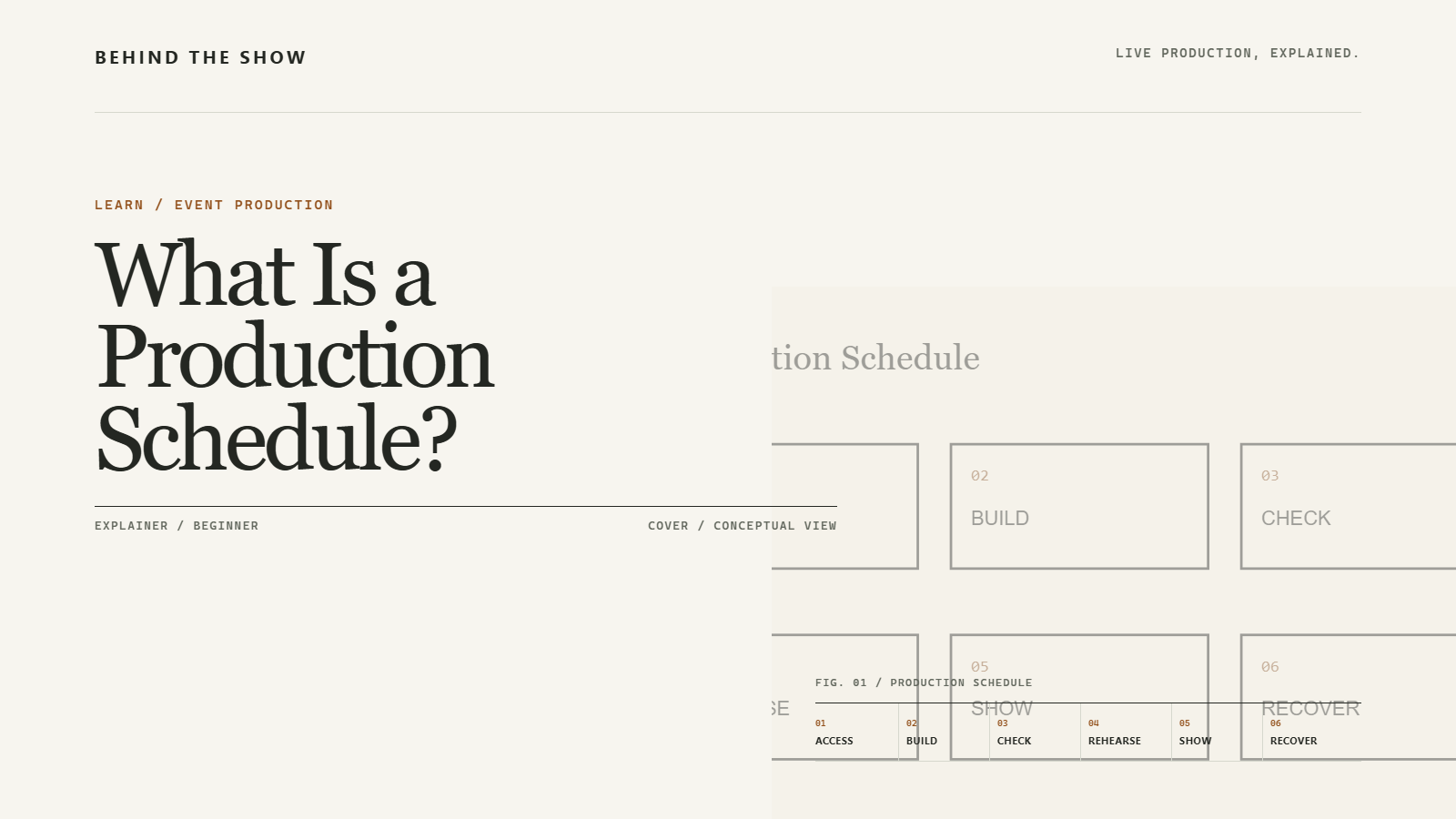
The production schedule describes the wider working timeline. Crew calls connect that timeline to the people delivering it. Department handoffs establish what one team can actually take forward from another.
People being present does not mean the next activity is ready to start.
Start with the work and its dependencies
Identify the work that must be completed before each relevant milestone. Include preparation, movement, checking, rehearsal, operation and removal where they are in scope. Ask the delivery leads what people, access, information and upstream results their work needs.
A task may depend on a defined area becoming available, an approved layout, another department completing its work or a required check being reported. Do not replace that dependency with a timestamp alone. The planned time is when the team expects the condition to be met; the actual confirmation tells it whether the condition has been met.
Use production advance to resolve these interfaces before calls are issued. Where the information is still missing, identify the owner and next decision point rather than inventing an allowance.
Agree the people and scope with the delivery lead
Ask each responsible supplier or department lead to confirm the proposed work, staffing and supervision within its scope. Identify which functions need to be available together and which specialist or venue personnel must attend a particular check.
A coordinator should not infer a suitable crew size from an equipment list or assume that a shorter window can be solved by adding people. Access, work sequence, competence, supervision and shared work areas may constrain the options. The responsible teams need to assess the real arrangement.
Confirm whether the named people are supplying installation, operation, rehearsal support, standby support, strike or some combination. Availability for one phase does not establish coverage for another. If a person combines functions, review overlapping demands instead of listing the same person as available for simultaneous work in different places.
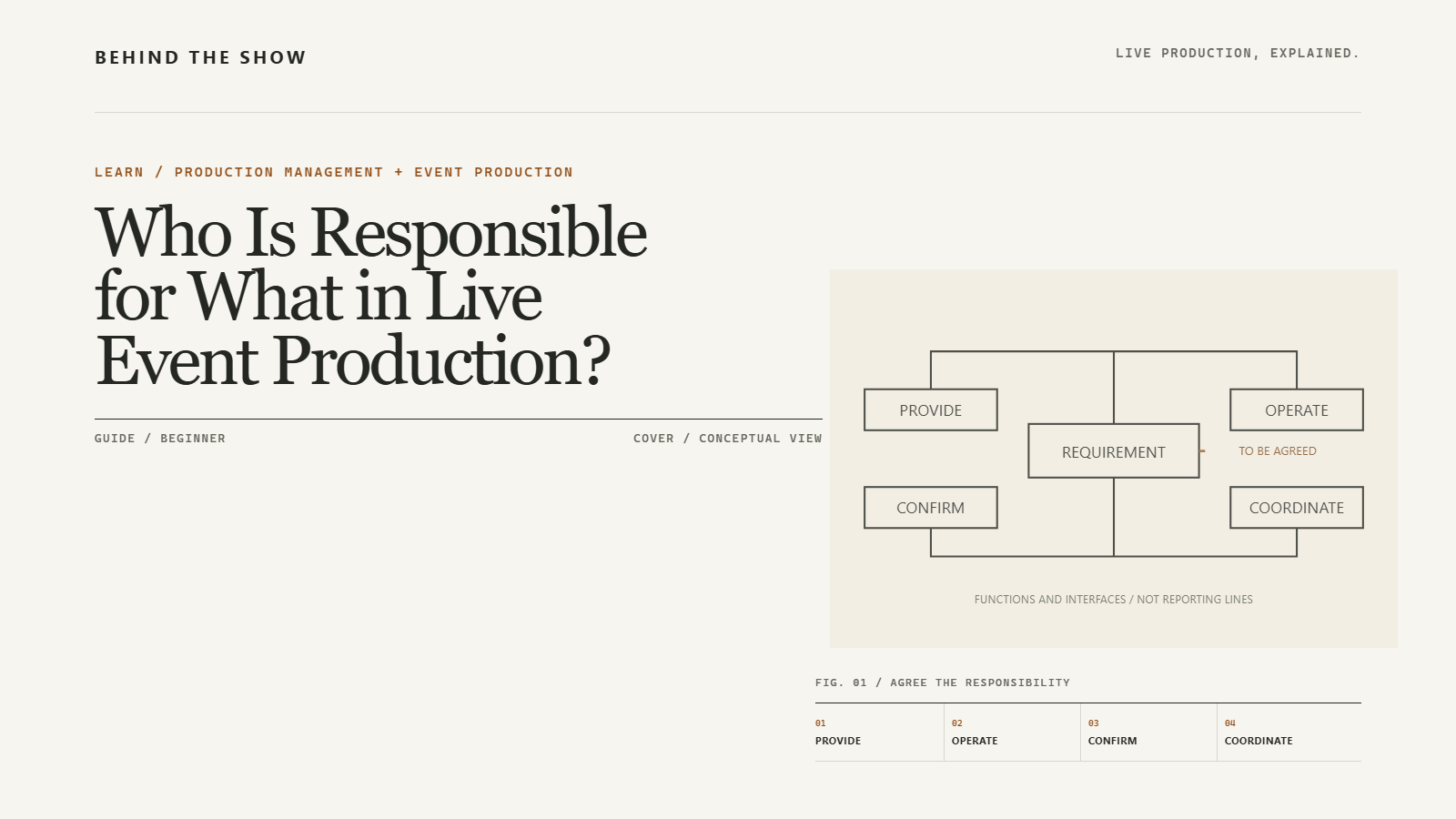
The responsibility guide explains how to assign scope without assuming that a job title owns every interface.
Make the reporting instruction usable
An agreed call should identify the event and date, reporting time, reporting point, contact, assigned scope and relevant access or briefing instructions. Distinguish reporting time from the expected start of the task. Someone arriving at the vehicle gate may still need to reach the work area and complete the agreed briefing before starting.
State the required availability or release arrangement, including rehearsal and operating coverage where relevant. Confirm the current version and how subsequent changes reach the people affected. Share necessary contact details through the agreed working channel rather than publishing a personal crew list on an unrestricted page.
Do not assume the supplier has accepted a revised call because an updated schedule was emailed. Obtain confirmation from the person authorised to commit the people and scope. Keep an unconfirmed request visibly separate from the agreed instruction.
Plan overlap deliberately
Some departments can work in parallel. Others need the same space, access route, equipment or person. Review these interactions with the affected leads before relying on overlap to make the schedule fit.
Include briefings, welfare arrangements, breaks, handover time and relief or replacement coverage in the review. Working-time requirements, employment terms and venue rules vary. This guide does not prescribe shift lengths, break intervals, overtime triggers or staffing ratios. Confirm the applicable arrangements with the responsible employer, supplier and venue.
The UK HSE guidance on managing an event distinguishes overall coordination of site activities from responsibility for individual contractors' technical work. Its UK guidance also addresses relevant information, competence and supervision. It is not a global employment rule or approval for overlapping activities at a particular event.
Define the handoff before the receiver needs it
Name the output or condition being handed over. Stage placement complete, audio connections checked and a programme transition rehearsed are different statements. Avoid reporting only that a department is done.
For each important interface, agree who reports completion, what checks are needed, who can accept the defined handoff and who receives the result. The same person may perform more than one function where appropriate, but the record does not create competence or decision authority.
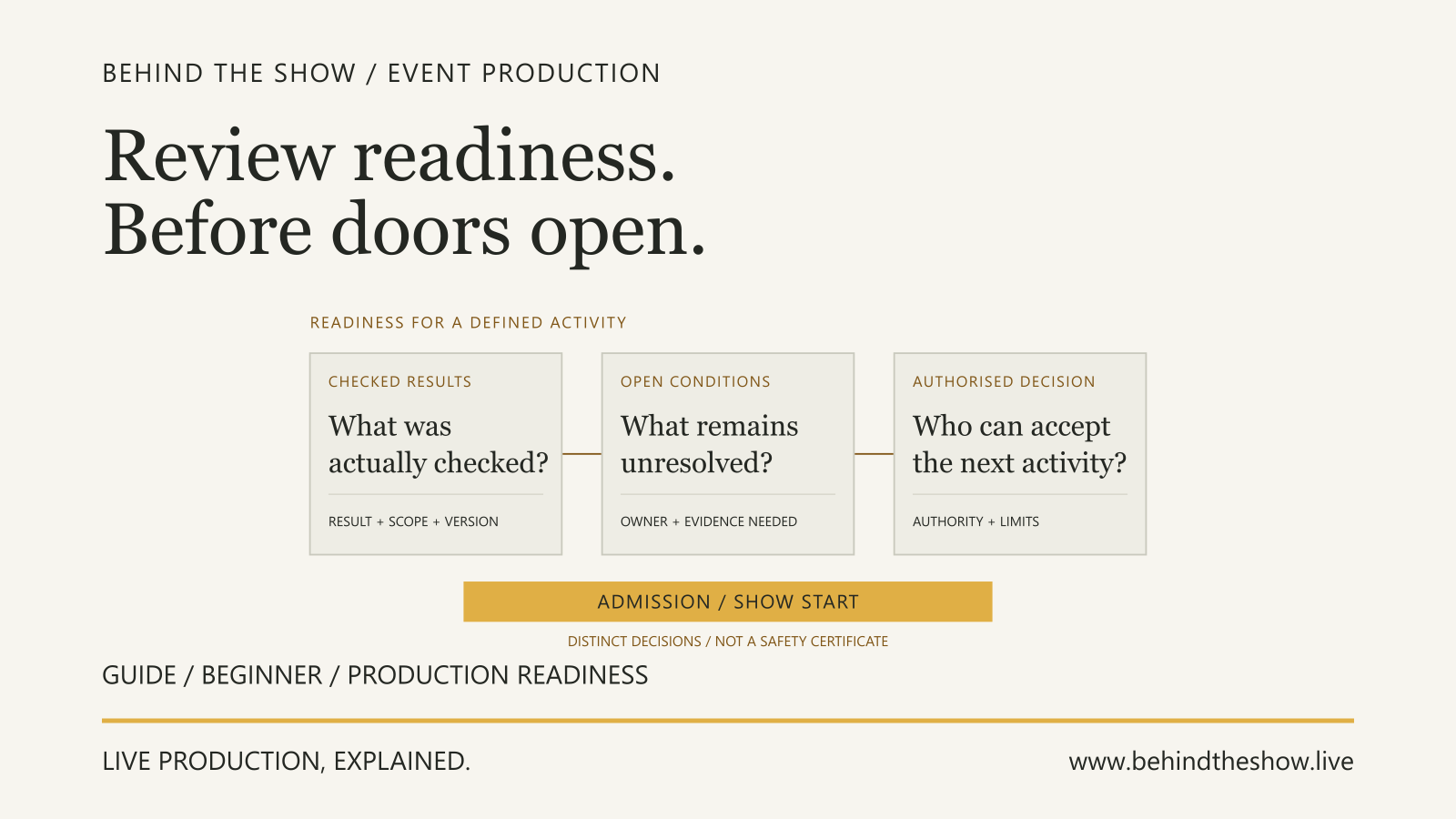
The receiving team should know what it is accepting and what it is not. Accepting a stage position for the next preparation task is not accepting every aspect of the event, certifying a structure or authorising audience entry. Required specialist and venue approvals remain with the appropriate people. The Production Readiness guide develops the later pre-doors review: bring scoped handoff results and open conditions to the people authorised to decide about admission. An accepted departmental handoff contributes evidence; it does not replace that decision or establish readiness for every programme segment.
A handoff needs a defined result and a receiving owner, not just a message saying “done”.
Worked example: the crew arrives before its work area is available
Consider a fictional conference with a panel rehearsal planned for 14:00. The panel needs an agreed furniture layout, microphones, presentation playback and coordinated entrances. The excerpt below concerns only those preparation interfaces. It is not a complete staffing plan, construction method or safety approval.
The venue has confirmed room access from 09:00. The stage supplier expects to make the panel area available for the next preparation work at 10:30, subject to its agreed checks and release. Audio and video personnel are called to report at 10:00 for briefing and preparation away from the occupied panel area. The responsible leads have confirmed that this preparatory work is available and that the required rehearsal coverage is included.
The times are fictional planning references, not recommended durations. Room access does not release work in every part of the room.
| Planned point | Work and dependency | Responsible confirmation | What it does not establish |
|---|---|---|---|
| 09:00 room access | Stage supplier reports through the agreed venue process and begins only the work released under its arrangements | Venue contact confirms the available scope; supplier lead confirms its work arrangements | Access alone does not approve all work or make the panel positions ready |
| 10:00 audio/video reporting | Personnel complete the agreed briefing and prepare the approved content and identification in the available area | Audio/video leads confirm attendance, assigned scope and permitted preparation | Arrival does not release entry to the occupied panel area |
| 10:30 proposed panel-area handoff | Stage supplier reports the defined layout complete, with the required checks and release still to be confirmed | Supplier lead provides the scoped result; assigned recipients confirm the conditions needed for their next work | A planned handoff time is not a substitute for an actual result |
| After the handoff is accepted for the next work | Audio/video teams complete their assigned positioning, connections and checks under the reviewed arrangement | Each lead reports its own results and limitations | Placement complete is not programme rehearsal complete |
| 14:00 planned rehearsal | Stage coordination, relevant operators and participants need the agreed arrangement ready together | Rehearsal lead collects the relevant scoped confirmations before the session proceeds | A rehearsal entry in the schedule does not establish readiness |
When the 10:30 handoff does not happen
At 10:20, the stage lead reports that furniture placement has changed and the proposed handoff cannot yet be confirmed. The coordinator records the affected panel area as unavailable for the dependent work. Audio/video teams continue only the preparation already agreed for their available area; they are not sent into the unfinished position to recover the printed time.
The coordinator asks the stage lead for the current layout reference, remaining work and next reporting point. The audio and video leads identify which preparation is now blocked and what checks must follow release. The schedule owner brings those responses together to assess the rehearsal plan. No replacement completion time is invented by subtracting the delay from the checking period.
In this example, the relevant teams confirm that a revised preparation sequence is workable, and the designated programme lead approves moving the rehearsal to 14:30. The venue confirms that the revised session fits its available room window. The affected suppliers confirm their personnel remain available under the revised arrangement. These are separate confirmations; programme approval alone does not extend venue access or commit supplier staff.
The stage lead later reports the defined panel layout complete with the required checks and release confirmed. The audio/video leads accept that scoped handoff for their next work. They carry out and report their own checks. The rehearsal lead then confirms the relevant people and arrangement are available for the revised session. The record does not claim that stage completion proved the audio or programme ready.
Carry the unresolved work across the personnel change
The video team has a planned operating-personnel handover after rehearsal. Before the outgoing operator is released under the agreed arrangement, the delivery lead confirms the incoming operator has received the current file reference, revised rehearsal record, relevant cue references and open actions. The incoming operator confirms what operational responsibility they are taking on and how unresolved work will be followed up.
The revised opening slide was checked during the session, but a later replacement panel graphic has not been checked through its intended destination. The incoming operator records that limitation and accepts responsibility for arranging the outstanding check, not a declaration that the replacement is ready. The delivery lead confirms coverage and the next decision point. The authorised programme lead must decide the affected programme response if the graphic cannot be confirmed in time.
The handover does not silently extend the outgoing operator's call or assume the incoming person can stay indefinitely. Any change to availability requires the appropriate confirmation. Nor does it permit intrusive testing during the live programme: the Backup and Recovery guide explains the limits around controlled testing and programme responses.
Why these decisions matter
The initial call had useful preparation attached to it, so arrival was not treated as wasted simply because panel access came later. When the upstream result changed, the team reviewed dependent work instead of compressing checks by assumption. The revised rehearsal required programme, venue and personnel confirmations. Finally, the shift handover transferred an identified open action without disguising it as a completed check.
ILLUSTRATIVE SCENARIO
Keep a personnel handover separate from a department handoff
A department handoff transfers a defined output or work condition across an interface. A personnel handover transfers an operating function, information or open actions to another person. One may happen without the other.
Plan an appropriate opportunity for the outgoing and incoming people to exchange the current arrangement. Identify what changed, what was checked, what remains limited and who now owns each follow-up. The lead responsible for staffing must confirm coverage; merely sending a document does not establish that the incoming person has accepted the function.
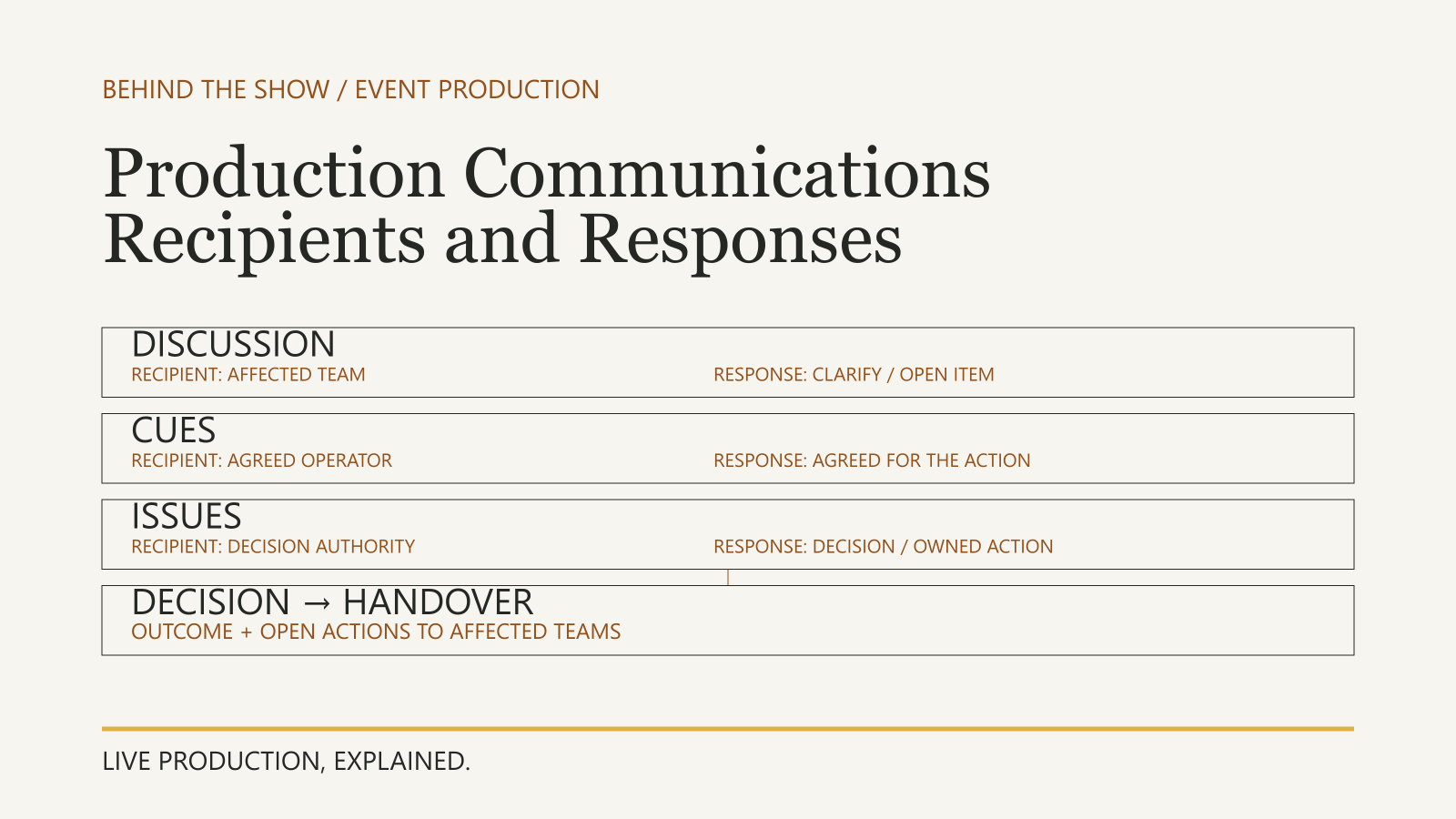
The Production Communications guide develops receipt, confirmation and escalation. Detailed handover records can use the same distinction between completion and acceptance explained in the Site Walk guide, without repeating its inspection examples.
Revise the call when the work changes
A delayed access window, changed layout or additional rehearsal can affect personnel availability, supervision, cost and downstream work. Ask the responsible leads to assess the consequences. Do not treat an earlier call or the same headcount as proof that the revised plan is deliverable.
Record the proposed change, who can commit the affected scope, what was confirmed and which version replaces the earlier instruction. Ensure the affected recipients receive the current arrangement. Where confirmation is missing, escalate it before the relevant decision point rather than silently treating the proposal as agreed.
Keep the working record proportionate. It needs to show the call, required scope, dependency, scoped result, receiving owner and open action. A large spreadsheet is not necessary; those distinctions are.
Call time commits an agreed reporting arrangement. Readiness still needs evidence for the next activity.
Related questions
What is a production crew call?
An agreed reporting arrangement identifying who reports, where, when and for what assigned work and availability. It does not, by itself, establish that the work area or dependent activity is ready.
How do you plan production crew calls?
Work back from the required tasks and checks. Confirm personnel, access, briefing, upstream readiness, supervision and availability with the responsible leads, then issue a current reporting instruction and obtain confirmation.
What should a department handoff confirm?
Identify the defined output or work condition, relevant checks, receiving owner, acceptance scope and remaining limitations. Confirm what permits the dependent activity to begin without treating one department's result as whole-event readiness.
What if the crew arrives before its work area is ready?
Keep the blocked dependency visible and use only preparation permitted under the agreed arrangements. Obtain current information from the responsible lead and review downstream work, checks and availability rather than assuming the delay can be absorbed.
What should a production shift handover include?
Transfer the current arrangement, changes, checked results, limitations and owned open actions. Confirm who takes over the operating function and how coverage and follow-up are maintained; receiving a document alone is not acceptance of the role.
Who confirms a revised production crew call?
The people authorised to commit the affected personnel and scope must confirm it, alongside any required venue and programme decisions. Circulating a revised schedule does not establish those commitments.
Is completing a production task the same as accepting its handover?
No. Reported completion, the required checks and acceptance for a defined scope are separate matters. Record what happened and who had authority to accept the relevant requirement.
Sources & references
- Managing an eventUK Health and Safety Executive / primary document
Continue learning