11 min read
GUIDE / Event Production
How to Plan Backup and Recovery for a Live Event
Plan backup and recovery by identifying the production functions the event depends on, what their loss would affect and which responses are feasible. Agree who can authorise a switch or programme change, who carries it out, what must be checked at the receiving destinations and how the event continues during the handover. Rehearse the agreed response where practicable, record untested conditions and decide separately when to return to the original arrangement. Spare equipment alone does not establish a workable recovery plan.
On this page
A spare is one resource. Recovery also needs an agreed response, checked handover and clear authority.
Begin with what the event needs to keep doing
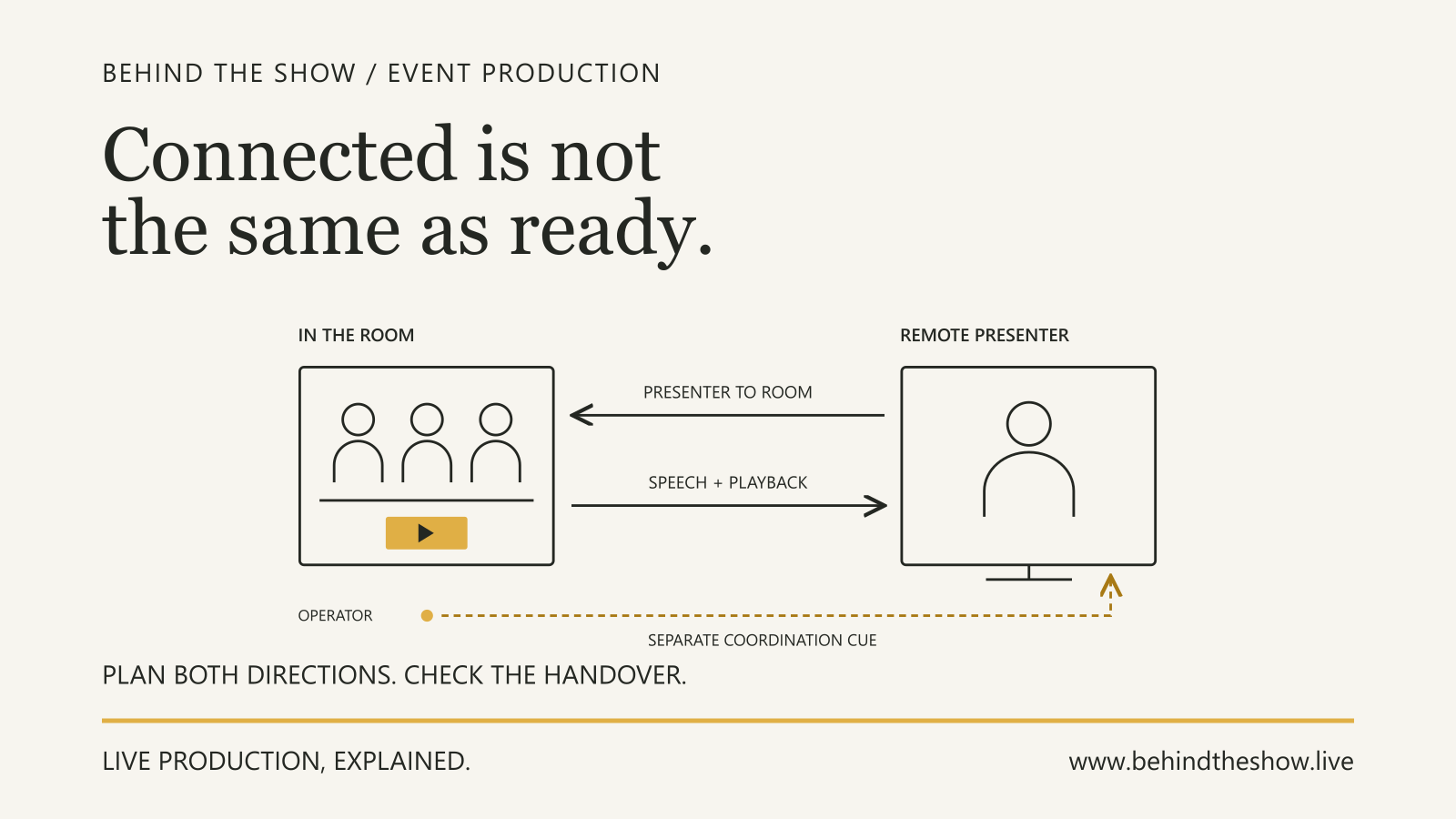
A spare laptop does not explain what the audience will see while playback is unavailable. An extra microphone does not establish who brings it to the presenter or how the change reaches the operator. A second connection does not establish that a remote guest can hear the room through it.
Start with the function: speech people can follow, an approved video, a remote conversation, a cue instruction or another agreed production activity. Ask what happens to the programme and its participants if that function is lost.
The response may involve another prepared system. It may instead be an approved spoken summary, a different programme sequence or a pause. The appropriate response depends on the actual event; keeping the original segment unchanged is not the only possible objective.
Plan the response, the handover and the decision to return.
Choose what needs a recovery response
Review the programme with the people responsible for delivering it. Which functions does the next activity depend on? What would their loss prevent, and who would be affected?
An opening film, a presenter microphone and a remote interview can have different consequences and different workable responses. A decorative content loop may not justify the same preparation as the only agreed way for a contributor to take part. Assess the actual requirement rather than labelling every equipment item equally critical.
Identify the effect on relevant recipients, including performers, remote participants and recording or streaming destinations where those are in scope. A response that restores the room display may not restore every other required destination. Use the Recording and Live Streaming Requirements guide to establish what those outputs must include or exclude and how they will be received and checked, so the proposed response is reviewed against the actual commitments.
Use production advance to agree these dependencies, supplier commitments and open questions while preparation can still change.
Distinguish the resource from the response
A backup resource might be another device, an approved content copy or another available operator. A recovery plan explains how an agreed function will be restored or the programme will continue using a different accepted arrangement.
For each proposed response, identify what it needs: current content, connections, access, available people, relevant permissions and a way to communicate the decision. Ask the technical team which parts of the normal arrangement it still relies on. A second playback device using the same downstream path does not, by itself, establish an alternative to a failure in that path.
Do not label an arrangement independent, seamless or automatic without evidence for the actual implementation. This guide does not specify redundancy architectures, switching hardware, electrical arrangements or platform settings. Those need the relevant technical review.
Agree the switching authority before the cue
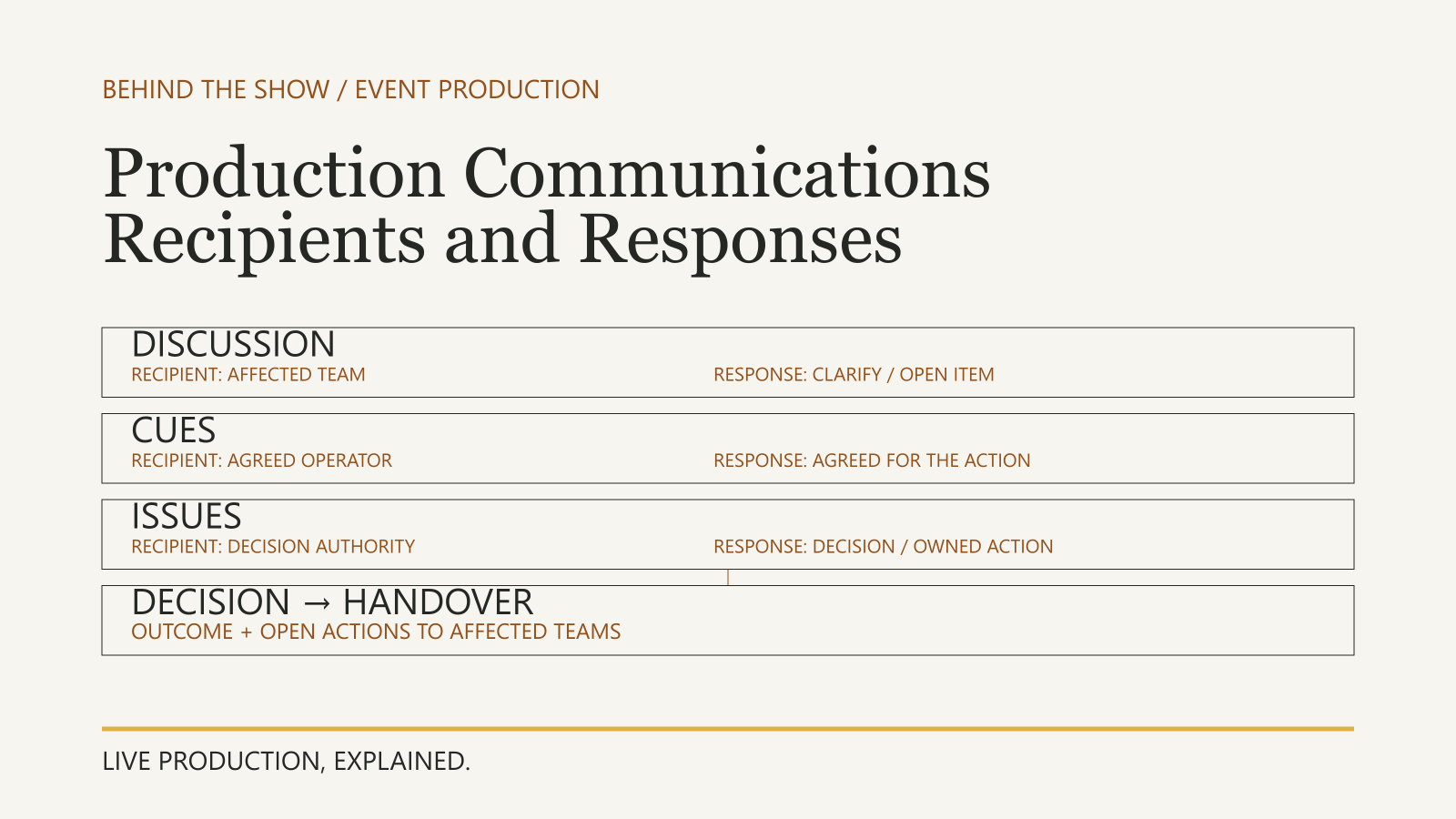
Separate reporting a problem, deciding the response, executing the change and confirming the result. They may be assigned to different people or combined in an agreed role. A job title alone does not establish the authority.
The programme owner can approve a different segment or sequence within their authority. The relevant technical people determine the conditions and actions within their scope. A caller coordinates the agreed instruction; that does not automatically authorise new content, an unrehearsed technical change or work outside the supplier's commitment.
Some responses can be delegated in advance. Record the trigger, the permitted action, required readiness reports and limits of that delegation. Others need a decision at the time. Identify the decision-maker and the agreed escalation route if that person is unavailable. Silence is not approval.
The Production Communications guide develops the distinction between working discussion, execution instructions and decisions. A report that an alternative is available is not, by itself, the instruction to use it.
Agree what happens during the interruption
The event still has participants while the team responds. Establish what the presenter, performer or moderator is expected to do, what the audience receives and who communicates with them. Include any relevant screen, programme-audio and content handovers in the reviewed arrangement.
Agree whether the interrupted item will resume, restart, be omitted or move to another point. These are programme decisions with practical consequences, not universal instructions for the operator to invent. Recovery time also affects the production schedule and run of show; neither document creates time that the event does not have.
Test the handover, not only the spare
A discussion can check whether people understand the decision and their roles. A device check can establish something about that device. Neither, on its own, demonstrates the complete change from the current arrangement to the alternative and back into the programme.
Agree the purpose, conditions, participants and limits of a recovery test with the responsible technical and production people. Include the intended content and relevant receiving destinations, the instruction to change, the operator action, the reported result and the next programme handover. Record any substitute participant, missing destination or different arrangement.
Testing a switch is not necessarily testing failure detection, every failure mode or automatic failover. State what was actually exercised. The Rehearsal explainer explains why checking a system and practising the people and sequence are related but different work.
A test must not create an uncontrolled interruption in order to prove a recovery plan.
The responsible teams must agree a suitable opportunity, permitted actions and a way to end or restore the test. Do not disconnect equipment, interrupt power, repatch a working path or inject faults into a live show to manufacture evidence. If a useful check cannot be performed within the agreed conditions, record the limitation and obtain a decision about the event response. Do not relabel the untested arrangement as ready.
Worked example: the alternative player has not checked the handover
Consider a fictional conference with a presenter introducing an approved sixty-second film, followed by a panel discussion. Recording and public streaming are not in scope.
The primary playback device is A. Device B holds a copy of the approved file. The operator has played B's copy on its own display and headphones, but the team has not checked using B through the intended room destinations or practised the transition to it. That is useful device evidence, not a completed recovery test.
Turn the option into an agreed response
The programme owner agrees two possible responses. The film may be omitted and the presenter may use an approved spoken summary before introducing the panel. Alternatively, the film may restart from the beginning on B, but only after the agreed receiving checks and handover rehearsal have been completed and the relevant operators report readiness. The technical team still has to establish whether B is suitable for that arrangement.
| Decision or action | Agreed authority in this example | Current boundary |
|---|---|---|
| Report an unsuccessful playback result | Relevant playback and audio/video operators report within their scope | Describe the observed result; do not assume which device or path caused it |
| Use the spoken-summary response | Programme owner approves the summary and delegates its use to the caller under the agreed trigger | Presenter and operators need the rehearsed instruction and associated room state |
| Select B for a film restart | Caller may cue the agreed restart only after the specified checks and readiness reports | Device-only playback does not satisfy the condition |
| Make a different content or timing change | Programme owner decides, with the affected teams assessing their work | The delegation does not authorise an unreviewed third option |
| Return to A after a recovery | Programme owner agrees the programme opportunity; technical teams confirm the affected conditions; caller coordinates execution | A becoming responsive again is not an automatic return instruction |
These are this event's allocations, not a required staffing model. The table describes authority and conditions, not a wiring specification or a safety acceptance.
Rehearse the response before relying on it
The responsible teams agree a controlled pre-show session. They rehearse selecting B using the reviewed arrangement, the current approved file and the intended room outputs. The relevant audio and video operators check the film's sound and picture at the agreed receiving positions. The presenter and caller rehearse both the restart handover and the spoken-summary response into the panel.
They record the file reference, arrangement, participants, destinations and results. The change to B and the following panel handover work under those checked conditions. They have not induced every possible fault, proved automatic detection or demonstrated independence from every shared part of the room system.
Apply the decision during delivery
During the film, the video operator reports that the intended audience picture is absent. The observation does not establish whether A or another part of the path has failed. The caller uses the rehearsed spoken-summary response under the programme owner's agreed delegation, with the relevant operators executing the associated content and audio actions.
B is not selected merely because it worked in rehearsal. If the current symptom could involve a part of the path B also uses, the responsible teams must assess the situation before describing B as usable for that response. In this example, the programme continues to the panel using the approved summary rather than turning the interruption into an improvised live diagnostic test.
Keep restoration separate from return
An operator later reports that A appears responsive. That report does not establish that its audience output is restored, identify the original cause or authorise replaying the film during the panel.
The programme owner decides not to reinsert the film. Further investigation and any intrusive testing wait for an agreed opportunity. The working record shows the symptom, the response used, the omitted film, the remaining technical question and who owns the follow-up. It does not claim that A is repaired or that every recovery option has been verified.
ILLUSTRATIVE SCENARIO
Plan the return as a separate decision
Restoring a device or connection and returning it to the live programme are different events. Identify what the responsible people need to confirm, which recipients may be affected by another change and who decides the programme opportunity.
Sometimes the agreed response is to remain on the checked alternative for the rest of the segment. Sometimes it is to leave an omitted item out. Returning immediately is not inherently better. Equally, staying on an alternative does not prove that it is suitable indefinitely; keep its limitations, required support and any later change visible.
For a specific application, Remote Presenter Participation distinguishes reconnection, receiving checks and permission to reintroduce a contribution.
Keep the limits and open actions in the handover
Record the function at risk, agreed response, current resource and content references, decision authority, execution owner, checks completed, limitations and next decision point. Include who receives the instruction and who confirms the relevant result. The working method can be simple; the distinctions need to remain clear.
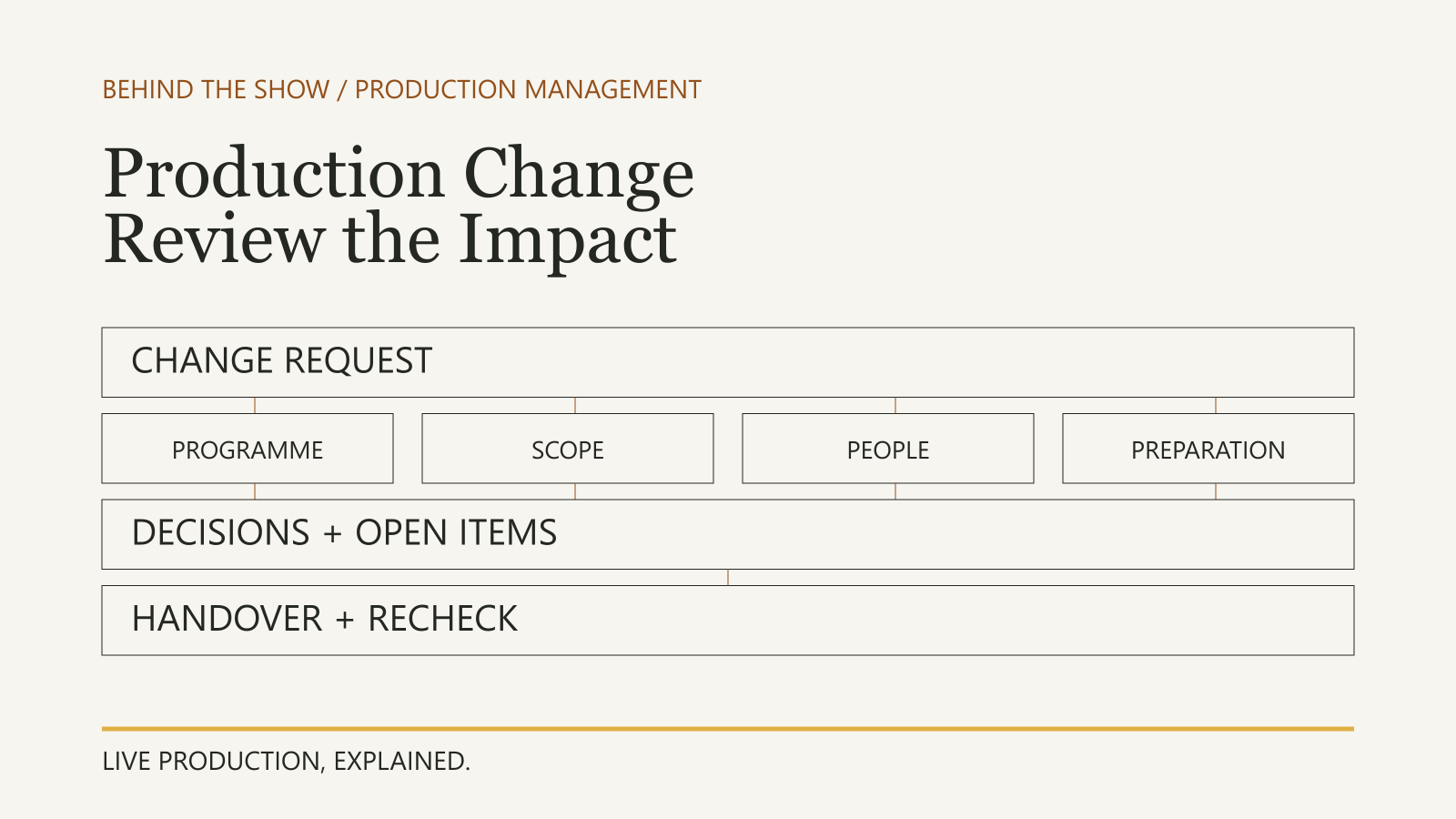
A later change to content, routing, location, staffing or programme can affect earlier evidence. Use the production-change review to identify the consequences and the checks or approvals that need revisiting. An earlier successful test does not approve a different arrangement.
If a proposed alternative remains untested, make that state explicit and obtain a decision about a workable programme response. The options might include an already agreed alternative, changed scope or a pause. This guide does not grant permission to proceed, prescribe cancellation or transfer specialist authority to the coordinator.
Keep technical recovery separate from emergency arrangements
This guide concerns production continuity. It does not replace the event's emergency procedures or the authority of the venue, emergency services and relevant specialists. A technical recovery instruction must not be treated as permission to bypass those arrangements.
The UK Health and Safety Executive's event guidance addresses proportionate emergency planning, clear emergency roles and agreed show-stop arrangements. That is UK guidance, not a universal legal framework or a procedure this article can implement for another event. Use the applicable local and venue arrangements with the responsible people.
A workable recovery plan explains the next action, its authority and its limits, not simply where the spare is stored.
Related questions
How do you plan backup and recovery for a live event?
Identify the functions the event depends on, the consequences of losing them and feasible responses. Agree authority, execution, receiving checks, programme handovers and the decision about returning. Record tested conditions and unresolved limitations.
Is spare equipment the same as a recovery plan?
No. A spare is a resource. A recovery plan also identifies the function it can support, its dependencies, who can authorise and execute its use, what recipients need to receive and how the programme continues.
What should a live-event recovery test cover?
Check the agreed change and programme handover with the relevant people, content and receiving destinations under controlled conditions. Record what was exercised, the results and limitations; a device test does not establish every route, failure mode or automatic response.
Can a backup be tested during the show?
Do not introduce an intrusive or unreviewed test into the live programme. The responsible technical and production people must agree the scope, opportunity, permitted actions and recovery from the test. Where those conditions cannot be met, record the limitation and seek a decision about the programme response.
When should a production return to the primary system?
Only at an agreed opportunity after the relevant technical conditions, receiving checks and programme decision have been confirmed. A device becoming responsive again is not, by itself, authority to switch back.
What if a proposed backup has not been tested?
Keep it explicitly untested rather than reporting it ready. Identify the missing evidence and owner, and obtain an authorised decision about a workable programme response. Availability or time pressure does not supply the missing confirmation.
Who approves changes to a live production?
Approval depends on the decision and agreed authority. Identify the relevant client, artist, venue or specialist approver and communicate the result to affected teams.
Sources & references
- Planning for incidents and emergenciesUK Health and Safety Executive / primary document
Continue learning