9 min read
GUIDE / Event Production
How to Review Production Readiness Before Doors Open
Review production readiness before doors open by comparing the current event plan with checked results from the responsible teams. Identify what is ready for audience admission, what is ready for programme delivery and what remains unresolved. For each open item, record its consequence, owner, required evidence, decision authority and next decision point. The people authorised under the event and venue arrangements decide whether admission can proceed, must wait or needs a reviewed change. A production readiness record does not replace required safety, specialist or venue approvals, and it does not itself instruct the first show cue.
On this page
A planned opening time needs a current decision supported by the right evidence.
Ask what is ready for the next activity
“Ready” needs an object. Ready for the audience to enter? Ready for the opening presentation? Ready to receive a remote panellist later in the programme?
Those conditions may differ. A checked opening slide does not confirm an untested film. An audio lead's report does not establish that the venue has released the room for admission.
Review readiness for a defined activity, using current evidence and named decision authority.
Use the production schedule to plan the review before doors. Leave an opportunity for the agreed checks, decisions and communication. There is no universal interval that makes every event ready. Starting the discussion at the published admission time leaves less opportunity to act on what it reveals.
Establish who reports, who accepts and who instructs
Agree these functions before the review:
- Department and specialist leads report what they checked, the result and any limits within their scope.
- The coordinating lead brings relevant reports and dependencies together, identifies conflicts and obtains missing decisions.
- The people authorised under the venue and event arrangements decide about admission within their responsibilities. Required specialist decisions remain with the appropriate people.
- The authorised programme lead decides proposed content or programme changes, with affected teams assessing delivery consequences.
- The caller or other assigned operator gives the agreed execution instructions when their conditions are met.
One person may perform several functions where the arrangement supports it. Job titles alone do not establish competence, delegation or authority. Agree the actual contacts, limits and escalation route, including what happens if a decision-maker cannot be reached.
The production-responsibility guide explains that allocation. Technical direction can coordinate technical interfaces; it does not automatically grant admission, programme or specialist approval powers.
Collect results rather than reassuring labels
Ask what requirement was checked, which arrangement and version were used, who observed the result and what remains outside that evidence.
“Playback ready” could mean a file opened on a laptop or that the intended content reached its receiving destinations during the relevant transition. Those are different reports. Record enough detail for the next decision without reproducing every department's technical paperwork.
Bring together the relevant production results, content versions, participant and operator availability, rehearsed handovers, communication arrangements and any required venue or specialist confirmations. The scope depends on the event. Identify who supplies each confirmation and what record supports it; do not make the coordinator certify work outside their competence.
In its UK guidance, HSE advises monitoring whether agreed risk controls work and assigning who checks them and how. That is jurisdiction-specific safety guidance. The readiness record below is BTS coordination methodology, not an equivalent inspection, a global legal standard or a replacement for the event's applicable safety arrangements.
Make unresolved conditions usable
An open-item entry should identify:
- The requirement and the current observation, including anything not checked.
- The activity or destination affected and the consequence if it remains unresolved.
- The owner obtaining the missing result or proposal.
- The person authorised to accept the defined result or decide the affected response.
- The next decision point and who must receive the outcome.
Use plain states such as checked for the stated scope, awaiting evidence, not ready, or removed from the current scope by an authorised decision. If a team uses colours, include the words and limits as well. “Amber” alone does not say what can happen next.
Recording an unresolved item does not make it acceptable. An owner and deadline organise follow-through; they do not supply missing evidence or permission to proceed.
Distinguish an issue that prevents admission from a later programme issue that may have a separately reviewed response. Do not decide that distinction from the item's department or scheduled time alone. Its consequences, applicable requirements and the responsible authorities matter.
Worked example: the room is almost ready
A conference plans doors at 15:30 and the opening at 16:00. At the 15:00 readiness review, several teams have reported progress. The following is a selected production extract, not a complete list of the event's admission requirements.
For this example, the venue representative and event lead have defined admission responsibilities. The programme lead can approve content changes; the production coordinator collects results; department leads retain their own checks; the caller executes the accepted programme. These are this event's allocations, not a universal staffing model.
| Requirement | Evidence at 15:00 | Outstanding decision or check | Owner and acceptance boundary |
|---|---|---|---|
| Agreed audience holding content is available during admission. | Video and audio leads report the identified holding version checked through its intended room destinations. | Retain that result for the checked holding arrangement; it says nothing about a later replacement file. | Department leads report their results; the coordinator records the defined scope. |
| The opening uses the current approved content. | The original introduction was rehearsed. A replacement film has arrived but has not been checked or accepted for use. | Keep the replacement unavailable for programme use pending checks and content approval, or obtain an approved response using the checked arrangement. | Content owner supplies the version; technical leads check delivery; programme lead decides the content response. |
| A remote panellist can follow audience questions later in the event. | The participant's incoming voice was checked, but they could not hear the representative room question. | Keep that exchange not ready. Establish a checked arrangement or an authorised programme response; a successful incoming connection does not close it. | Audio and remote-participation leads coordinate the repeat check with the participant; programme lead decides any segment change. |
| Required admission confirmations are available. | The venue representative has not yet provided the confirmation required under this event's opening arrangements. | Keep admission unreleased. Obtain the actual confirmation or follow the agreed hold and escalation process. | Venue and event authorities act within their agreed responsibilities; the coordinator cannot replace the missing confirmation. |
What the review decides at 15:00
The coordinator reports that the holding arrangement is checked for its stated scope, the replacement film is unconfirmed, the remote question exchange is not ready and admission remains unreleased.
The team does not declare the event ready because three departments have finished setup. Nor does the caller open doors merely because the run of show says 15:30. The assigned audience-facing lead receives the current hold status and the agreed escalation contact so the waiting audience can be managed under the event's arrangements. This is not an instruction to improvise crowd-control measures.
The programme lead proposes retaining the previously approved and checked opening without the new film. That is a proposed response until the relevant content, timing, handover and operating consequences are confirmed. The remote team continues investigating its exchange; nobody reports the later panel ready simply because it is not the first segment.
What changes at the second review
At 15:20, the programme lead approves the opening without the replacement film. Relevant operators and the presenter confirm the revised sequence after the affected handover is tried. The current run of show and content references reflect that decision. The untested film is excluded from this opening; it is not silently relabelled checked.
The remote exchange still has no successful receiving result. The programme lead approves removing that contribution from the current running plan rather than relying on a repair during admission. The moderator, participant and relevant operators receive the decision and confirm the changed handover. The technical issue remains open for follow-up. Reintroducing the participant would need the relevant checks and a new authorised programme decision.
At 15:25, the designated venue and event authorities confirm that the admission conditions required by this event's arrangements are satisfied, including the relevant confirmations outside this selected extract. They authorise admission for 15:30 using the agreed holding arrangement and current programme. The coordinator records who made that decision, when, its scope and the evidence references.
This is a fictional outcome, not evidence that the four rows establish safe admission. Required venue and specialist processes remain independent of this teaching record. If those admission confirmations had remained missing, the hold would have remained in force under the agreed process.
Admission authorised is not the instruction to start the show. At 16:00, the caller still needs the agreed opening conditions and cue procedure. Neither a previous acceptance nor the clock cancels a newly reported restriction.
ILLUSTRATIVE SCENARIO
Record a scoped decision and pass it on
Record the activity accepted, the current plan and versions, relevant evidence references, the decision-maker, time, limitations and outstanding actions. If a programme element is removed, record who approved that change and update the affected instructions. Do not close the underlying technical fault merely because its affected segment was removed.
Communicate the result to the people who act on it: venue and audience-facing leads, stage coordination, operators, caller and affected participants as appropriate. Obtain the confirmations the arrangement requires. Sending the record does not establish that every recipient has understood a changed instruction.
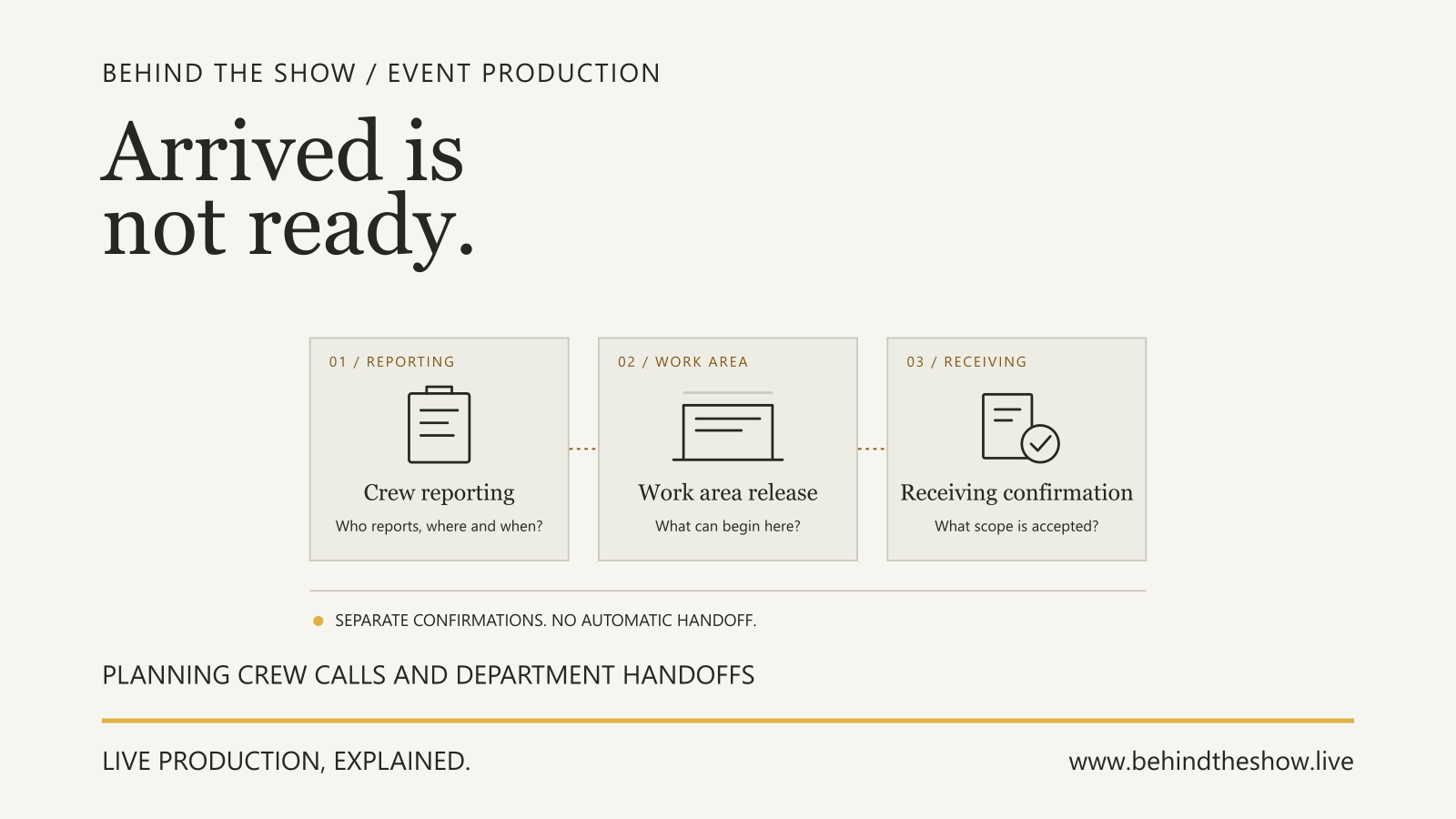
The Production Communications guide develops those reporting and escalation routes. Crew Calls and Department Handoffs explains how an incoming operator receives current responsibilities and open conditions.
Reopen the affected decision when conditions change
A new file, changed stage position, unavailable operator or failed receiving check can invalidate part of an earlier result. Identify what changed, who assesses the consequence, which checks must be repeated and whether the previous admission or programme instruction needs to be held or revised through the agreed authority.
Do not carry out disruptive tests in an occupied room simply to turn an entry green. The responsible teams must agree the conditions and permissions for further work. A production guide cannot authorise specialist testing or override venue restrictions.
Use the Backup and Recovery guide when the response involves an alternative arrangement. Availability is not readiness: identify switching authority, receiving checks and the programme handover before relying on it.
The review gives the next activity a current, accountable decision. Monitoring and responding to changed conditions continue after doors open.
Related questions
How do you review production readiness before doors open?
Compare the current event plan with scoped checked results, identify unresolved conditions and obtain decisions from the people authorised for admission and affected programme changes. Record the evidence, limitations, owners and next decision points, then communicate the accepted arrangement.
Who can authorise audience admission at a live event?
The people authorised under the event and venue arrangements decide within their responsibilities, using the required confirmations. Agree actual contacts, delegation and escalation in advance. A production coordinator or show caller does not acquire that authority merely through their title.
Is being ready for doors the same as being ready to start the show?
No. Admission and programme delivery have different conditions and decision scopes. An accepted holding arrangement does not confirm every later segment, and admission authorisation is not an instruction to execute the opening cue.
What should a pre-doors unresolved-item record contain?
Identify the requirement, current observation, affected activity, consequence, owner, missing evidence, decision authority and next decision point. Recording an owner or deadline does not establish that the condition is acceptable or permission to proceed.
Does a production readiness checklist certify that an event is safe?
No. A coordination record does not replace required safety assessments, inspections, specialist decisions or venue approvals. The responsible people must follow the arrangements and requirements applicable to the actual event.
What happens if conditions change after the readiness review?
Identify the affected evidence and decisions, notify the responsible people and obtain the necessary review, rechecks and revised instructions. Follow the agreed hold and escalation process where relevant; earlier acceptance does not override a new restriction.
What should a department handoff confirm?
Identify the defined output or work condition, relevant checks, receiving owner, acceptance scope and remaining limitations. Confirm what permits the dependent activity to begin without treating one department's result as whole-event readiness.
Is completing a production task the same as accepting its handover?
No. Reported completion, the required checks and acceptance for a defined scope are separate matters. Record what happened and who had authority to accept the relevant requirement.
Sources & references
- Managing an eventUK Health and Safety Executive / primary document
Continue learning