11 min read
EXPLAINER / Event Production
What Is Technical Direction in Live Event Production?
Technical direction in live event production connects the technical requirements, specialist systems and operating arrangements needed to deliver the programme. It involves reviewing how departments work together, resolving technical interfaces and coordinating evidence that the agreed arrangement works. A Technical Director may lead that function, but the scope varies by production. The title alone does not establish authority over programme changes, spending, specialist approvals or show cues.
On this page
Individual systems can work while the programme still does not. Technical direction connects the requirements between them.
The problem between working systems
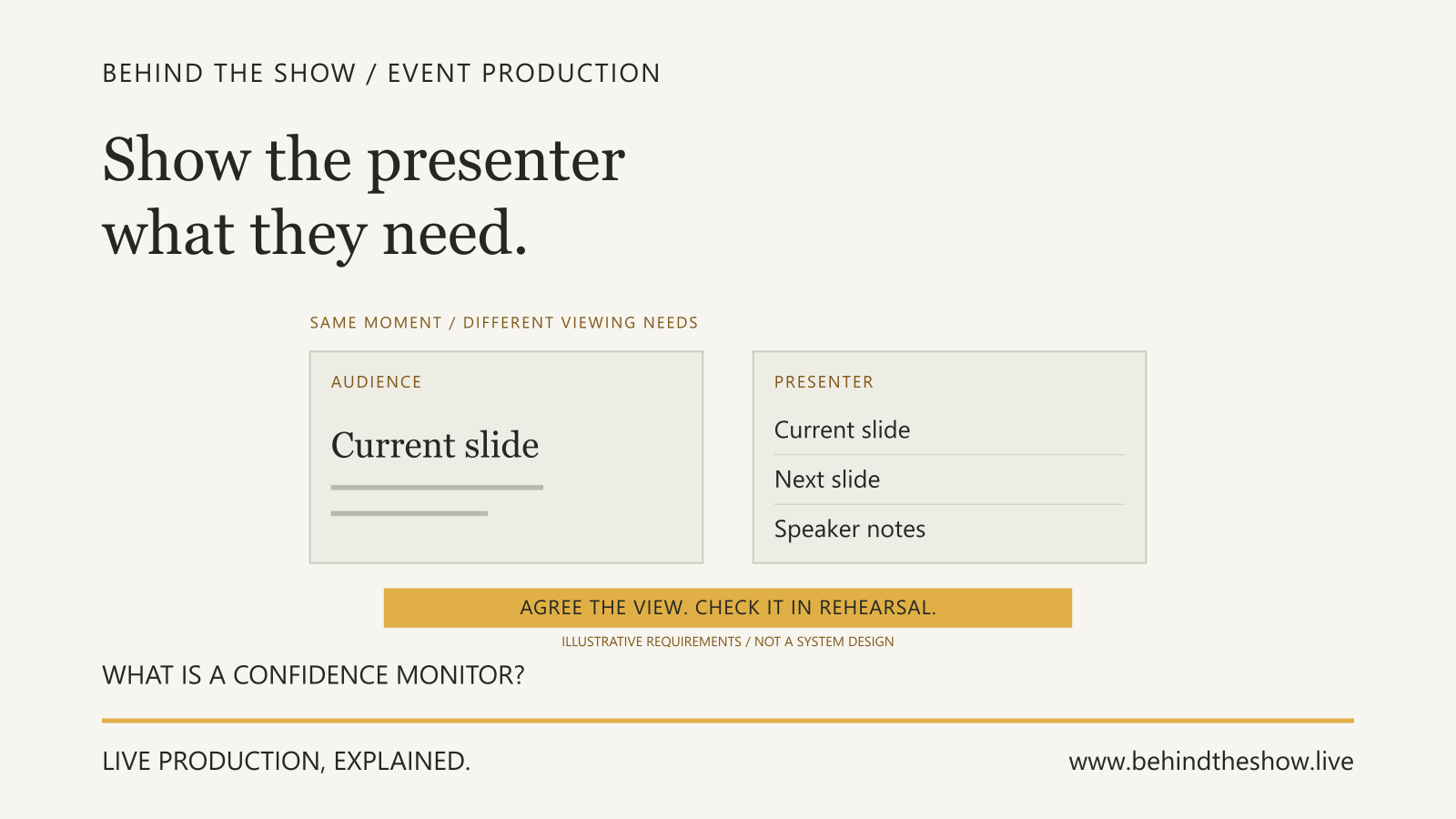
The presentation plays. The audience screens work. The presenter can see a confidence display showing the next speaking prompt.
Then the programme changes to a live demonstration camera. The audience sees the demonstration correctly, but the presenter's confidence display also changes to that camera. The speaking prompt disappears at the moment it is needed.
Nothing in that observation proves a broken screen. The individual equipment may be working as arranged. The arrangement does not yet meet the combined requirement.
Technical direction pays attention to those connections: what one department provides, what another needs to receive, and what has to remain true when the programme moves on.
A department can be ready for its own task while the handover between departments remains unresolved.
Define the function before relying on the title
In this Article, technical direction means the coordination of technical design interfaces, integration and technical delivery across the agreed live-event scope. It can involve sound, video, lighting, staging, communications, venue systems and other relevant disciplines. It does not mean one person personally designs or operates every system.
For a bounded occupational example, Berklee's theatre Technical Director profile describes a role spanning technical planning, execution and departmental coordination. That theatre example supports the breadth of the function; it is not a universal reporting structure for concerts, conferences or festivals.
The title also needs context. In a US television example, the Motion Picture Editors Guild's journal describes Technical Directors working as vision mixers. That is a particular broadcast use of the title, not evidence that a live-event Technical Director always operates the video switcher.
Ask what the person is appointed to coordinate, what systems they cover, who they work with and which decisions they can make. Another production may allocate the integration work to a Production Manager, supplier lead or several named specialists. If roles are combined, the responsibilities still need distinguishing.
What technical direction brings together
Start with what the programme needs to do. An instruction such as “show the product demonstration” is incomplete until the team understands who needs to see it, what the presenter needs at the same time, what sound accompanies it and how the transition happens.
The technical-direction function connects those requirements to specialist proposals. Useful questions include:
- What must each department provide, and to whom? - What information, physical arrangement or signal does the receiving team need? - Which conditions must be ready before a dependent action can proceed? - Does the proposed arrangement support the actual programme transition, not only a static equipment test? - Who will check the result, and what decision remains if it does not meet the requirement?
An interface is simply a point where one part of the production depends on another. It may be a signal between systems, an agreed performer position, content handed to an operator or a readiness report before a cue. The job is to make the relevant interface explicit enough to prepare and check.
During production advance, this can reveal a missing scope or incompatible assumption before build. During preparation and rehearsal, it can reveal that separate departmental checks have not yet tested the exchange the programme requires.
Technical direction and production management
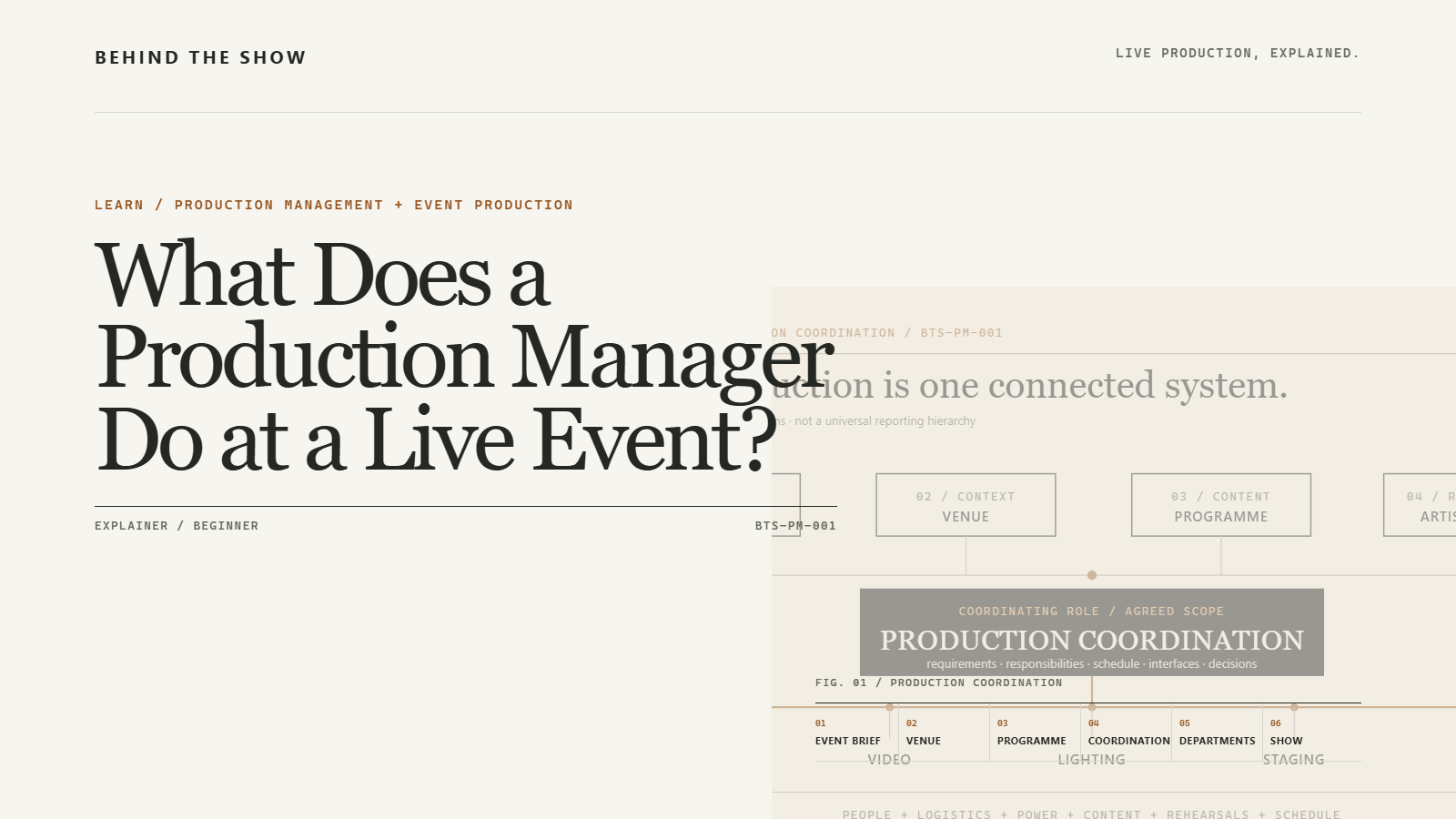
The Production Manager may maintain the broader picture of requirements, suppliers, people, access, schedule, logistics and resources. Technical direction may concentrate more deeply on how the technical parts fit together and how their delivery is coordinated.
This is a distinction of focus, not a fixed hierarchy. Some productions combine the work. Others separate it between client, agency, venue, touring and supplier teams.
For example, a technical lead may identify that an additional presenter display is one possible response to a programme requirement. That does not automatically authorise the cost, make a supplier responsible for providing it or establish that the proposed position is acceptable. The appropriate people still need to agree feasibility, scope, access and approval.
An integration recommendation and a supply commitment are different things.
Stage management, show calling and specialist operation
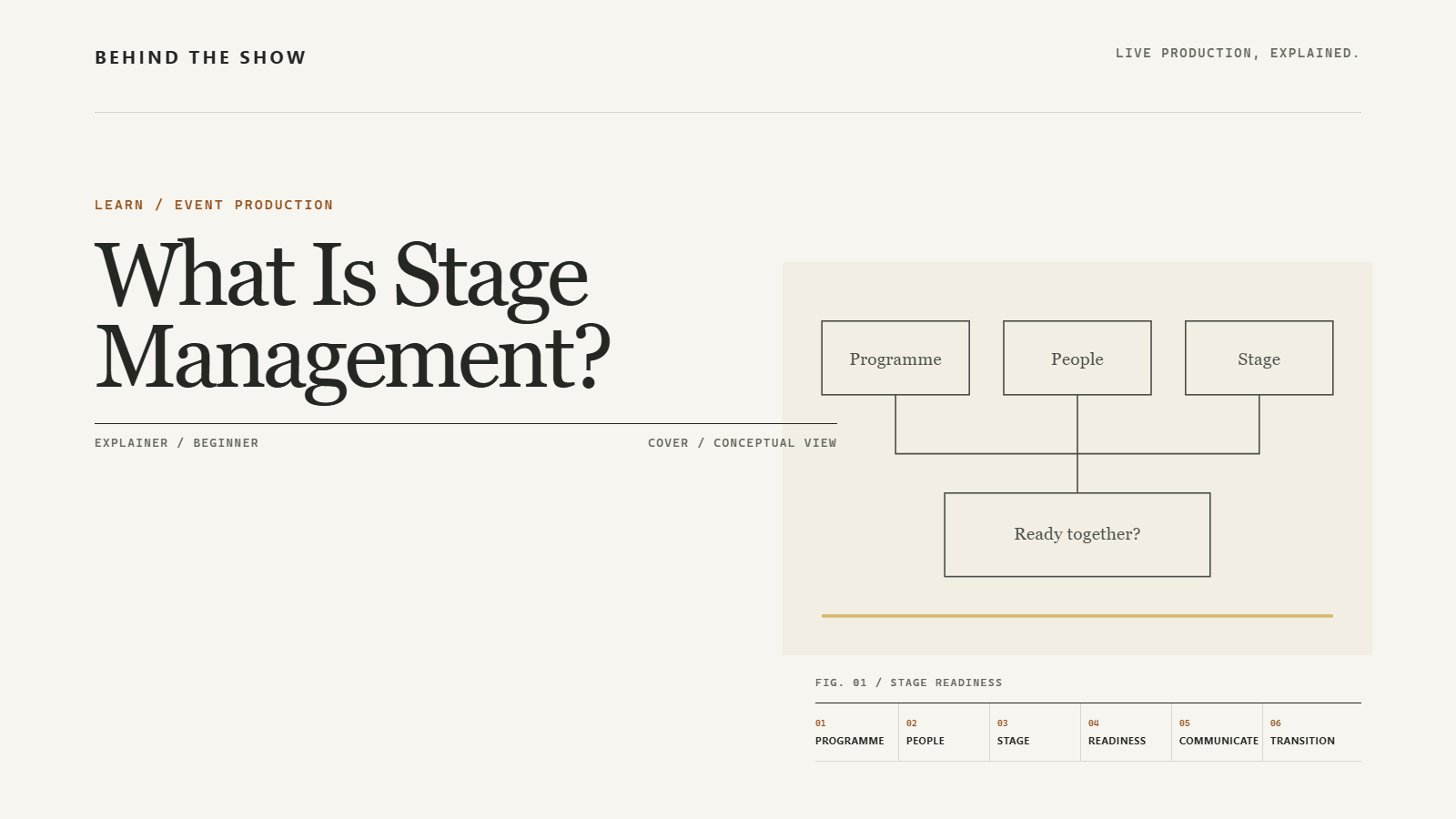
Stage management coordinates the relevant stage activity, performers and transitions within its agreed scope. Technical direction needs that information when positions, equipment access or programme changes affect the technical arrangement.
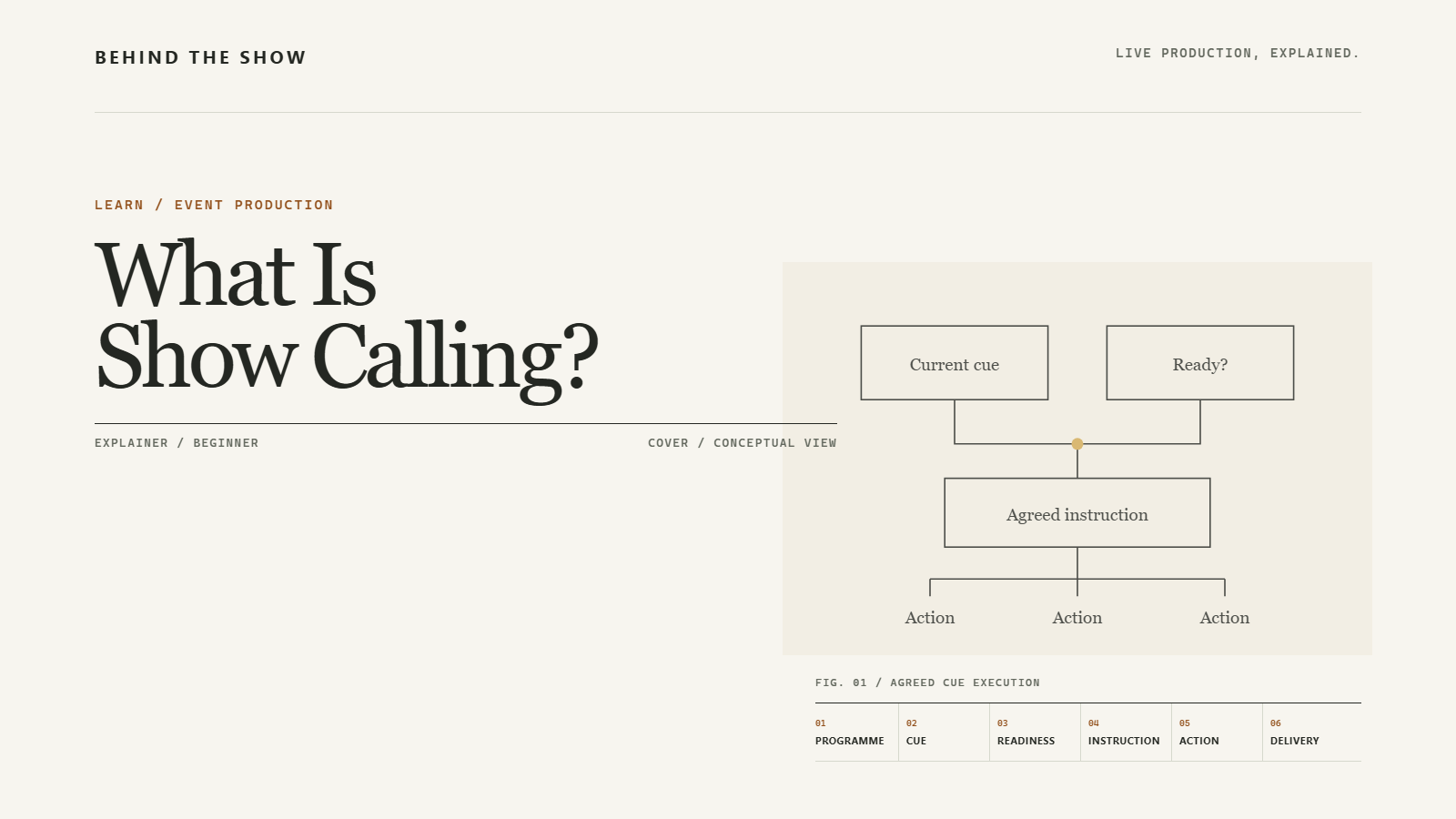
Show calling coordinates agreed cue instructions and timing. Technical direction may help establish the conditions on which a cue depends. A technical readiness report is not automatically the instruction to run the cue.
Specialist leads and operators prepare, assess and operate their assigned systems. A coordinator asking whether the presenter can see the required material is not thereby qualified or authorised to change every video, lighting or audio setting.
The useful boundary is not “technical people versus production people”. It is which person is supplying evidence, recommending a response, approving a consequence and executing the agreed action. One person can hold more than one function, but the production should know when that is the case.
Worked example: the audience view changes, but the presenter still needs the prompt
A fictional conference includes a presenter-led product demonstration. Before the demonstration, the room screens show the presentation. During it, the audience needs a close-up camera view of the product while the presenter continues using the agreed speaking prompt on a confidence display.
Everyone contributing is in the venue. Recording, streaming and remote participation are outside this example. No connection design, equipment settings or movement method is specified.
For this event, a Technical Director coordinates the technical interfaces. Video and lighting leads retain their specialist responsibilities, stage management coordinates the agreed presenter and demonstration positions, and a separate caller gives programme cues. The organiser has named a programme approver; production management coordinates any effect on resources and schedule. These are assigned functions for this example, not compulsory separate jobs.
| Requirement | Evidence from rehearsal | Decision needed | Assigned follow-through in this example |
|---|---|---|---|
| Room audience receives the demonstration camera when the segment begins. | The audience screens show the agreed camera view during the attempted transition. | Record that observed result; do not infer the presenter view from it. | Video lead reports the checked audience destination. |
| Presenter retains the agreed speaking prompt during the camera segment. | The confidence display changes to the camera view and the prompt disappears. | Keep this requirement unresolved; establish a workable proposal rather than treating the audience result as complete acceptance. | Technical Director coordinates the requirement with the presenter and video lead. |
| Demonstration remains visible from the agreed presenter position. | The first camera framing and lighting checks used the existing reviewed position. | Any proposed position change needs affected review; it cannot inherit the old results automatically. | Stage, video and lighting contacts review any changed conditions within their responsibilities. |
| Programme handover uses the accepted arrangement. | The transition has not yet passed with the required audience and presenter views together. | Repeat the affected transition before using its readiness report. | Relevant leads report results; caller and programme approver use the agreed decision and cue arrangements. |
Find the missing agreement before choosing equipment
The Technical Director first checks the requirement with the presenter and organiser's programme approver. The prompt must remain available during the live camera segment. It is not intended to follow every change on the audience screens.
The video lead reviews how the current system is arranged and proposes a way to provide those different views with the available system. The Article does not diagnose a particular output setting or promise that every video system can do this. The responsible specialist must establish feasibility for the actual equipment.
The Technical Director brings that proposal back to the other affected people. Does it preserve the reviewed presenter position? Does it alter operating workload, content preparation, supply scope or the time needed to check the transition? A solution is not agreed merely because it is technically imaginable.
In this scenario, the video lead confirms a feasible arrangement that retains the current presenter position. No extra equipment or programme alteration is proposed. Production management confirms the revised preparation and check window with the affected teams. The presenter and programme approver confirm the intended content behaviour; that confirmation is not a substitute for the technical check.
Why moving the presenter is a different decision
An alternative suggestion is to move the presenter so they can use another display. That suggestion is not adopted simply because the display can be seen from somewhere else.
It would change the position on which stage, camera and lighting preparation was based. The relevant teams would need to review the affected arrangement, including access and any venue conditions, and repeat the appropriate checks. If it changed the presentation or schedule, those consequences would also need their assigned approvals.
Here, the team retains the reviewed position and checks the video lead's agreed proposal. The example does not establish that retaining a position is always preferable. It shows why a cross-department consequence needs review instead of being treated as one operator's convenient fix.
Check the exchange and hand over the result
The presenter and affected operators repeat the transition using the agreed material. The video lead's nominated check confirms the audience screen changes to the demonstration view. The presenter confirms the required prompt remains visible and usable at the agreed position. The team also tries the return to the presentation and the matching programme handover.
These observations establish the tested result for that arrangement and passage. They do not establish every camera view, future content revision or whole-show readiness.
The Technical Director records the coordinated result and any limits. The caller receives the current cue and readiness information. Within this event's agreed arrangements, the programme approver accepts the reported result for this segment; the caller executes the subsequent cue sequence when its agreed conditions are met. Neither that acceptance nor a cue instruction overrides a specialist restriction or venue procedure.
The lesson is not that every event needs separate audience and presenter feeds. This event had different viewing requirements, and the combined transition needed evidence that both were met.
ILLUSTRATIVE SCENARIO
What authority needs to be explicit?
A Technical Director may have delegated authority over specified technical decisions. Establish that scope rather than assuming it follows automatically from the title.
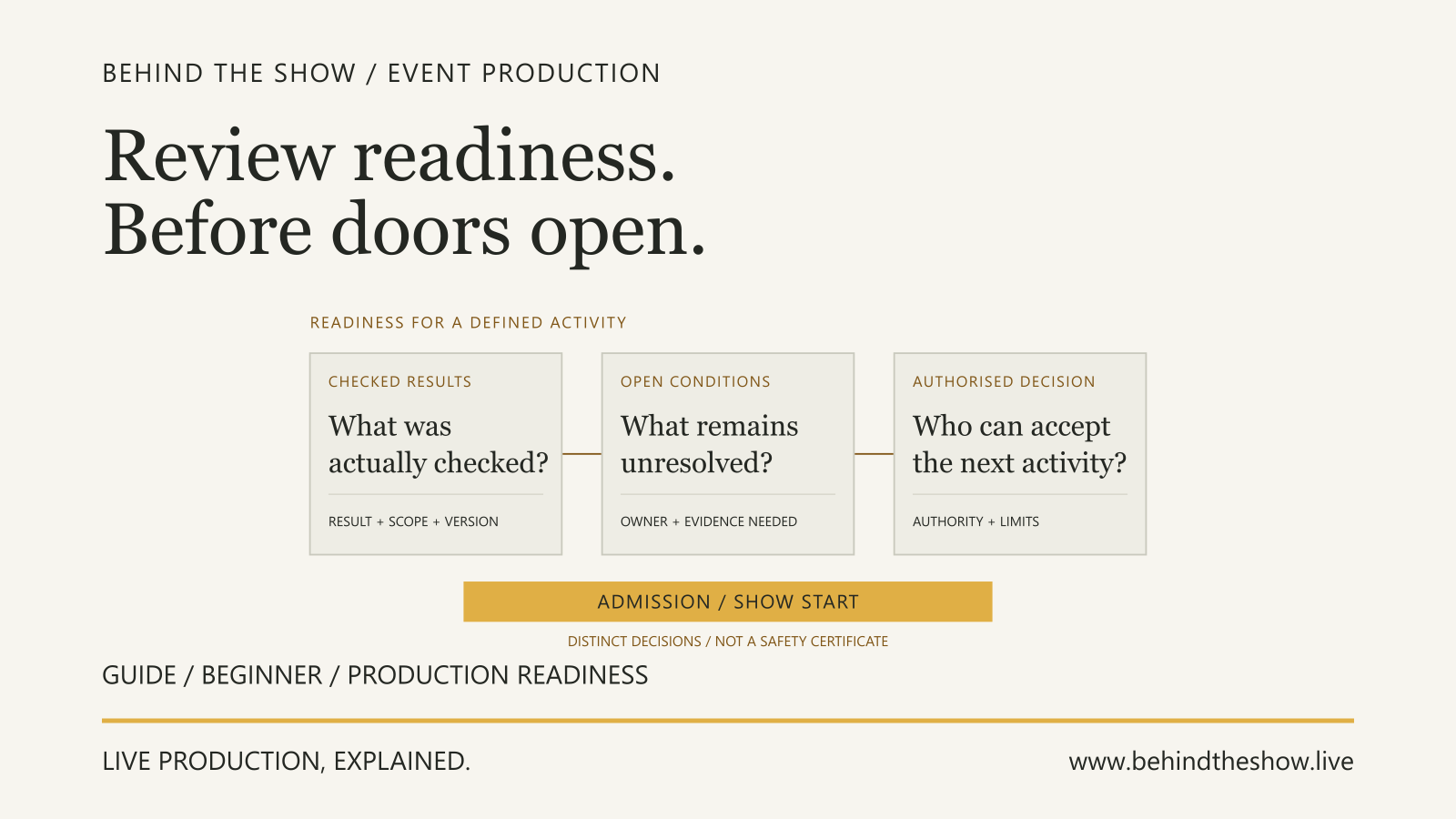
Keep at least these decisions distinguishable: the specialist's assessment of an arrangement; acceptance of additional supply or cost; approval of a programme change; the instruction to execute a cue; and any venue or specialist approval needed for the work. For the pre-doors decision, the Production Readiness guide shows how scoped technical results and unresolved conditions reach the people authorised to decide about admission. Coordinating those reports does not grant the Technical Director admission authority or turn a technical result into a whole-event safety acceptance.
The production-responsibility guide develops how to assign those interfaces. An unresolved responsibility should reach someone who can resolve it. It should not disappear into “the TD is handling it”.
Where structural, electrical, rigging, fire, life-safety or other specialist matters are involved, technical direction coordinates the relevant people and requirements. This explanation does not confer competence, establish legal duties or replace the approvals and procedures applicable to the actual event. An ordinary programme decision is not a safety clearance.
Carry decisions through preparation and delivery
Useful technical-direction records identify the requirement, affected interfaces, current agreed proposal, owners, decision authority, checks and unresolved conditions. They can sit in existing plans; a new document is not required for every conversation.
Keep them consistent with the current programme, layouts, specialist information and operating instructions. If an arrangement changes, identify the affected preparation and evidence. A previously checked transition does not automatically cover a revised position, content version or receiving destination.
The handover needs to reach the people who act on it. The Production Communications guide distinguishes working questions, cue instructions and escalation. A decision understood by technical leadership is not yet an instruction understood by every affected operator.
Some events can provide this integration through an experienced existing team. More complicated interfaces may warrant a dedicated lead. The requirement is sufficient coordination and appropriate specialist input, not a particular title on every crew list.
Technical direction connects the technical decisions. It does not make every decision the Technical Director's to approve.
Related questions
What is technical direction in live event production?
Technical direction connects technical requirements, specialist systems and operating arrangements so they can deliver the agreed programme. Its scope and authority vary by production.
Does a technical director design and operate every system?
No. Technical direction coordinates the relevant interfaces while appropriately assigned specialists assess, prepare and operate their systems. One person may combine roles only within the agreed scope and competence.
Is technical direction the same as show calling?
No. Technical direction addresses technical integration and delivery; show calling coordinates agreed cue instructions and timing. The functions may be combined, but a readiness report is not automatically an execution instruction.
When should technical direction become involved?
Involve the responsible integration lead while requirements and specialist proposals are being developed, early enough to resolve interfaces and plan relevant checks. Review affected arrangements again when the programme or system changes.
What information should technical direction hand over?
Hand over current requirements, agreed technical interfaces, owners, decision authority, relevant check results and limitations, operating implications and unresolved work to the people who need to act on them.
Does every live event need a separate technical director?
Not necessarily. An experienced existing team may provide sufficient technical integration. Decide from the interfaces, workload, competence and agreed responsibilities rather than the title alone.
What is the difference between a production manager and a technical director?
A Technical Director may focus more deeply on technical design, integration and execution, while a Production Manager may coordinate the broader requirements, resources, suppliers, schedule and operational delivery. Some productions combine the roles.
What should happen when a production responsibility is unassigned?
Make the gap visible, identify who can resolve it and agree the delivery scope and timing rather than assuming another team will take it on.
Sources & references
- Technical DirectorBerklee / primary document
- Mixing with Vision: Technical Directors Call the ShotsCineMontage / Motion Picture Editors Guild / primary document / 01 Nov 2007
Continue learning