10 min read
GUIDE / Production Management
How to Turn a Production Site Walk Into Actions and Handover
Turn a production site walk into actions by recording each relevant observation against the current requirement, assigning an agreed action owner and identifying dependencies, evidence and the person authorized to accept the result. Keep reported completion separate from checking and acceptance. Hand over open items with their next decisions, and confirm that the receiving person understands and accepts the work they are taking on.
On this page
Give each observation a requirement, an owner and a defined next decision.
Begin with the work the walk needs to resolve
A production walk-through can reveal an unfinished position, conflicting information or a task that nobody has accepted. Seeing the issue is only the beginning. The next person needs to know what is required, who will act and what will count as resolving it.
Before walking, identify the area and production phase being reviewed. Use the current layout, scope and working schedule. Agree who needs to take part for the questions likely to arise, including the people who can explain constraints and accept the relevant work.
Some productions use Area Managers, department leads or production coordinators for this function. Others combine it with an existing role. A title does not establish which work somebody owns or what they may approve. Use the agreed production responsibilities.
This is operational coordination, not a replacement for required specialist inspections. An urgent safety concern must go through the event's established escalation arrangements immediately; entering it in an ordinary action list is not a substitute for that response.
Describe the observation before prescribing the solution
Record the location, what was observed and the requirement it affects. Preserve the reference and time or production phase that make the observation useful. A position can change between the initial walk and the next shift.
For example, “supplier cases occupy the marked service passage” identifies an observable condition. “The supplier has ignored the plan” adds a conclusion about cause or conduct that the observation alone does not establish.
State which plan or agreement defines the intended condition. If that requirement is missing or contradictory, the first action may be clarification. Do not issue a corrective instruction based on an unconfirmed assumption.
The venue-information review guide explains how to distinguish an observation from a supplied statement and an event-specific confirmation. Keep that distinction when the information becomes an onsite action.
Assign the action and the authority separately
An action needs a defined result, an owner who accepts the task and a decision point suited to the work. Identify what must happen first and who needs the outcome before continuing.
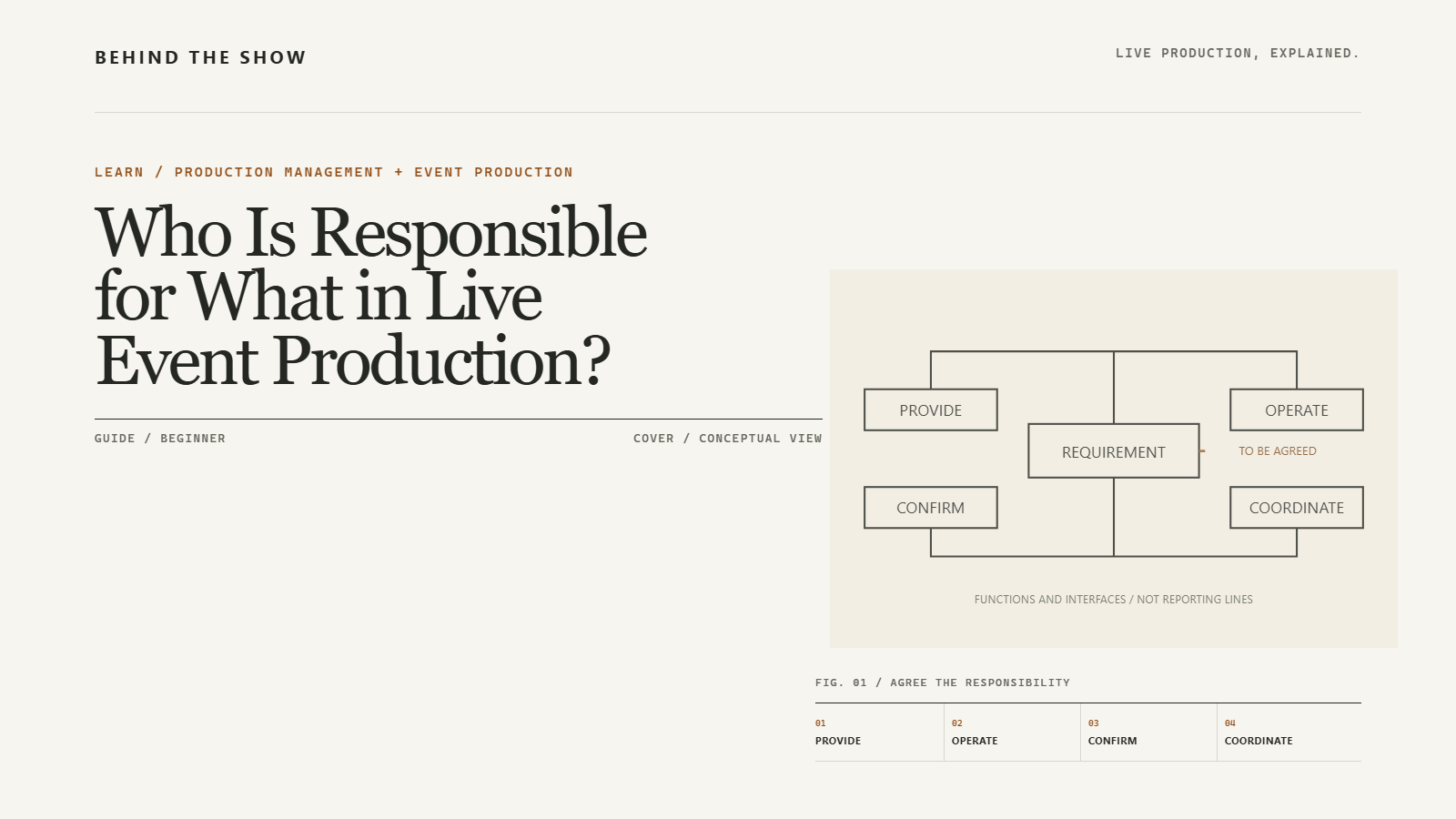
The action owner arranges or carries out the agreed work within their scope. A person checking the result compares it with the specified requirement. The person accepting the handover decides whether that defined scope is accepted within their authority. A coordinator keeps those functions connected and the record current.
One person may perform more than one function where the arrangement permits it. Do not invent separate staff positions to fill a form. Equally, a person cannot acquire specialist competence or approval authority because their name has been entered in a column.
If no owner has accepted a task, record it as unassigned and identify who can resolve the allocation. Copying someone into a message is not acceptance of the task. A supplier exclusion does not automatically transfer it to the venue or another department.
Make the state more useful than a tick
Work reported complete is not the same as work checked and accepted.
Use wording that tells the next person what actually happened. These distinctions are useful when a simple open/closed label would hide something important:
| Record state | What it establishes | What it does not establish |
|---|---|---|
| Observed | A condition has been recorded in a stated place and context | The cause, solution or responsible party has been determined |
| Reported | The concern has been sent through an identified route | Someone has accepted the action |
| Assigned and accepted | An owner has taken on a defined action | The action has been performed |
| Completion reported | The owner says the specified work is complete | Required checks or acceptance have occurred |
| Checked | The stated comparison or check has been carried out, with a recorded result | All other checks passed or the wider area is accepted |
| Accepted for the stated scope | The authorized person has recorded acceptance of that requirement | Unrelated work, the whole production or legal matters are settled |
This is a way to distinguish information, not a mandatory six-step sequence. An observation may require clarification, a checked result may be rejected, or a changed requirement may reopen work previously accepted. Record the actual state instead of advancing an item through labels to make the list look finished.
Agree the evidence needed for the particular action. A photograph may support a visible position or condition at one moment. It cannot establish every technical property, the condition of something outside the frame or continued suitability after a change.
Worked example 1: cases in a service passage
During setup at a fictional conference, the coordinator sees supplier cases in a passage shown as available for service movement on the current event layout. The next delivery team expects to use that passage. The observation does not determine where the cases can be stored instead.
The coordinator records the location and layout reference, then asks the venue contact to confirm the agreed passage use and the supplier lead to review relocation. In this example, the venue contact confirms a temporary storage position for those cases. The supplier lead accepts moving them there before the next planned delivery uses the passage. The coordinator communicates that dependency to the delivery lead.
This record concerns an agreed operational movement arrangement. It is not an emergency-route assessment or an instruction for handling heavy equipment.
| Action item | Owner and dependency | Evidence, decision and state |
|---|---|---|
| Confirm the passage requirement and proposed storage position | Coordinator obtains the venue contact's event-specific response before relocation is agreed | Venue contact confirms the arrangement in the shared record; this clarification is resolved |
| Relocate the identified supplier cases | Supplier lead accepts the defined relocation before the next delivery's agreed use of the passage | Supplier lead reports completion and identifies the cases and destination; comparison with the agreed arrangement is still outstanding |
| Check and accept the agreed relocation handover | Coordinator checks the recorded positions; venue contact accepts the defined operational arrangement | Record the result and acceptance separately; the next delivery lead receives the outcome |
In the completed outcome for this example, the coordinator compares the passage and storage positions with the recorded arrangement. The venue contact accepts that defined relocation handover, and the delivery lead receives the current position before sending equipment through. The record identifies who checked, who accepted and the scope of each decision.
The team closes the case-relocation action, not an unrestricted “area safe” item. Any separate technical checks or required safety approvals remain with the responsible people. If the observed condition had not matched the agreed arrangement, the action would have remained open with the discrepancy recorded.
ILLUSTRATIVE SCENARIO
Worked example 2: a drawing discrepancy at shift handover
At a fictional event, a supplier reports a playback desk position complete against layout A. During a walk-through, the coordinator finds that another team is working from layout B, which shows a different position. Nobody on the walk can establish which position is currently approved for delivery.
The coordinator records the conflicting references without telling the crew to move the desk. The agreed person authorized to confirm the production layout must resolve that requirement. The supplier lead will then review the effect on its work and confirm what preparation or checks remain necessary.
The outgoing coordinator's shift ends before the layout answer arrives. The receiving coordinator accepts responsibility for following up the decision and passing the answer to affected teams. That acceptance is a handover of the open action, not approval of either desk position.
| Item passed to the incoming coordinator | Current state | Required next action |
|---|---|---|
| Playback desk position | Supplier completion reported against layout A; layout B conflicts | Obtain the authorized current layout decision and reference |
| Supplier preparation | Cannot be accepted against an unresolved position requirement | Supplier lead reviews the confirmed requirement and identifies resulting work and relevant checks |
| Adjacent team's work | Its layout reference differs from the supplier's | Receiving coordinator gives affected teams the decision and confirms its effect on their work |
| Open-action ownership | Receiving coordinator accepts follow-up, not layout approval | Record the receiving person's acknowledgement and agreed next decision point |
At this handover, the position remains unresolved. The receiving coordinator knows the question, the decision route, the affected teams and what must happen next. No one marks the desk accepted merely because the supplier completed work against one of the drawings.
If the layout decision changes work already recorded as accepted, identify which earlier acceptance is affected and arrange the relevant review. Preserve the earlier record rather than quietly replacing it with a new tick.
ILLUSTRATIVE SCENARIO
Set decision points around dependencies
“Before the next shift” may be too vague if another team needs the answer earlier. Identify the dependent work and agree when a decision or further update is needed. Carry material changes into the production schedule.
A follow-up deadline is not evidence that the task can be completed in that time. Ask the owner to confirm the work and its dependencies. If an answer has not arrived at the agreed decision point, use the established escalation route rather than treating silence as permission to continue.
When the matter needs a programme, scope, cost, venue or specialist decision, identify the appropriate authority. The coordinator can obtain information and bring the decision to the right person without making it on their behalf. Use a production meeting where discussion is needed; not every open action needs a meeting.
Hand over the open work explicitly
A list sent to the next shift is useful only if the recipient can understand what they are taking on. Identify the current record, the scope and state of each item, the accepted owner, the evidence already available and the next decision. Keep an unassigned action visibly unassigned until the allocation is resolved.
Ask the receiving person to confirm the responsibility they are accepting. They may accept coordination of an open question while another person remains responsible for delivering the work. Record both functions so the original supplier's action does not disappear during the shift change.
Partial acceptance should be specific. “Cases relocated; final storage handover outstanding” is more informative than “handover done”. If evidence is disputed or incomplete, state the unresolved point and who needs to decide it.
Give each recipient the information relevant to their work. Do not circulate unnecessary personal details or unrelated commercial correspondence merely because it sits in the same record.
Keep the record current as the production changes
Revisit relevant items when layouts, equipment positions, responsibilities or operating conditions change. An earlier check describes the condition and scope checked at that time; it does not automatically apply to a revised arrangement.
Keep the previous decision identifiable, record the change and tell the teams whose work depends on it. Close only the agreed scope and retain the remainder with its owner and next step.
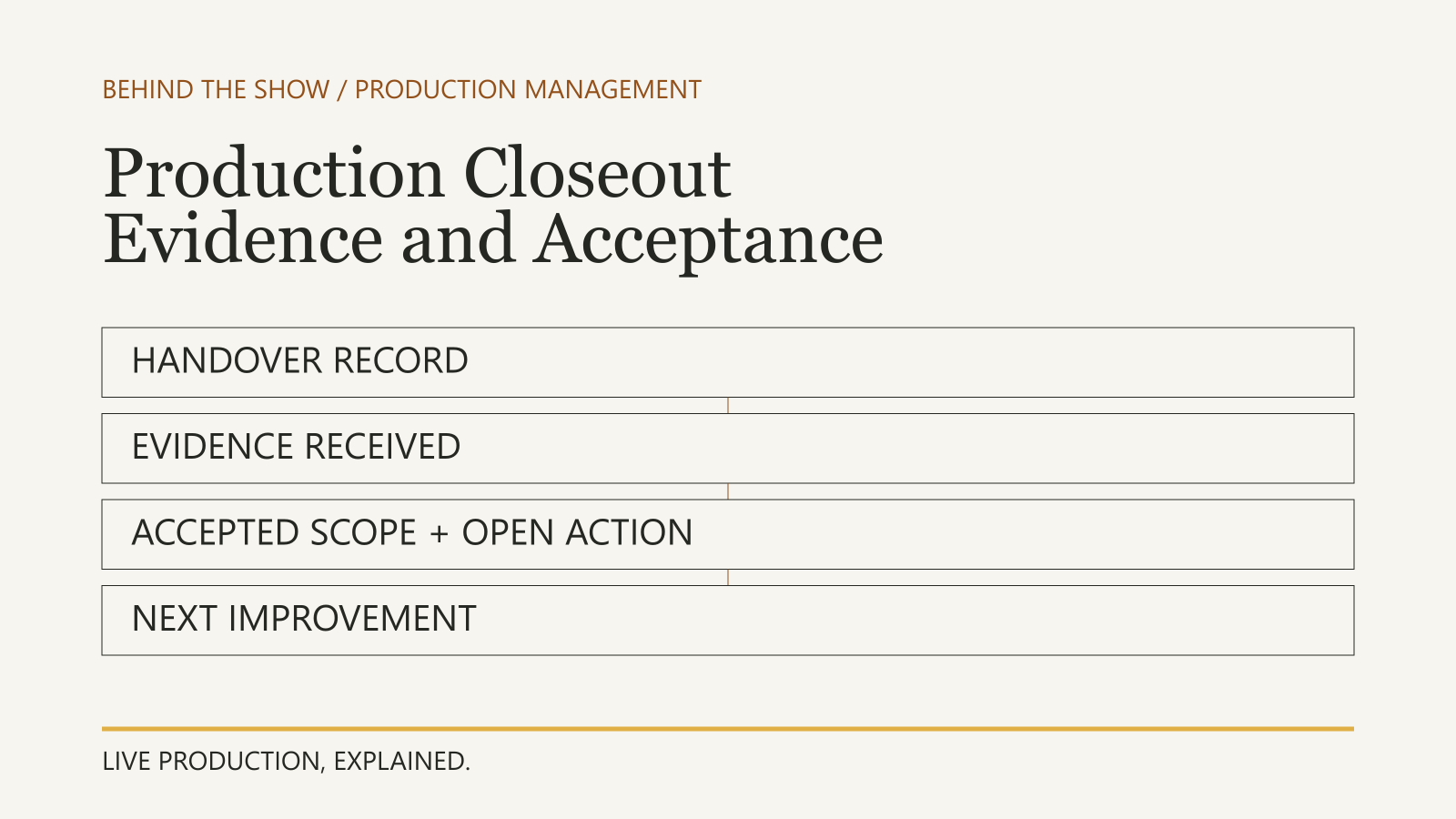
When an action continues after the event, carry its current record into production closeout rather than starting an unrelated list without its history.
The useful outcome of a site walk is a shared understanding of what is resolved, what remains open and who acts next.
Related questions
How do you turn a production site walk into actions?
Record the observation and current requirement, agree the action owner and dependencies, identify the evidence and acceptance authority, and carry unresolved items into a confirmed handover.
Is completing a production task the same as accepting its handover?
No. Reported completion, the required checks and acceptance for a defined scope are separate matters. Record what happened and who had authority to accept the relevant requirement.
What should a production site-walk action handover contain?
Include the location and requirement, current state, accepted action owner, dependencies, evidence, decision authority and next decision point. Confirm what responsibility the recipient is taking on.
How should production responsibilities be recorded?
Record specific requirements, named participants, delivery and approval functions, dependencies and unresolved work in a shared current plan.
What should happen when a production responsibility is unassigned?
Make the gap visible, identify who can resolve it and agree the delivery scope and timing rather than assuming another team will take it on.
Who approves changes to a live production?
Approval depends on the decision and agreed authority. Identify the relevant client, artist, venue or specialist approver and communicate the result to affected teams.
Continue learning