4 min read
GUIDE / Event Production
How to Review Venue Information Before Planning Production
Review venue information by confirming the exact room, event date and document version, recording what was observed or stated and identifying what remains unconfirmed. Resolve conflicting information with the responsible contact, then record the planning decision, owner and follow-up in the current working brief.
On this page
Trace venue information to its source before using it in a production plan.
Confirm the room and event the information describes
A venue name does not identify the exact production space. Establish the room, event date and intended arrangement before relying on a brochure, plan or email. A document can be accurate for one room or event and not answer the question you are working on.
The production brief should make that context clear. Ask the venue which information applies to this event and who can confirm conditions that affect preparation.
Keep the source and confirmation status separate
An observation describes what somebody saw at a particular time. A venue statement describes what a contact or document says. Neither should lose its date or context when it is copied into a planning record.
Confirmation is a separate question. A route may have been visible during a visit without being available for your event. An email may state an access time without identifying the room. Preserve what the evidence actually establishes and ask for the missing scope.
An assumption is not evidence. If the team needs a provisional basis for planning, identify it as an assumption, record why it is being used and state whose confirmation is needed.
Review a fictional access question
In this illustrative exercise, a team is planning an event in Hall B at a fictional venue. The access time below is an example, not a recommended working window or proof that the production can be built in the time available.
| Evidence reference | Source and scope | What it establishes | Confirmation status |
|---|---|---|---|
| E1 | Visit photograph showing a route marked Hall B, recorded on the visit date | A route with that label was visible at the time | Event-day availability unconfirmed |
| E2 | Venue email stating Hall B access begins at 14:00, naming this event date | The venue contact has stated a room-specific access time | Needs reconciliation with the programme's earlier assumption |
| E3 | General brochure referring to early access, without a room or event date | A general statement, not an event-specific commitment | Cannot establish access for this event |
The brochure does not override the more specific statement merely because its wording is convenient. Equally, the email does not establish whether vehicles, movement routes and the room become available at the same moment. Ask the questions that affect the production rather than filling those gaps by assumption.
Turn the difference into a follow-up decision
The team had provisionally planned for earlier access. The current record should show the mismatch, not quietly keep the earlier assumption in the schedule.
| Planning item | Current treatment | Confirmation or action owner | Status |
|---|---|---|---|
| Room identity | Use Hall B, as stated in the event-specific venue email | Production coordinator records the source | Identified for this example |
| Working access basis | Retain 14:00 as the provisional planning basis while seeking clarification | Venue contact to confirm what becomes available and when | Open |
| Preparation timeline | Ask the schedule owner to review the consequence of the provisional access basis | Agreed schedule owner | Review needed; adequacy not established |
Agree a real follow-up deadline with the relevant people. This example does not prescribe one. A provisional basis allows a planning question to be examined; it is not an approval to proceed or evidence that the window is sufficient.
Ask the responsible people the question they can answer
The venue can clarify its arrangements and supplied information. Suppliers and production teams can review the consequence for their preparation. Qualified specialists must address matters that require their competence.
A photograph, brochure or coordinator's review cannot certify structural capacity, rigging, electrical suitability, safe occupancy or a complete technical design. Keep those questions routed to the relevant competent people rather than marking the venue as approved in this record.
Carry the decision into the working plan
Once clarification arrives, identify what it resolves and what remains open. Update the brief and affected production schedule. Share the change with teams whose load-in or preparation depends on it.
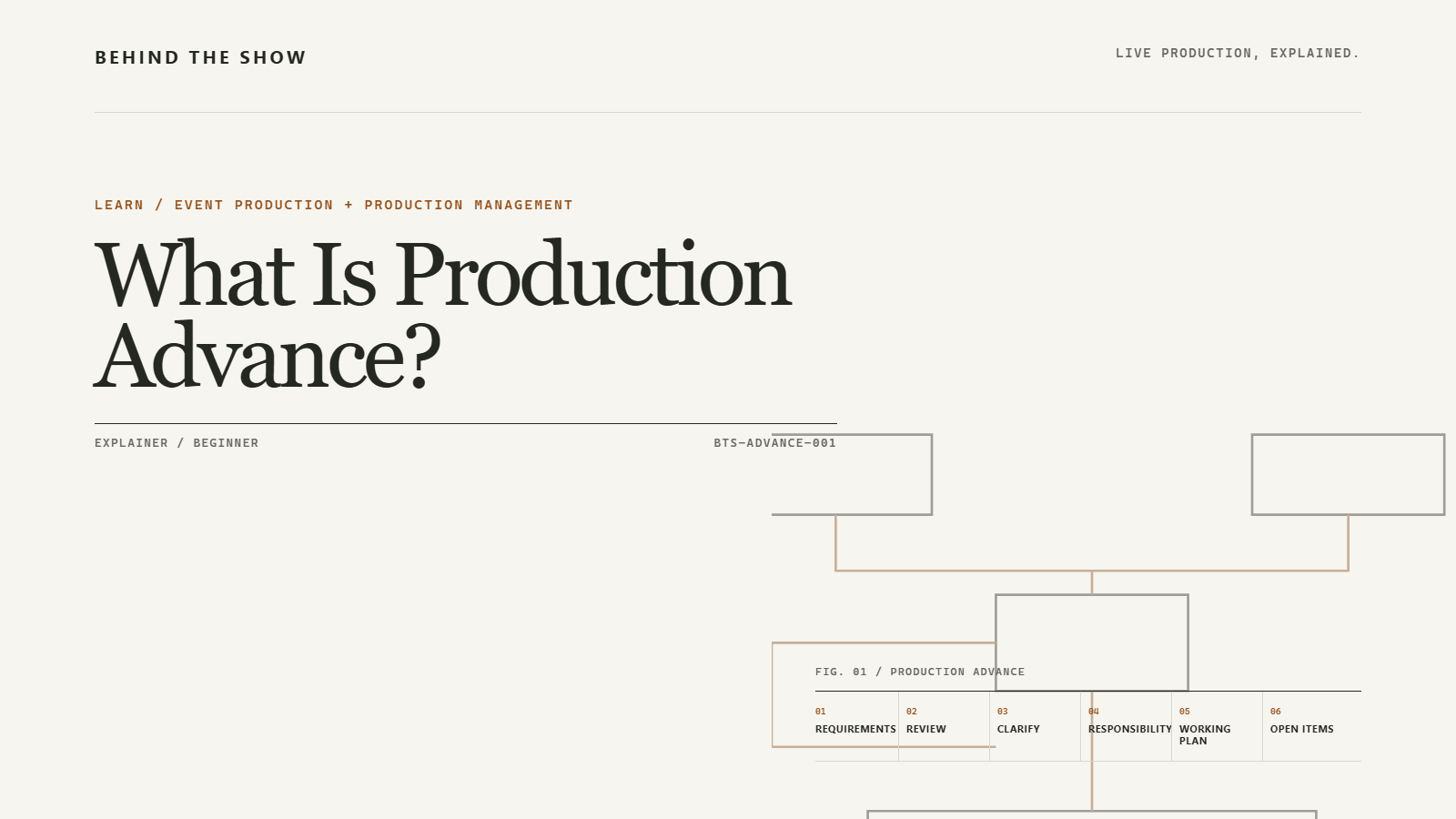
This review feeds production advance. It does not replace the wider coordination of programme, venue, artist and supplier requirements.
A useful venue record shows what the information establishes, what it does not establish and who needs to resolve the remaining question.
Related questions
Why does the exact venue room matter for an event production quote?
Different rooms in the same venue can have different dimensions, access, installed systems, power, rigging, internet and restrictions. The exact space gives the supplier a more reliable basis for planning.
What if I do not know all the production requirements yet?
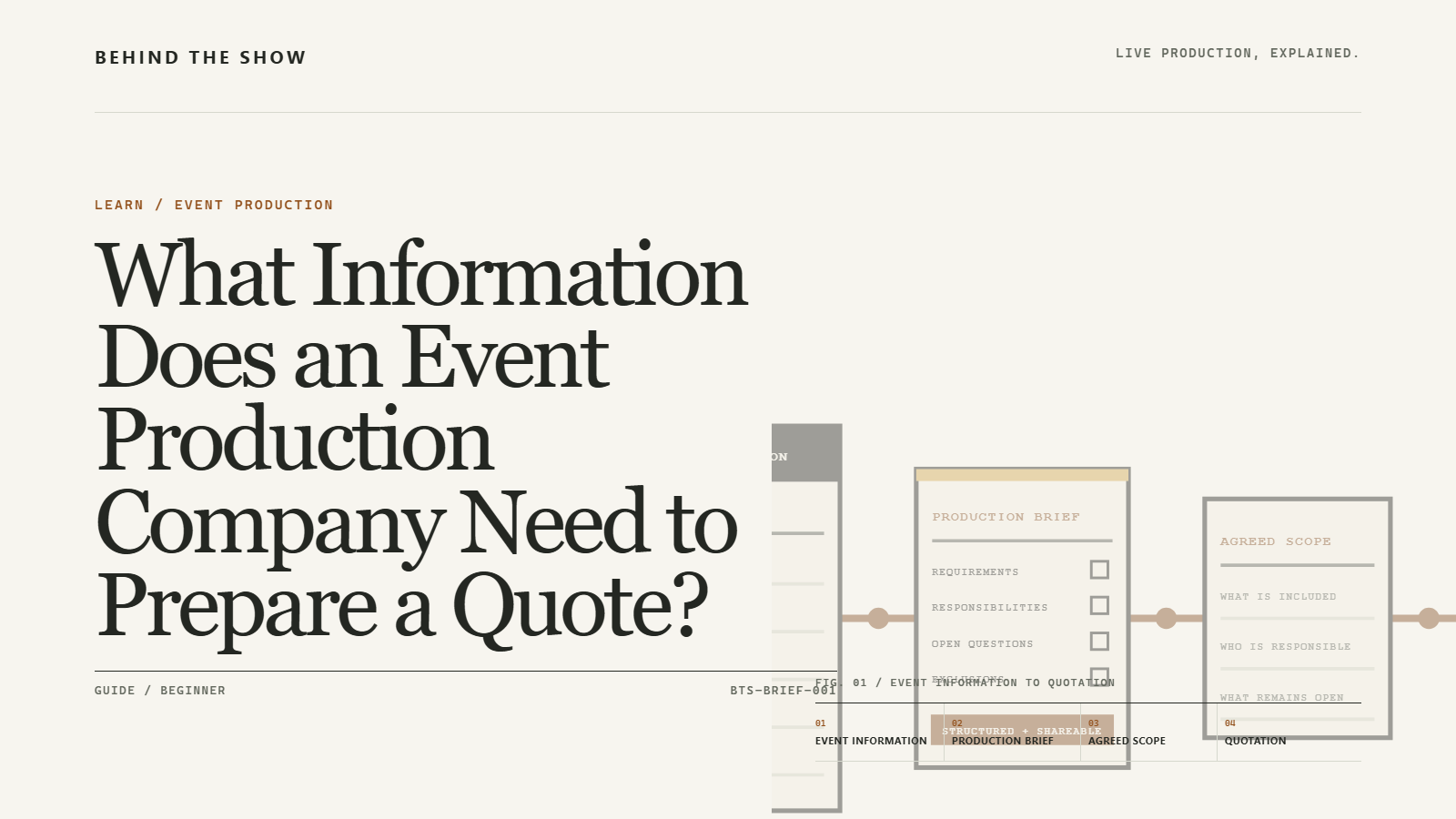
Mark relevant unknowns as to be confirmed. A useful brief separates confirmed information, open questions, non-applicable items and responsibilities that have not yet been assigned.
What information is needed to plan load-in?
Loading location, routes, access windows, vehicle arrangements, crew responsibilities, equipment sequence and storage conditions.
What information is reviewed during production advance?
The team may review the brief, programme, venue, technical riders, stage plots, input lists, supplier scopes, content, access, schedules, responsibilities, approvals and unresolved requirements relevant to the event.
Put the knowledge to work
Check your understanding
Three questions from this guide, with an explanation after each answer. Optional, untimed and just for you. Answers and scores are not saved.
Continue learning