7 min read
GUIDE / Production Management
How to Close Production Actions After an Event
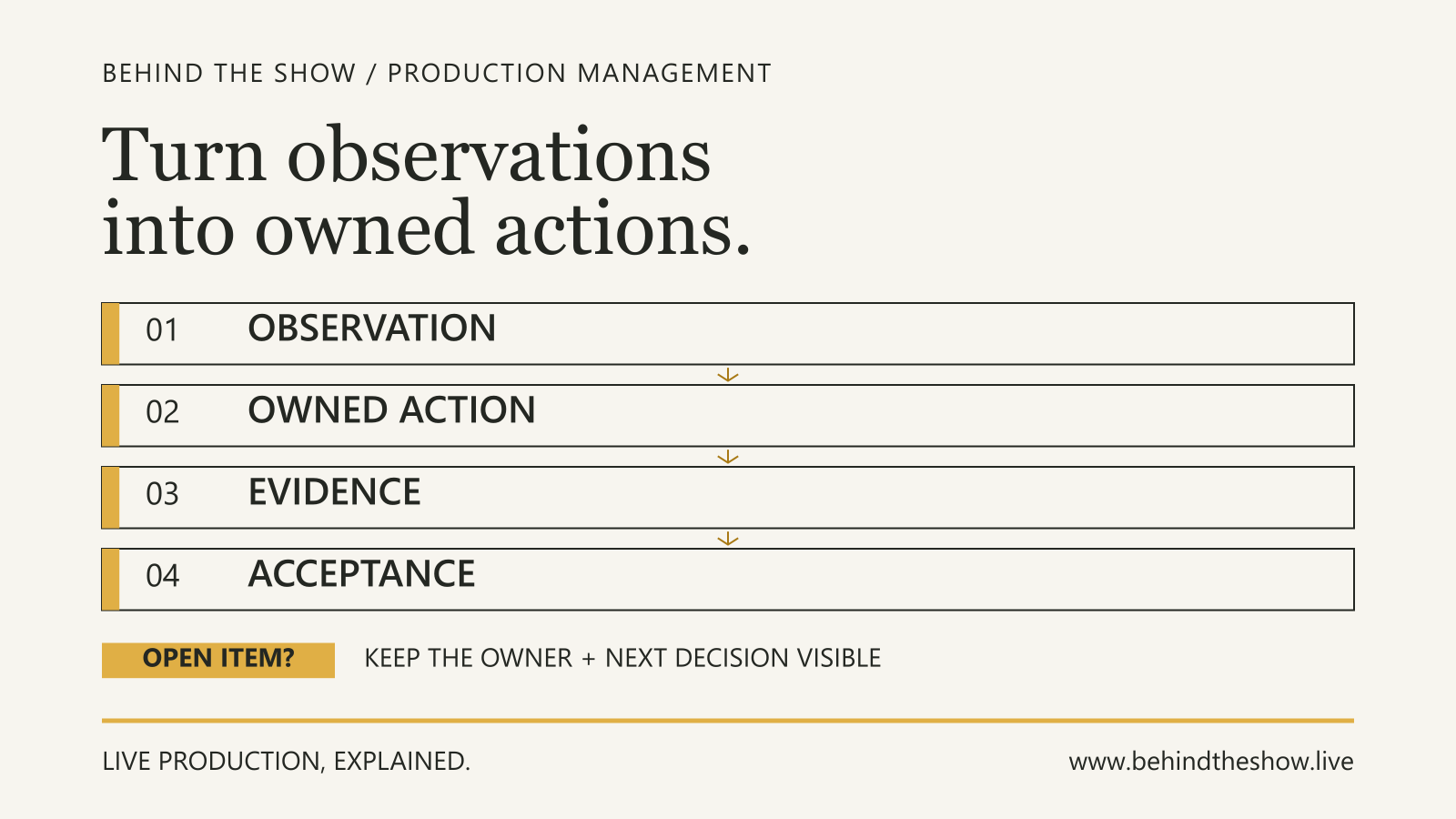
Close production actions after an event by comparing each remaining item with the agreed requirement, identifying the evidence needed and naming the person authorized to accept closure. Record evidence received separately from that acceptance, close only the scope actually accepted, and retain owners and next decisions for unresolved or contested work. Use the debrief to agree a specific improvement and carry it into the next brief or handover.
On this page
Close each agreed action against its evidence and acceptance, while keeping unresolved work and the next improvement visible.
Start with the remaining work
After the event, collect the current handover records and outstanding actions. Identify what each item concerns, what was agreed and which person or organization is responsible for the next step.
Load-out concerns recovering and moving the production. Closing the remaining actions also involves the information and decisions that follow equipment departure. A vehicle leaving and a venue handover can be separate matters, and either can leave a specific discrepancy unresolved.
Begin with the actual working record. Keep the agreed requirement identifiable alongside subsequent messages or evidence so the person reviewing an item can understand what it needs to resolve.
Give each action a closure requirement
Describe the action precisely enough for its owner to know what is needed. “Follow up with supplier” is less useful than identifying the particular discrepancy, the record needed to resolve it and the person who can accept the answer.
Agree the owner, evidence required, acceptance authority and next decision point. These functions may sit with different people. A coordinator may obtain the evidence while a venue representative or supplier contact has authority to accept closure of the relevant item.
Use the established responsibility record rather than assuming that the person receiving a message owns its resolution. If authority is unclear, keep the action open while that question is resolved.
Separate receipt from acceptance
Evidence may be an identifiable handover record, a supplier return record, a written clarification or another agreed document. Record what arrived, who supplied it, when it was received and which requirement it addresses.
Receiving the material does not establish that it answers the question. The authorized person still needs to review it against the closure requirement and record their decision. Keep the distinction visible: evidence received, review outstanding; or evidence reviewed, further information required.
When acceptance is recorded, identify the person, date, reference and scope of that acceptance. An acknowledgement that a file arrived is not the same as acceptance that the action is resolved. Silence should not be converted into agreement.
Close the accepted scope and retain the rest
An item can be partly resolved. Record the part accepted and identify the remaining question, owner and next decision separately. Do not let a broad closed label hide the remainder.
If the parties disagree, record the specific disagreement and their positions alongside the relevant evidence. Keep the next action and authorized decision route visible. A coordinator can organize the record and seek a decision without deciding a disputed matter outside their authority.
Supplier reconciliation here means comparing the agreed production scope and handover records with the returned information. If an item raises a cost, payment, contractual or legal question, route it to the authorized party and track the response. An operational closure record does not establish entitlement, liability, payment approval or a legal release.
Work through a fictional post-event record
Consider a fictional event with separate equipment-removal and venue-handover actions. A supplier provides a departure record identifying the equipment removed. The venue contact still needs to accept the agreed room handover. These are two actions in the working record.
The coordinator receives the room handover checklist. It confirms that the event furniture has been returned to the agreed arrangement, but the supplier copy and venue copy use different descriptions for the final document set. The coordinator records the discrepancy without choosing either version by assumption.
In this example, the venue contact accepts the furniture arrangement portion only. The document-set discrepancy remains open. The supplier lead must provide the version reference and the venue contact must review it against the agreed handover requirement.
| Action | Evidence and receipt | Acceptance and remaining work |
|---|---|---|
| Confirm agreed equipment removal | Supplier departure record received and identified | Named supplier lead accepts this defined removal action as closed; it does not close the venue handover |
| Confirm furniture arrangement portion of room handover | Checklist received; venue contact reviews this portion | Venue contact records acceptance of that portion only |
| Reconcile final handover document descriptions | Supplier and venue records contain different descriptions | Discrepancy remains open; supplier lead provides the version reference, then venue contact reviews it |
The coordinator does not mark the whole venue handover complete. The record identifies the accepted portion and carries the document question forward with its owner, required evidence and next review point. The example does not decide why the descriptions differ or assign fault.
| Open-item field | Fictional record |
|---|---|
| Requirement | Identify the final document set required by the agreed room handover |
| Owner | Named supplier lead to provide the version reference |
| Evidence needed | Identifiable document set and the agreed handover reference |
| Authorized acceptance | Named venue contact, for this document requirement |
| Current state | Open discrepancy; clarification requested, closure not accepted |
| Next decision point | Agreed follow-up before the coordinator issues the next closeout update |
During the debrief, the team observes that its working record did not give the supplier and venue copies a shared final document reference. That observation supports a preparation improvement, not a conclusion about the cause of every discrepancy. The production coordinator agrees to add a final-document reference field to the next event's handover record, obtain the relevant parties' agreement during advance and check that both copies use it before issue.
The learning action has its own owner and completion evidence: the revised handover record and recorded review by its users. At the end of this example, that improvement is planned and the document discrepancy is still open. Planning an improvement has not resolved the current action.
ILLUSTRATIVE SCENARIO
Debrief toward a specific next action
Start with an observation supported by the production record. State what happened before interpreting why it happened. If the cause is uncertain, keep that uncertainty rather than presenting an explanation as a finding.
Ask which practical change the team agrees to make and where it will appear. An improvement might change a field in the next brief, the timing of a confirmation or the contents of a handover. Identify the owner, the point at which it will be reviewed and the evidence showing it was put into use.
“Communicate better” gives the next team little to act on. A defined change to an agreed record or review step can be assigned and checked. Keep the improvement distinct from any unresolved item from this event.
Where a debrief requires a decision, use the approach in How to Run a Production Meeting That Produces Decisions. The purpose is an agreed next action, not merely a list of comments.
Issue the current closeout state
Share a version of the closeout record that identifies accepted closures, partial acceptances and open or contested actions. Give the relevant owners the evidence references and next decisions they need. Preserve the earlier requirement and acceptance history when an item changes.
A closeout update can be issued while work remains open. Its value is a clear account of the state of each action, not an unsupported claim that the whole production is settled.
If an owner changes, record who has accepted the ongoing action and what they need to resolve it. Keep the action visible until the authorized acceptance is recorded. The next event's improvement record should be available to the team preparing that event, with unnecessary personal or commercially sensitive detail removed for its audience.
Related questions
What should be checked before a supplier leaves?
Its agreed equipment and responsibilities, any missing or damaged items, and the status of relevant venue or production handovers.
How should production responsibilities be recorded?
Record specific requirements, named participants, delivery and approval functions, dependencies and unresolved work in a shared current plan.
What should happen when a production responsibility is unassigned?
Make the gap visible, identify who can resolve it and agree the delivery scope and timing rather than assuming another team will take it on.
Put the knowledge to work
Check your understanding
Three questions from this guide, with an explanation after each answer. Optional, untimed and just for you. Answers and scores are not saved.
Continue learning