13 min read
GUIDE / Production Management
How to Build an Event Plan
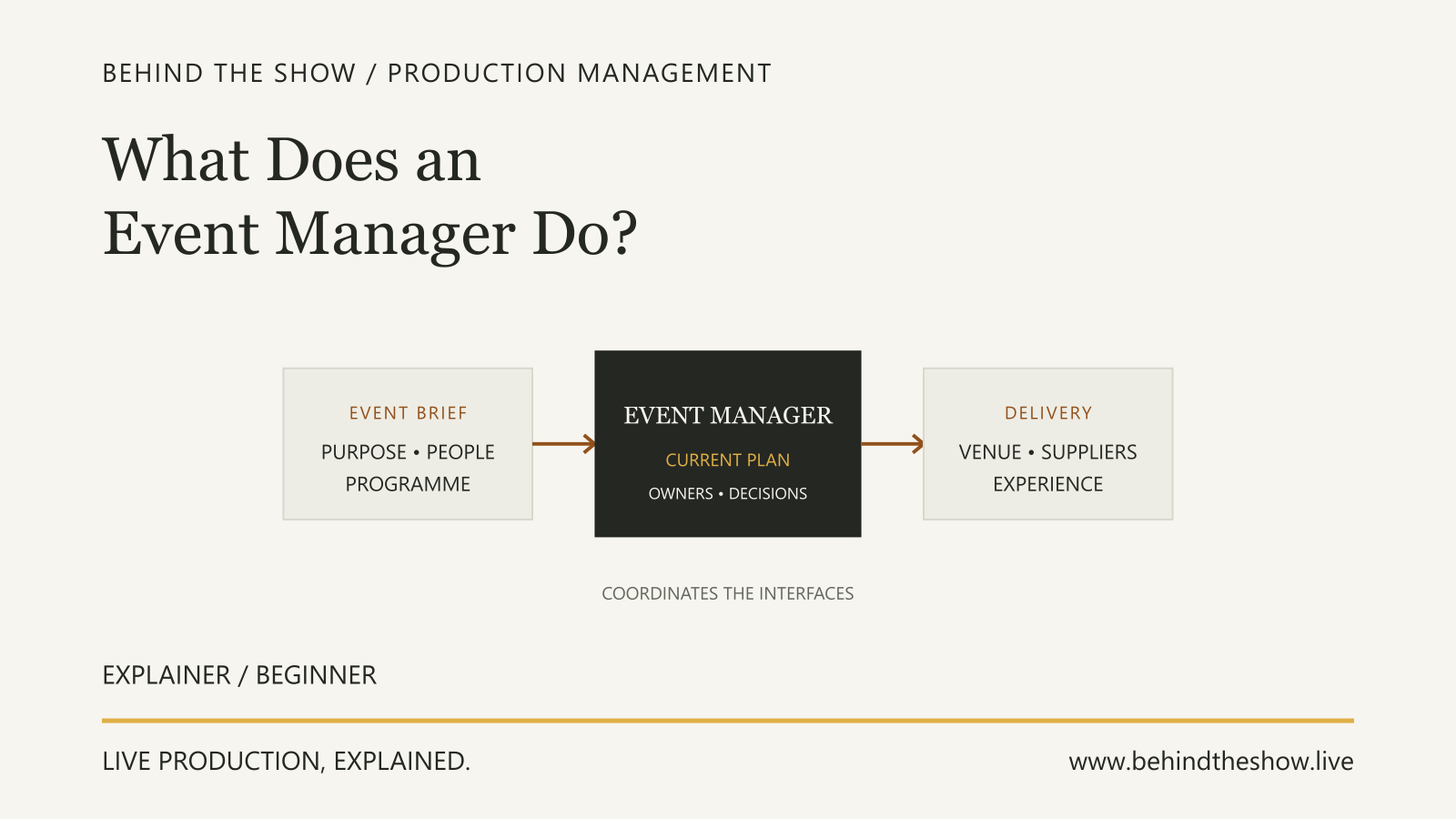
An event plan is a current record of how an event is intended to achieve its purpose. It connects the audience, programme, venue, people, suppliers, budget, production, schedule, responsibilities, approvals and unresolved questions. Build it by defining the result first, dividing the work into owned areas, recording dependencies and decisions, and linking to the specialist documents that support delivery. Keep the plan current as information changes. It should coordinate the work, not replace risk assessments, emergency plans, technical designs, contracts or specialist approvals.
On this page
A practical method for connecting an event's purpose, audience, programme, venue, budget, responsibilities, supporting documents and open decisions.
In Brief
An event plan turns an objective into coordinated work. It should tell the team what the event is trying to achieve, what has been agreed, who owns each area, what other work it depends on and what remains unresolved.
A useful plan is not simply a long list of tasks. It connects decisions. If the programme changes, the plan should show which venue, participant, supplier, production, schedule, communication and budget arrangements need review.
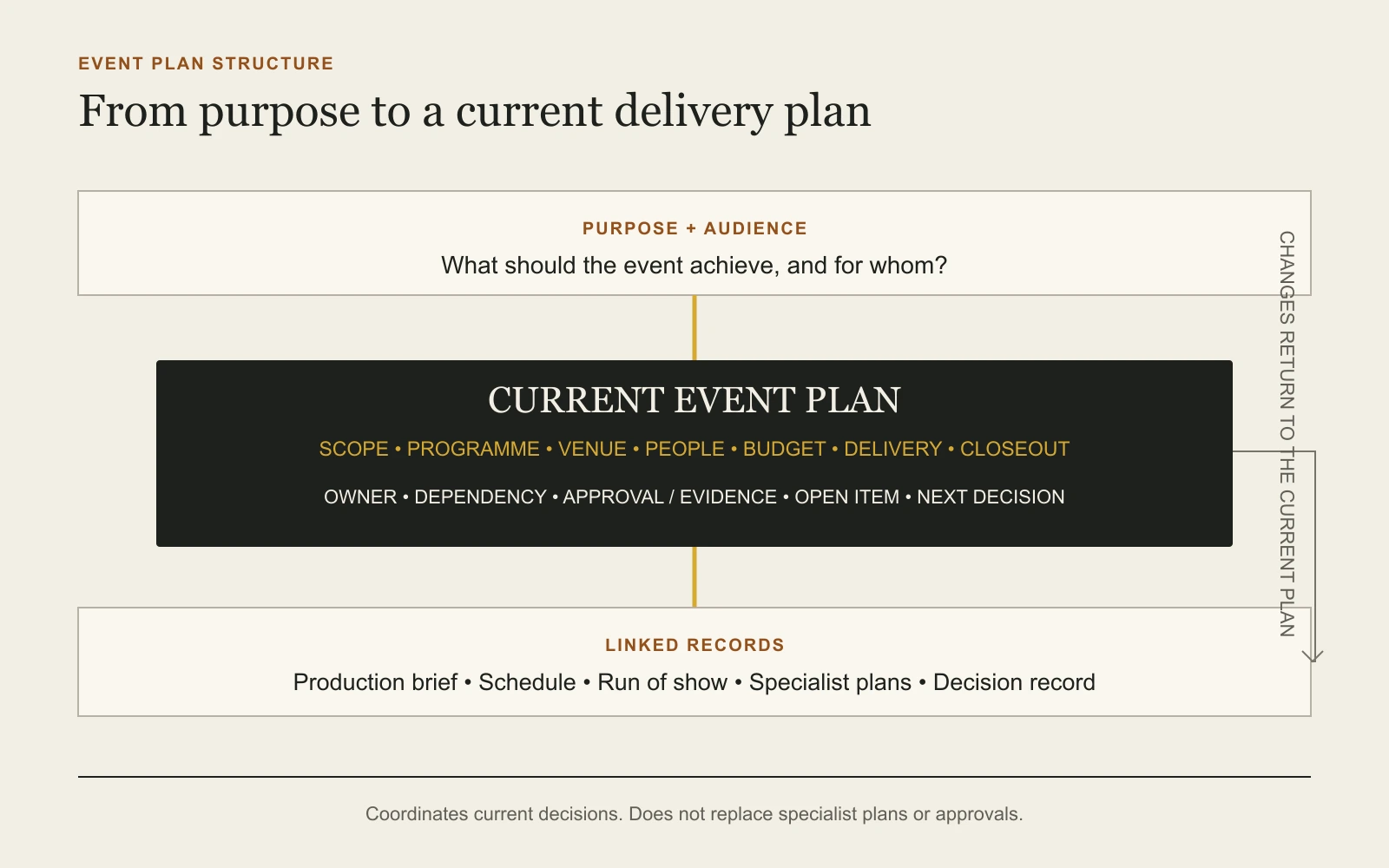
The plan can be one controlled document with linked records, or a structured set of connected documents. The format matters less than whether the team can identify the current arrangement and the decisions still needed.
Start With the Event Purpose
Write down why the event exists before listing equipment, rooms or suppliers.
The purpose might be to launch a product, hold an annual meeting, teach a subject, recognise employees, host a public programme or bring a professional community together. Record the intended audience and the result the organiser wants from their participation.
Use language that can guide decisions. “Annual conference” describes a format. “Help regional teams understand the new strategy and leave with actions for the next quarter” gives the programme, communication and production teams something more useful to plan around.
Not every objective can be reduced to one number. Separate intended results from the evidence that may later be available. Registration, attendance, completed sessions, participant feedback and agreed follow-up actions measure different things.
Define Scope and Boundaries
State what the plan covers. Include the event dates and locations, expected attendance, programme format, public or private status, participant groups and the preparation and closeout periods that matter.
Also record what sits outside the current scope. A conference plan might include the plenary, breakouts and reception while excluding independently organised travel. A venue may provide security at public entrances but not backstage credential control. An event plan becomes misleading when an unassigned responsibility is hidden by a broad label such as “venue,” “production” or “organiser.”
Record assumptions as assumptions. Expected attendance is not confirmed attendance. A proposed room is not a contracted room. A supplier quotation is not an agreed scope until the relevant commitments and approvals are clear.
Build the Plan Around Workstreams
Divide the event into areas that can be owned and reviewed. Depending on the event, these may include:
- audience, registration and attendee communication;
- programme, speakers, artists or participants;
- venue, access, rooms and hospitality;
- production and technical delivery;
- suppliers and contracted services;
- staffing, crew and volunteers;
- budget, approvals and purchasing;
- accessibility and participation arrangements;
- safety, security, welfare and emergency planning;
- marketing, media, recording or streaming;
- event-day operation and communication;
- load-out, venue handover and closeout.
The categories are not a universal department structure. Combine or separate them to suit the event. The useful test is whether each requirement has an owner, a decision route and a visible relationship to the other work it affects.
Record Responsibilities and Decision Authority
For each workstream, identify who coordinates it, who supplies information, who performs the work, who checks the result and who can approve a change.
One person may hold several roles on a small event. A larger event may divide them across an organiser, Event Manager, venue, agency, Production Manager, suppliers and specialists. Titles alone do not prove authority.
Use the BTS responsibility guide to distinguish coordination, delivery, checking and acceptance. The person maintaining the event plan does not automatically become the person qualified to approve structural, electrical, technical or safety-critical work.
Connect the Programme to the Audience Journey
The programme describes what participants are expected to experience over time. The audience journey includes how they receive information, arrive, register, find the right space, participate, take breaks, move between activities and leave.
Review the programme and journey together. A short turnaround between sessions may affect room reset, speaker movement, attendee movement, accessibility support, catering, content changes and production cues. A remote participant may need preparation, a receiving arrangement and a recovery decision, not merely a video-call link.
Record the current programme at the level needed for wider planning. The detailed running sequence can live in the run of show. The event plan should link to that current document rather than copy an uncontrolled version into several places.
Confirm the Venue and Access Conditions
Connect the event requirement to the actual venue conditions. Record the rooms and areas required, capacities or agreed limits, access periods, loading arrangements, audience routes, participant routes, available services, restrictions and required venue decisions.
Use the venue information guide to separate confirmed information from assumptions and unanswered questions. A venue brochure can support initial selection, but it may not establish the operating conditions needed for the final event.
Where permits, licences, local authority submissions or venue approvals may apply, identify the relevant jurisdiction and obtain appropriate local advice. Do not copy a requirement from another event or country and present it as universal.
Build a Budget From Commitments
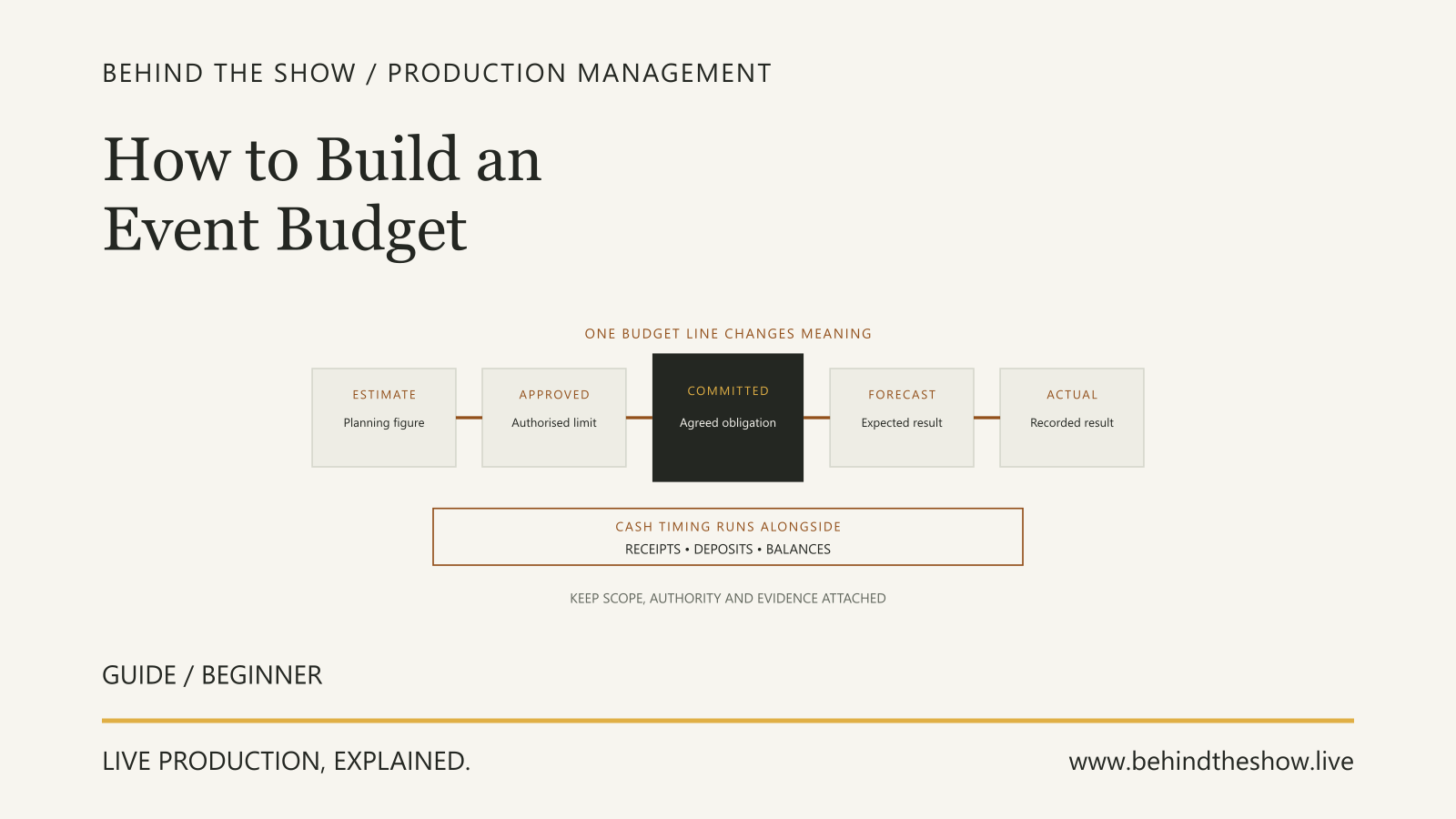
An event budget should connect money to scope. Record the expected cost, approved allowance, committed amount, actual cost where known, approval owner and relevant assumptions for each area.
A reduced cost may also reduce the agreed result. Removing rehearsal, crew time, an accessible service, a backup arrangement or an event-day role can change delivery. Make that consequence visible before the saving is approved.
Use the BTS quotation comparison guide when supplier responses describe different commitments. Comparing totals without reconciling scope does not create a reliable budget decision.
Create Milestones Before Detailed Timings
Begin with the decisions and deliveries that must happen before other work can proceed. Examples include venue confirmation, programme approval, participant confirmation, supplier appointment, content deadlines, production advance, final attendee information, rehearsal and readiness review.
Give each milestone an owner and a decision date. Identify the consequence of missing it. A “final presentation deadline” is weak if the plan does not say who accepts the file, what checks remain possible and what happens when a revision arrives later.
The production schedule should contain the detailed operational timeline for access, build, checks, rehearsals, doors, show operation, strike and load-out. The event plan should connect that timeline to the wider event milestones and decisions.
Link Specialist Plans Instead of Absorbing Them
The event plan should identify the specialist records required and their owners. Depending on the event and jurisdiction, these may include risk assessments, emergency arrangements, medical, security, crowd, fire, traffic, weather, accessibility, temporary structure, electrical, rigging or food-safety documentation.
Do not turn a general planning guide into a substitute for competent specialist work. The event plan can record that a document is required, who owns it, its status, the approval route and the implications of an unresolved condition. It does not create the evidence by declaring the item complete.
The UK Health and Safety Executive advises that event planning detail should be proportionate to event scale and risk, that safety responsibilities should be understood and that incidents and emergencies should be planned for. Those principles support the need for explicit ownership and linked specialist plans. They do not make this BTS guide a safety plan or jurisdiction-specific compliance checklist.
Make Accessibility Part of the Plan
Ask speakers and participants about access requirements early enough for arrangements to be developed with them and the relevant providers. Accessibility may affect venue routes, seating, stage access, breaks, materials, interpreting, captioning, assistive listening, remote participation and communication.
W3C guidance recommends considering accessibility during initial event planning, asking speakers and participants about their requirements and coordinating materials and services in advance. Use that as a planning prompt, not as proof that a particular event is accessible.
Record who will confirm the requirement, who will coordinate provision, what the participant or provider needs to receive and how the relevant arrangement will be checked.
Keep Decisions and Open Items Visible
An open item needs more than a red status. Record:
- the question or unresolved condition;
- why it matters;
- the person responsible for the next action;
- the information, evidence or approval needed;
- the decision authority;
- the next decision point;
- the affected plan if the answer changes.
Do not hide a missing decision inside meeting notes. Move the current result into the event plan or its controlled decision record.
Use version information that helps the team identify the current state, such as an issue number, date, owner and change note. When a change affects another controlled document, update or reference that document rather than silently leaving conflicting instructions in circulation.
Worked Example: Registration Exceeds the Planned Room Capacity
A one-day professional forum is planned for 180 participants. It includes a plenary session, two breakout rooms and an evening reception. Three weeks before the event, confirmed registrations reach 230. The original ballroom layout cannot simply absorb the additional people within the venue's agreed arrangement.
The Event Manager records the issue in the current event plan and asks the affected owners to review options. The Event Manager does not declare a new capacity, instruct a technical redesign or assume that a second room is operationally ready.
The revised plan links to the updated programme, production schedule, room layout, participant communication, production records, staffing call and readiness review. Each responsible team checks its own result.
During rehearsal, the relay works in both rooms, but an audience question from the overflow room is not heard in the ballroom. The issue remains open. The audio and production teams review the relevant paths and propose an adjusted question arrangement. The programme owner confirms that questions from both rooms remain part of the intended format.
The exchange is repeated from the overflow microphone through the moderator's response and back to both audiences. The relevant teams report the checked result. The Event Manager updates the current plan and attendee instructions. The authorised organiser accepts the revised opening arrangement within the agreed venue and budget conditions.
The event plan did not solve every department's work. It made the change, dependencies, decisions, evidence and remaining conditions visible to the people responsible for solving them.
ILLUSTRATIVE SCENARIO
Use the Plan During Delivery
Before the event opens, review the current plan against the latest checked results and open items. The production readiness guide explains how to distinguish reported completion, evidence and accepted scope.
During the event, use the agreed communication and decision routes. Do not let the event plan become a parallel cue channel. The run of show, show caller, Stage Manager, Production Manager and other operating roles retain their defined functions.
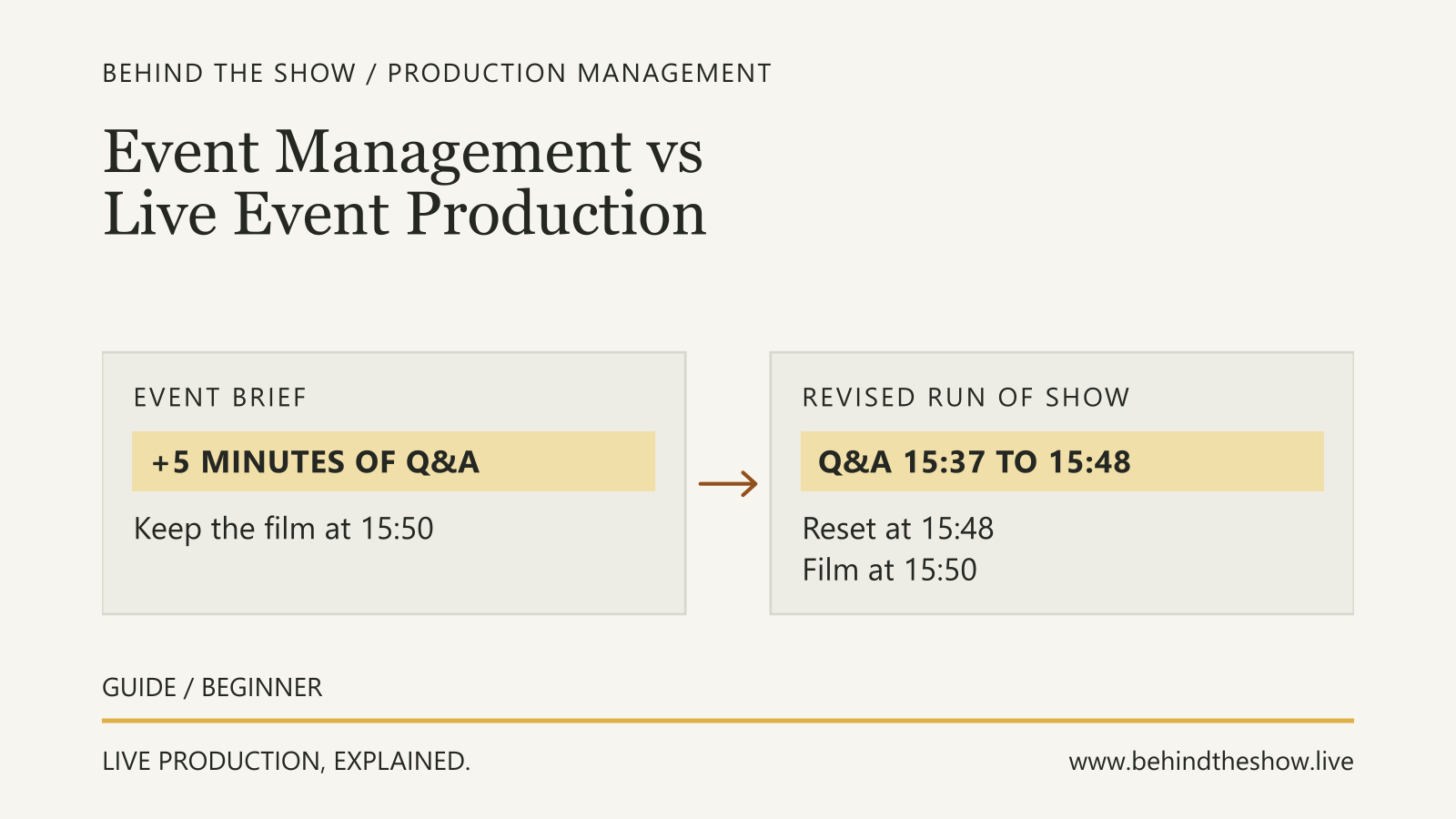
When a material change is approved, record what changed, who approved it, which documents or teams are affected and what must be rechecked. A spoken instruction can be necessary in the moment, but the controlled record should catch up while the information still matters.
Close the Plan After the Event
An event is not fully closed merely because the audience has left. Record venue handover, supplier records, equipment or damage issues, financial commitments, attendee feedback, unresolved actions and lessons that have an owner.
Separate completed load-out, venue clearance, financial closure and action closure. The BTS closeout guide explains how evidence and acceptance authority can carry an unresolved item to a documented conclusion.
Review the event against the purpose recorded at the beginning. Distinguish observed results from assumptions. Attendance data, participant feedback, delivered programme, incidents, budget result and open actions each describe a different part of the outcome.
What Makes an Event Plan Useful?
A useful event plan is:
- connected to a clear purpose and audience;
- current enough to guide decisions;
- explicit about responsibilities and authority;
- linked to supporting specialist documents;
- honest about assumptions and unresolved conditions;
- structured around dependencies, not isolated tasks;
- usable during preparation, delivery and closeout;
- proportionate to the event's scale and complexity.
The plan is successful when the people delivering the event can find the current arrangement, understand what they own and identify which decisions still stand between the brief and a workable event.
Related questions
What is an event plan?
An event plan is a current record of how an event is intended to achieve its purpose. It connects the audience, programme, venue, people, suppliers, budget, production, schedule, responsibilities, approvals and unresolved questions.
What should an event plan include?
Include the event purpose, audience, scope, programme, venue, workstreams, responsibilities, budget, milestones, supporting specialist plans, approvals, assumptions, open items, readiness and closeout arrangements. The detail should suit the event.
Who prepares an event plan?
An Event Manager, organiser or another authorised coordinator may maintain it, with information and decisions supplied by the people responsible for each area. Maintaining the plan does not transfer specialist authority to that person.
When should event planning begin?
Begin while the purpose, audience, format, venue, budget and delivery approach can still be shaped. Update the plan as decisions, constraints and responsibilities become clearer.
Is an event plan the same as an event management plan?
The terms may overlap, but usage varies. An event plan can mean the current coordinating record for the whole event, while an Event Management Plan may be a defined document required by a venue, authority or organisation. Confirm the intended scope rather than relying on the title.
How should changes be recorded in an event plan?
Record what changed, why it matters, who approved it, which work or documents are affected, what remains unresolved and what must be checked again. Use issue information so the team can identify the current plan.
How detailed should an event plan be?
Use enough detail to make the current arrangement, responsibilities, dependencies, approvals and open items clear. The depth should reflect the event's scale, complexity, risk and stakeholder needs.
Does an event plan replace risk assessments or emergency plans?
No. It can identify and link the required specialist plans, their owners, status and decision routes. It does not replace competent risk assessment, emergency planning, technical design, contracts or required approvals.
Sources & references
- Getting started: Event safetyUK Health and Safety Executive / primary document
- Planning for incidents and emergenciesUK Health and Safety Executive / primary document
- Making Events Accessible: Checklist for meetings, conferences, training, and presentations that are remote/virtual, in-person, or hybridWorld Wide Web Consortium, Web Accessibility Initiative / primary document
Continue learning