12 min read
GUIDE / Production Management
How to Build an Event Budget
Build an event budget by listing the income and expenditure connected to the current event plan, assigning an owner and approval status to each line, and separating estimates from approved allowances, commitments, forecasts and actual amounts. Record assumptions, taxes or fees where relevant, payment timing, contingency authority and material variances. Update the budget when scope or information changes. A budget should show the financial consequence of the event plan, not hide a scope change inside a revised total.
On this page
A practical method for connecting event scope to income, expenditure, approvals, commitments, forecasts, cash timing and actual results.
In Brief
An event budget is a working financial record for the event. It connects the current event plan to expected income, planned expenditure, approved limits, contracted commitments, cash timing and actual results.
A useful budget answers more than “What is the total?” It shows what the total includes, which figures are still estimates, what has been approved, what has been committed, what could still change and who can make the relevant decision.
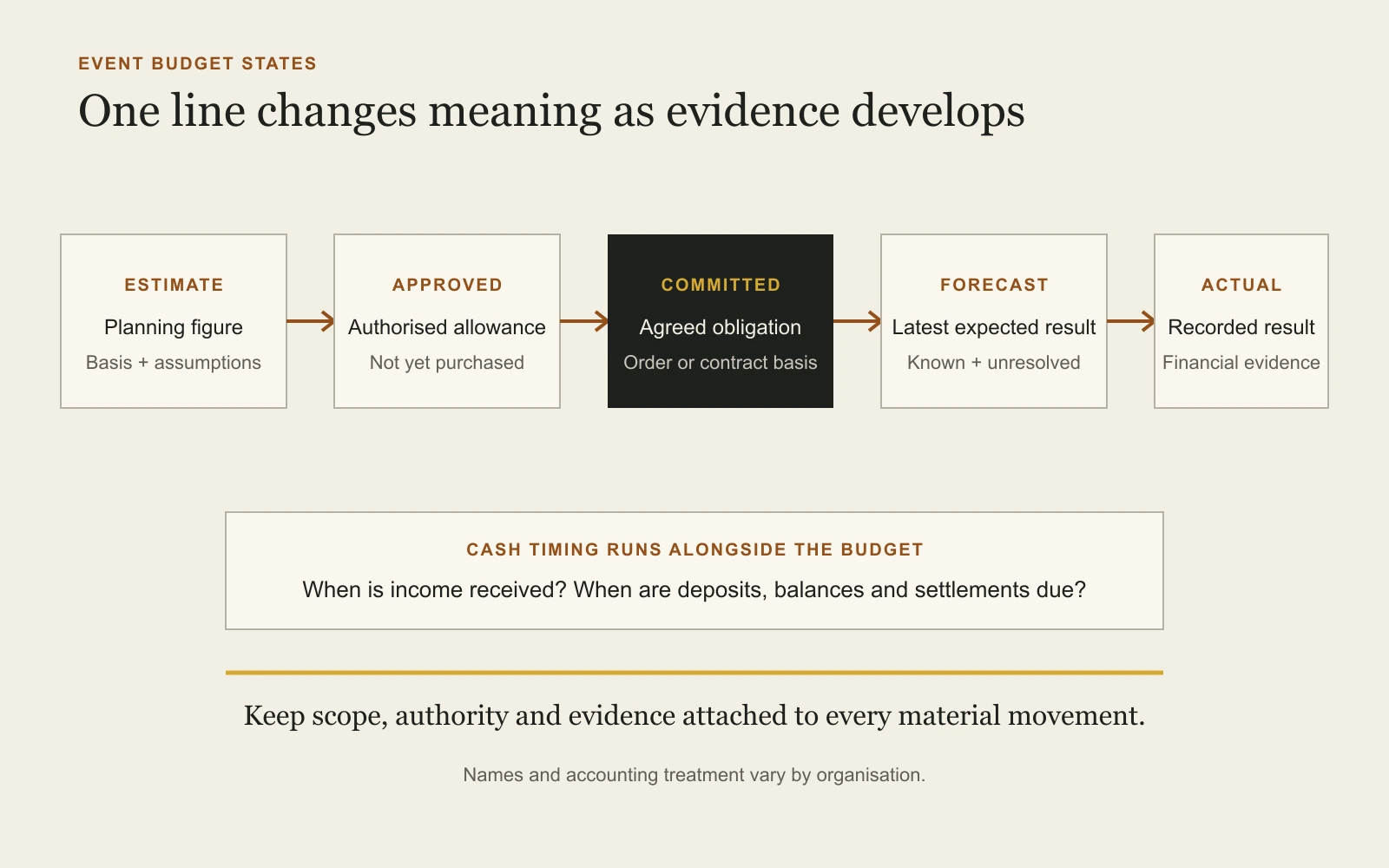
The budget should develop with the event. Early figures may support feasibility. Later versions should reflect quotations, contracts, approved changes, invoices and closeout. Keep the current version identifiable so that an outdated total does not become a new planning assumption.
Start With the Current Event Plan
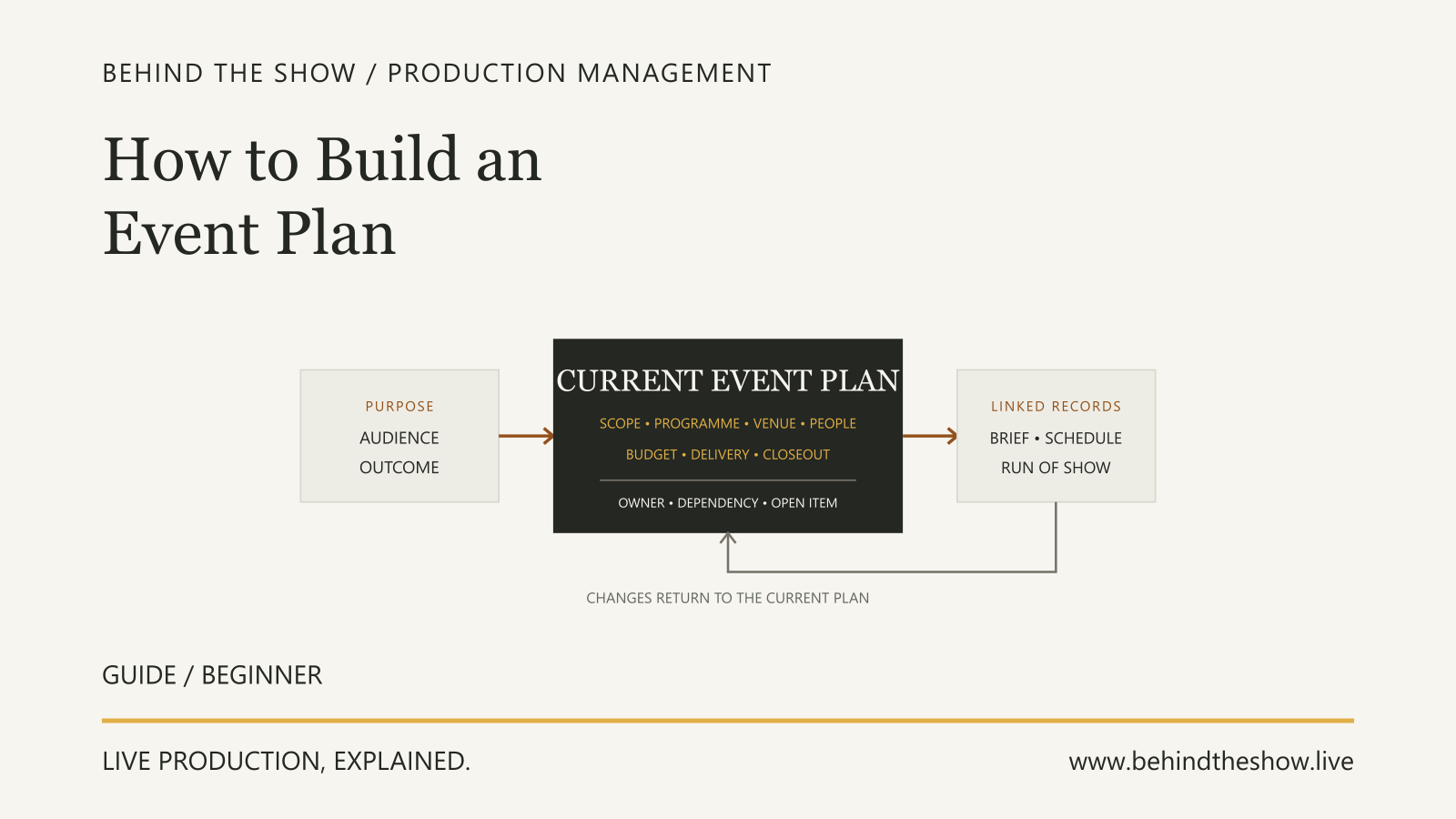
Before building cost lines, understand the event purpose, audience, scope, programme, venue, dates and delivery approach.
Use the Event Plan guide to make the current arrangement, owners and open decisions visible. The budget should then represent that plan financially.
If the budget assumes one ballroom, 300 attendees and a single programme stream, record those assumptions. When attendance, rooms or programme change, identify which budget lines require review. A total copied forward without its assumptions can create false certainty.
Separate Income From Expenditure
Record expected income and expenditure separately.
Income may include an organiser allocation, ticket revenue, sponsorship, grants, exhibitor fees, donations or other approved funding. Expenditure may include venue, production, catering, staffing, speakers or artists, travel, accessibility provision, marketing, registration, security, insurance, permits, transport, accommodation, waste, recording or other event requirements.
Not every category applies to every event. Do not add a line merely because it appears in a template, and do not omit a requirement because it lacks a convenient category.
Show whether income is confirmed, conditional or forecast. A sponsorship conversation is not confirmed income. Ticket capacity multiplied by ticket price is not the same as collected revenue.
Use Budget Lines That Preserve Scope
A budget line should be specific enough to show what the money supports. “Production” may be too broad if it hides several suppliers, working periods or deliverables. “Venue” may conceal room hire, access hours, furniture, power, cleaning or security.
The correct level of detail depends on who uses the budget and which decisions it must support. A summary can group lines for reporting while a controlled working sheet retains the detail needed for scope review.
Useful fields can include:
- category and line description;
- related scope or deliverable;
- quantity or assumption where useful;
- estimated amount;
- approved allowance;
- committed amount;
- current forecast;
- actual amount;
- income or expenditure status;
- tax, fee or currency note where relevant;
- payment timing;
- owner and approval authority;
- source document, such as a quotation or contract;
- variance and explanation;
- unresolved condition or next decision.
The budget should not become a substitute for the quotation, contract or purchase record. Link the current source instead of copying an uncontrolled summary and losing exclusions or assumptions.
Estimate, Approved Allowance, Commitment, Forecast and Actual
These values answer different questions.
Estimate is the best available planning figure before the final commitment is known. Record its basis, date and important assumptions.
Approved allowance is the amount authorised for that scope under the event's financial process. It does not prove that a supplier has been appointed or that the final cost will equal the allowance.
Committed amount is the financial commitment created by an approved order, contract or equivalent arrangement. The exact point at which an organisation recognises a commitment depends on its process.
Current forecast is the latest expected final amount, including known commitments and reasonable estimates for unresolved costs.
Actual amount is the amount recorded after the relevant invoice, payment, revenue or accounting evidence is available. Confirm the organisation's accounting treatment rather than assuming that an invoice, payment and recognised expense are always the same event.
Keeping these columns separate prevents an early estimate from being mistaken for approval and prevents an approved budget from being treated as money already spent.
Record Assumptions and Exclusions
Every material estimate has a basis. It may depend on attendance, programme duration, venue access, supplier hours, travel dates, exchange rates, taxes, consumption, ticket sales or participant requirements.
Record assumptions close to the affected line. A catering estimate based on 250 guests needs review when registrations reach 320. A production quotation based on a ten-hour day needs review when access or programme changes extend the working period.
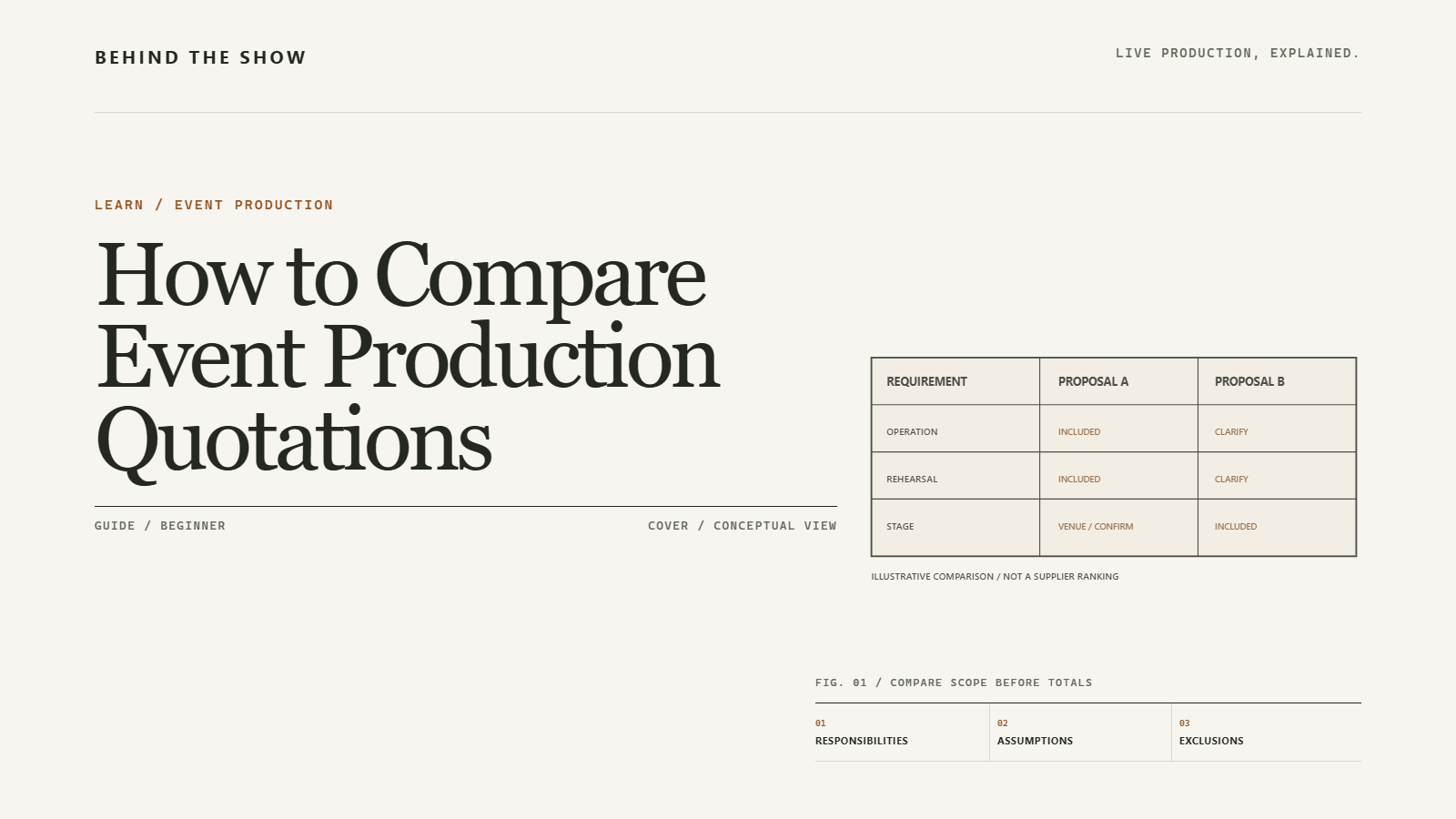
Use the production-quotation comparison guide to compare commitments and exclusions before comparing totals. A lower quotation does not create a saving when it covers less work.
Connect Budget Changes to Scope Decisions
When a line changes, identify why.
The cause may be:
- new or expanded scope;
- a clarified requirement;
- a supplier substitution;
- attendance or programme change;
- changed venue conditions;
- revised dates, hours or quantities;
- tax, fee, travel or currency change;
- an error or omitted requirement;
- movement from estimate to confirmed commitment.
Do not describe every increase as an overrun. A cost can increase because the approved event scope increased. Conversely, a lower cost may reflect reduced scope, transferred responsibility or a missing requirement.
Record the decision that accompanies the financial change. If the organiser accepts an additional deliverable, identify its funding and approval. If scope is removed to remain within the budget, record what result or responsibility changed.
Track Contingency Without Treating It as Free Money
Contingency is an approved financial allowance for uncertainty within defined authority. It is not evidence that every new idea is funded.
The appropriate amount and use depend on the event, uncertainty, risk, organisational policy and stage of planning. This guide does not prescribe a percentage.
Record:
- the contingency amount or method;
- what it is intended to cover;
- who may approve its use;
- which uses require escalation;
- committed and remaining amounts;
- whether its use changes event scope or risk treatment.
An unexpected cost may reveal that the original scope was incomplete. Record that cause rather than hiding it under contingency. A safety-critical or required accessibility measure should not be omitted merely because a general contingency line is exhausted; the event plan and authorised decision-makers need to address the unresolved requirement.
Budget and Cash Flow Are Different
A budget can show a viable final result while the event still lacks cash at the time invoices or deposits are due.
Record when income is expected and when payments are required. Identify deposits, milestone payments, ticket-settlement dates, grant or sponsorship conditions, refunds, retention or final invoices where relevant.
The NSW Government Event Starter Guide distinguishes the event budget from cash-flow planning and recommends considering how pre-event bills will be paid before event income arrives. This is a useful planning distinction, not a universal accounting method.
Refer cash-flow, tax, revenue recognition and accounting questions to the organisation's finance professional or qualified adviser.
Give Every Financial Decision an Owner
Identify who may:
- approve the original budget;
- approve a line or purchase;
- sign a contract or order;
- accept a scope change;
- release contingency;
- move money between lines;
- accept a variance;
- confirm final closeout.
These authorities may be held by different people. An Event Manager may maintain the working budget and explain consequences without having authority to approve every commitment.
Suppliers should provide accurate financial and scope information within their responsibilities. The organiser or budget owner decides whether an event-level commitment is accepted. Technical, safety and specialist approvals remain with the relevant competent people even when a budget owner accepts the cost.
Keep a Current Forecast
Compare the approved budget with commitments, unresolved estimates and actual amounts throughout planning.
The New Zealand Qualifications Authority event-management unit standard describes producing a budget with sources and uses of funds, defining financial responsibilities, and monitoring and updating the budget while informing stakeholders of variances. This supports the planning principle. It does not impose a global accounting standard.
Use a current forecast to show the expected result if the event proceeds under the latest known conditions. Explain material movement rather than reporting only a changed total.
Useful variance explanations include:
- “attendance forecast increased from 250 to 320”;
- “venue access extension approved after programme revision”;
- “recording deliverable added with sponsor funding”;
- “final invoice includes the approved additional crew call”;
- “estimate replaced by contracted amount with no scope change.”
Worked Example: A Sponsor Requests an Edited Event Film
A professional association has approved a one-day conference budget of 100,000 currency units. The programme, venue and in-room production are agreed. The sponsor then asks for the keynote and panel to be recorded, followed by a short edited film for later publication.
The request is not added to the production line without review. Recording, post-production, rights, approvals, delivery dates and sponsor use were not in the agreed scope.
First budget review
The production supplier returns a separate proposal of 8,000 for the recording and edit, subject to a confirmed content brief, rights, review rounds and delivery date. The Event Manager records the proposal and its assumptions. The supplier has not been appointed merely because the figure appears in the budget.
The sponsor offers an additional 6,000 if the agreed film carries specified sponsor recognition. The organiser reviews whether that condition fits the event and publication plan. The budget owner does not use the full contingency automatically, because other event uncertainties remain open.
Approved revision
The authorised organiser approves the recording deliverable and sponsor condition. The sponsor contribution is recorded as conditional income until the agreement is confirmed. The budget owner approves 1,000 of existing forecast headroom and 1,000 from contingency for the remaining amount.
The budget is not treated as final at this point. Once the sponsor variation and supplier appointment are complete, the relevant amounts move from conditional or approved to committed. The current forecast remains visible.
After the event, the supplier's approved invoice is 8,000 and the sponsor contribution is received as agreed. The budget records the actual amounts, preserves the change approval and keeps any unrelated remaining contingency separate. The closeout report explains that the increased total came from an approved additional deliverable with identified funding, not an unexplained production overrun.
ILLUSTRATIVE SCENARIO
Review the Budget Before Committing
Before approving a commitment, confirm:
- the requirement and current scope;
- the relevant quotation, assumptions and exclusions;
- the approved allowance and available funding;
- the person authorised to commit the organisation;
- payment timing and conditions;
- tax, fee and currency treatment where applicable;
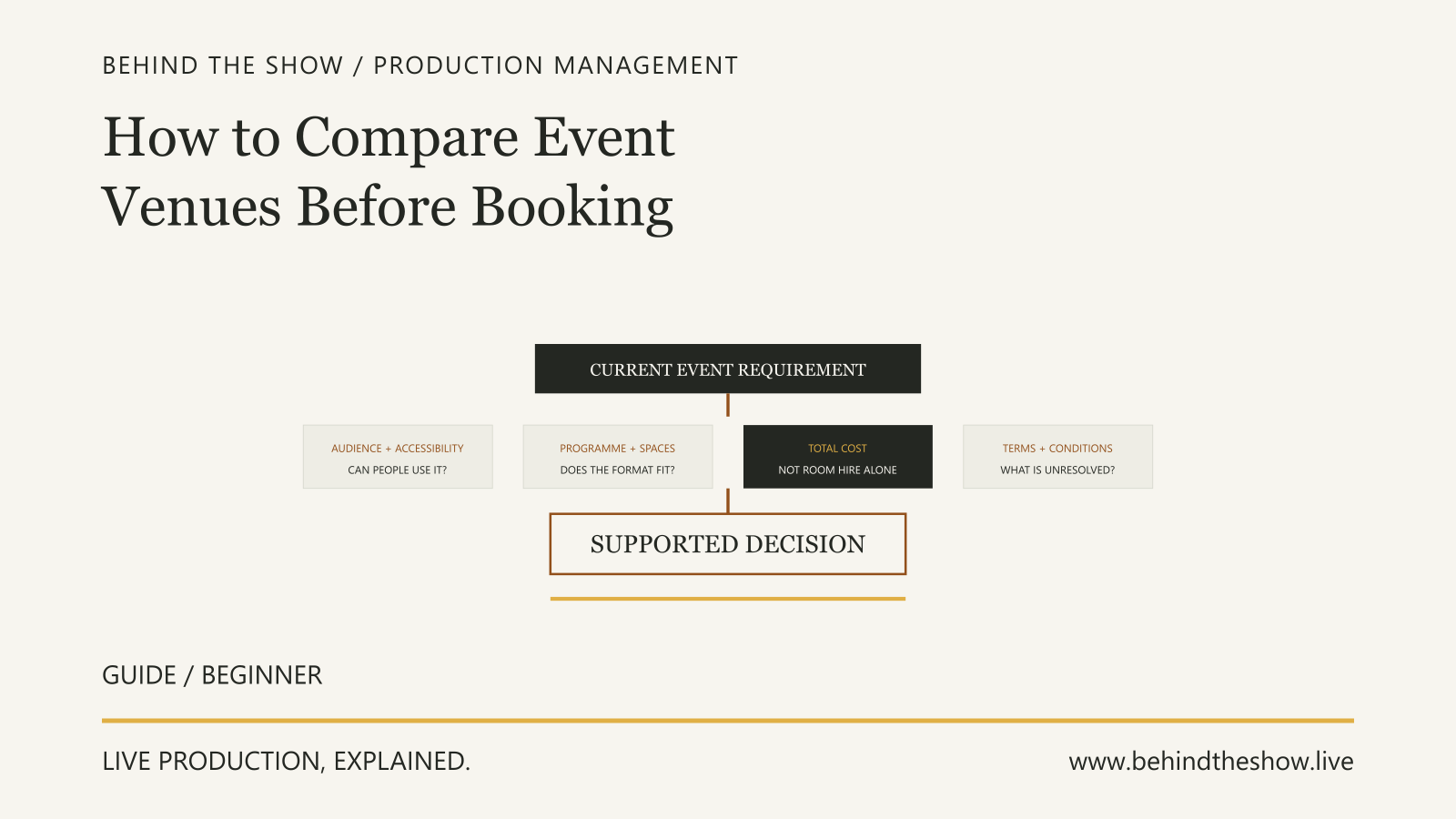
- related venue, production, programme or participant decisions;
- any required specialist approval;
- how the line affects the current forecast and contingency.
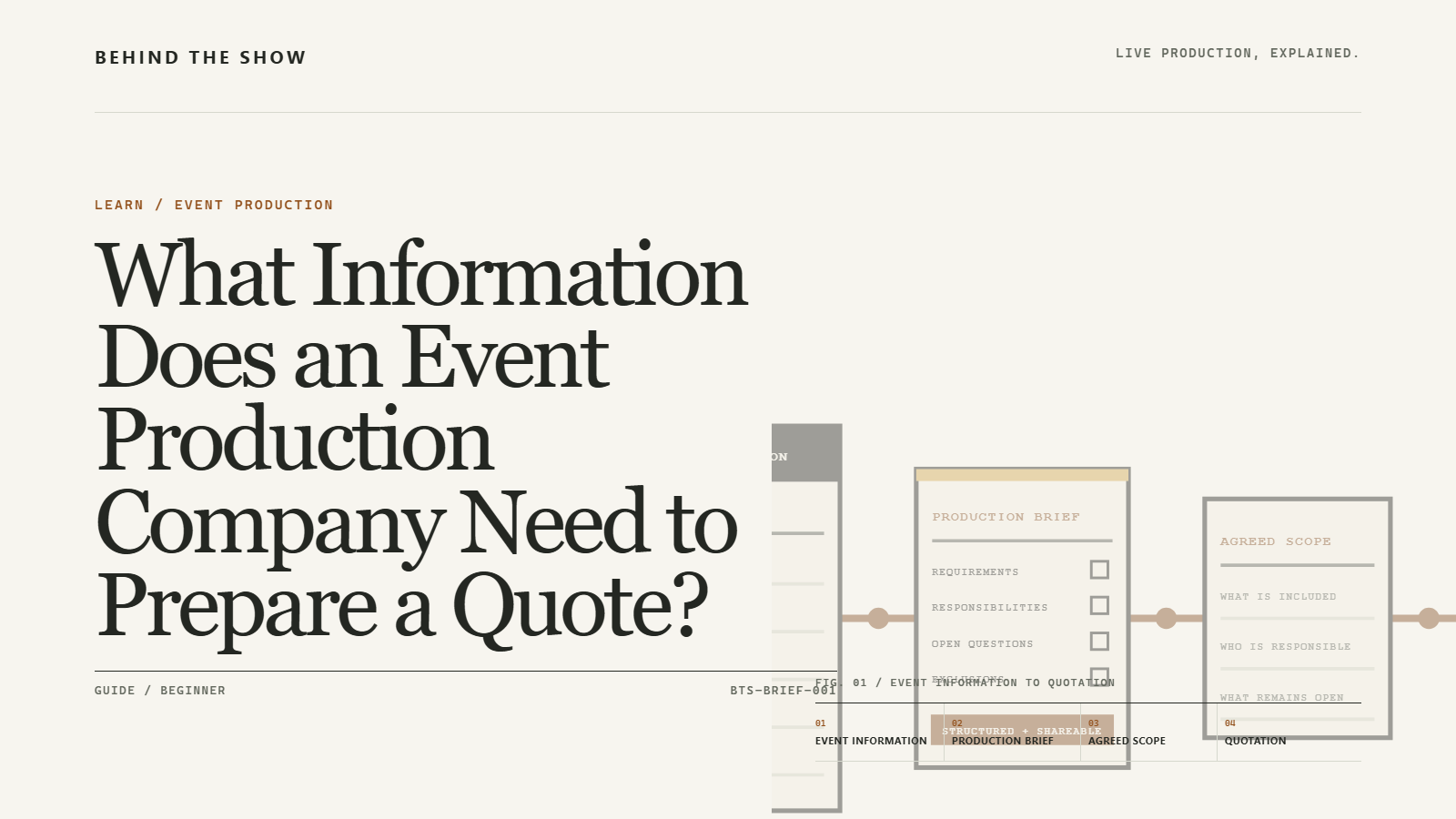
The production-quote briefing guide helps provide suppliers with enough information to prepare a useful response. The Event Production Brief Builder can document known requirements and unknowns without selecting a supplier.
Close the Budget After the Event
Do not treat the event-day total as final before outstanding invoices, credits, refunds, ticket settlements, sponsor payments or disputed items are resolved.
Reconcile the working budget with the organisation's financial records. Record actual income and expenditure using the accounting evidence and methods required by that organisation. Keep open actions visible with owners and expected resolution dates.
The UK Government's voluntary-event guide recommends separating takings by source and reviewing the event afterwards to improve the next budget. This supports the learning principle for that context. Larger or commercial events may require different controls and professional accounting support.
Review which assumptions were accurate, which costs changed with scope, which commitments arrived late and which categories need better evidence next time.
What Makes an Event Budget Useful?
A useful event budget:
- follows the current event scope;
- separates income and expenditure;
- distinguishes estimates, approvals, commitments, forecasts and actuals;
- records assumptions and source documents;
- shows payment timing as well as final totals;
- identifies authority for changes and contingency;
- explains material variances;
- remains current through preparation and closeout;
- supports decisions without replacing contracts or financial records.
The budget is useful when the team can understand what the event currently costs, what has been authorised, what is already committed, what could still change and who can decide what happens next.
Related questions
What is an event budget?
An event budget is a working financial record that connects the current event plan to expected income, planned expenditure, approved limits, commitments, forecasts, payment timing and actual results.
What should an event budget include?
Include expected income and expenditure, scope assumptions, estimates, approved allowances, commitments, current forecasts, actual amounts, payment timing, owners, approval authority, source documents, contingency and material variances.
When should an event budget be created?
Create an initial budget while the event's purpose, scope and feasibility are being considered. Update it as the venue, programme, attendance, suppliers, funding and other requirements become clearer.
What is the difference between an estimate, budget, commitment and actual cost?
An estimate is a planning figure. An approved budget authorises an allowance under the organisation's process. A commitment follows an approved order, contract or equivalent arrangement. An actual cost is recorded from the relevant financial evidence after delivery or billing.
Should an event budget include contingency?
Where the organisation approves one, contingency can provide an allowance for defined uncertainty. Record its purpose, amount or method, approval authority, uses and remaining balance. There is no universal percentage for every event.
Is an event budget the same as cash flow?
No. A budget describes expected income and expenditure, while cash-flow planning considers when money will be received and when payments become due. An event can appear viable overall but still face a timing shortfall.
Who can approve changes to an event budget?
The organisation should define who may approve the budget, commitments, transfers, contingency use and variances. An Event Manager may maintain the record without holding authority to approve every financial or specialist decision.
When is an event budget final?
It is ready for closeout when relevant invoices, credits, refunds, settlements, income and disputed items have been resolved or clearly handed over, and the working record has been reconciled with the organisation's financial records.
Sources & references
- 11650 Plan, implement and evaluate a business conference, event, or functionNew Zealand Qualifications Authority / primary document
- Documentation for your public and outdoor eventNSW Government / primary document
- The can-do guide to organising and running voluntary and community eventsUK Government / primary document
Continue learning