12 min read
EXPLAINER / Event Production
How Is Power Planned for a Live Event?
Power planning for a live event begins by identifying what needs electricity, where and when it will operate, what supply information is available, and who is responsible for each part of the system. Production teams provide current requirements. The venue and electrical specialists establish what can be supplied, how it will be distributed, what checks and records are required, and who can authorize connection or use. Unknowns and changes remain visible until the responsible people resolve them. This guide explains the information, responsibilities and decisions needed to plan event power. It does not design an electrical system or replace a competent electrical contractor, the venue's authorized electrical representative, applicable standards or local law.
On this page
Learn how live-event power requirements, venue supplies, responsibilities, timing and evidence become a coordinated specialist-reviewed plan.
Power Is a Production Requirement and a Specialist System
Sound, lighting, video, staging systems, communications, catering, registration and other event functions may all depend on electricity. Their requirements do not become a safe or workable system merely because each supplier brings equipment.
Production planning asks:
- what needs power; - where it will operate; - when it will operate; - which functions may run at the same time; - what supply information is available; - who provides each part of the arrangement; - what remains to be designed, checked and authorized.
The responsible electrical specialists then determine how the source, distribution, protection and connections can meet the actual requirement. That distinction matters. A production coordinator can collect and coordinate information without becoming qualified to design or approve the electrical installation.
The International Electrotechnical Commission describes temporary electrical installations for exhibitions, shows and related entertainment purposes as a distinct specialist application. National rules, licensing requirements, venue procedures and the actual system still determine what applies to an event.
Three Layers Need to Stay Distinct
| Layer | Central question | Typical output |
|---|---|---|
| Production planning | What needs power, where, when and why? | Current requirements, positions, timing, responsibilities and open questions |
| Electrical design and delivery | How will the source, distribution and protection meet those requirements? | A specialist design and installation appropriate to the event and jurisdiction |
| Verification and acceptance | What must be inspected, tested, recorded and authorized before use? | The required specialist evidence, status and handover |
The first layer cannot replace the other two. A spreadsheet total is not an electrical design. A supplier saying that equipment has arrived is not evidence that the installation is ready for use.
Start With the Venue and the Actual Event Space
The venue should provide current information about the exact event space and the person authorized to discuss its electrical facilities. Useful information can include available supply points, access restrictions, existing systems, operating rules, environmental conditions and any venue approval process.
A photograph of an outlet, a previous event's plan or a general venue brochure does not establish that a supply is suitable for the proposed production. The venue-information guide explains how supplied facts, observations and specialist confirmations should remain distinguishable.
The UK Health and Safety Executive's event guidance identifies site layout, power requirements, available mains supplies, environmental conditions, the timetable of demand and emergency requirements among the matters that need consideration. Its legal framing is specific to Great Britain, but the planning questions are useful internationally. HSE electrical safety at events
Each Department Declares a Usable Requirement
Every department that expects electrical supply should provide information the responsible electrical team can assess. That may include:
- equipment identity and manufacturer information; - intended location; - planned operating period; - whether operation overlaps with other systems; - environmental exposure; - startup, continuity or shutdown requirements that materially affect planning; - the supplier or department responsible for the equipment; - changes that remain possible.
Do not treat an equipment name, plug type or total wattage as a complete design instruction. The responsible specialist needs to interpret the actual equipment, operating characteristics, available supply, distribution, protection, environment and local requirements.
Event Lighting, Event Video Production and Live Sound explain why the production requirement begins with what each system must do. Power planning brings their declared electrical requirements into one coordinated review.
Position and Time Affect the Plan
The same equipment requirement can produce a different planning problem when its position, operating period or relationship to other work changes.
A video system may need to remain available while lighting equipment is being prepared. Catering equipment may begin operating before the audience arrives. An outdoor position may introduce conditions that were absent from an indoor plan. A late change in stage position may alter routes, access and the reviewed arrangement.
The Production Schedule should show when electrical information, installation, checks, handovers and dependent department work are expected. Time allocated to a technical check is part of the requirement. It is not spare time that can be removed without review.
Responsibility Boundaries Must Be Explicit
The event should identify who is responsible for:
- providing venue supply information; - designing the temporary electrical arrangement; - supplying and installing distribution equipment; - making final equipment connections; - inspecting, testing and recording the required results; - controlling access to electrical equipment; - authorizing alteration, isolation, energization or use where applicable; - monitoring the arrangement during the event; - responding to a fault or changed condition; - handing over the current status to production.
These responsibilities may belong to different organizations. A venue may provide a supply point while a production electrical contractor provides temporary distribution. A technical supplier may be responsible for equipment after an agreed connection point. The exact boundary must be confirmed for the actual event.
Technical Direction can coordinate interfaces between systems, but coordination does not confer electrical competence or approval authority. Who Is Responsible for What in Live Event Production? explains how responsibility, authority and handover should be recorded.
Teaching Diagram: Requirement to Authorized Use
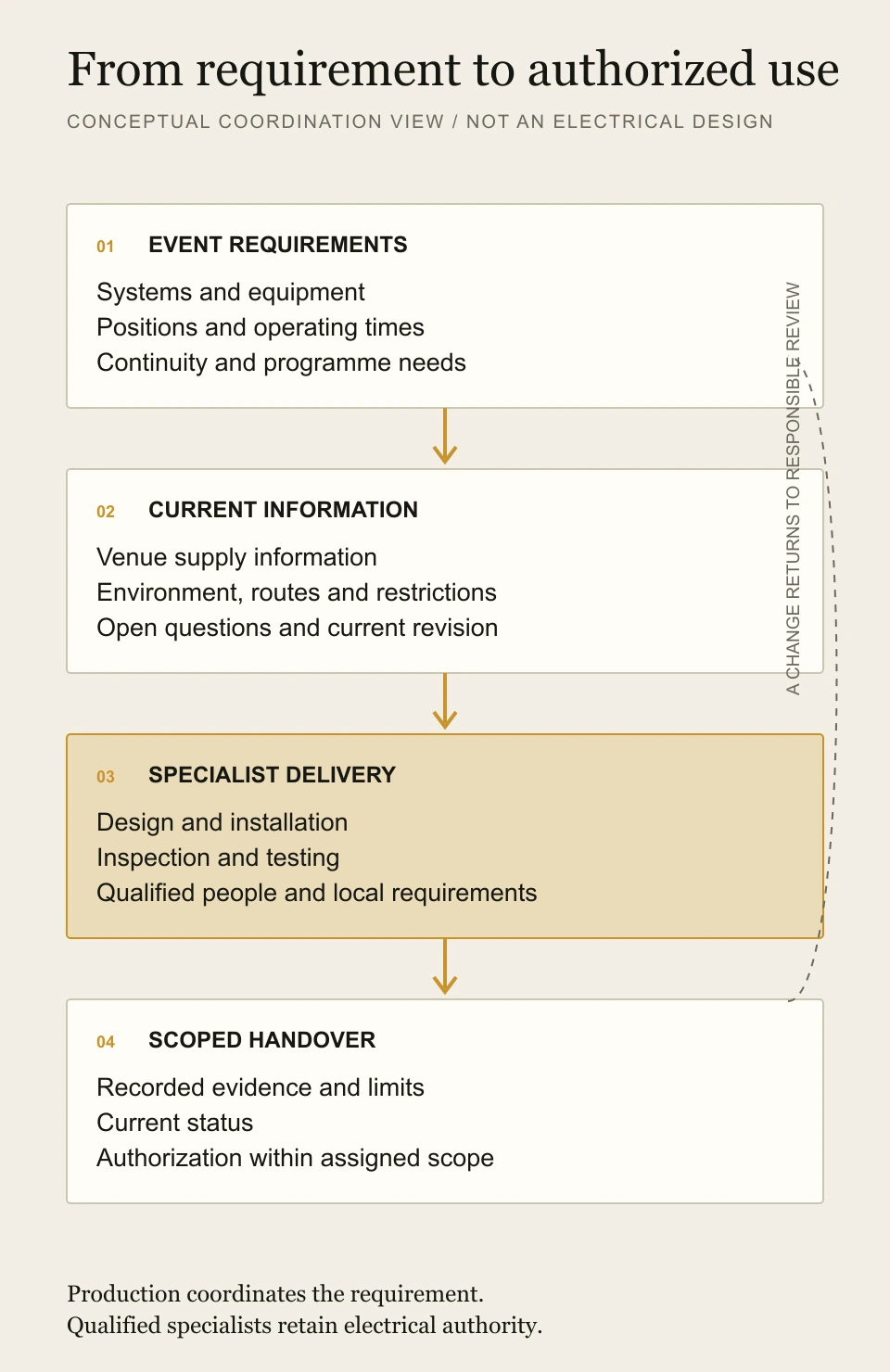
The figure should show four connected layers:
1. EVENT REQUIREMENTS: systems, positions, operating times and continuity needs. 2. CURRENT INFORMATION: venue supply details, environment, routes, restrictions and unresolved questions. 3. SPECIALIST DELIVERY: design, installation, inspection and testing by the responsible qualified people. 4. SCOPED HANDOVER: recorded evidence, limits, current status and authorized use.
Changes loop back from every layer to the responsible review. The diagram must state CONCEPTUAL COORDINATION VIEW / NOT AN ELECTRICAL DESIGN OR TEST PROCEDURE.
Accessible text equivalent: Production and venue information informs specialist electrical design and delivery. Required inspection, testing and authorization produce a scoped handover for use. A changed requirement returns to the responsible review rather than inheriting the previous result.
Suggested alt text: Diagram showing event requirements and venue information passing through specialist electrical delivery to a recorded and authorized handover.
A Generator Is Not Automatically a Recovery Plan
A generator may be a proposed source, but its presence does not establish that critical functions can continue or recover.
The team still needs to know:
- which functions are considered critical; - what alternative source or arrangement is proposed; - whether the source and receiving system are compatible; - who can decide to switch or isolate; - what changeover method applies; - what operating, access and fuel responsibilities exist; - how the relevant recovery arrangement will be checked; - what remains unavailable during the response.
Generator connection, transfer arrangements, protection, earthing and operation require qualified specialist design and control. The Backup and Recovery guide explains why spare equipment is not the same as a workable recovery plan. OSHA's portable-generator guidance also identifies shock, unintended energization, carbon monoxide, fire and fuel hazards. Its requirements are US-specific, but the hazards demonstrate why a generator cannot be treated as an ordinary spare.
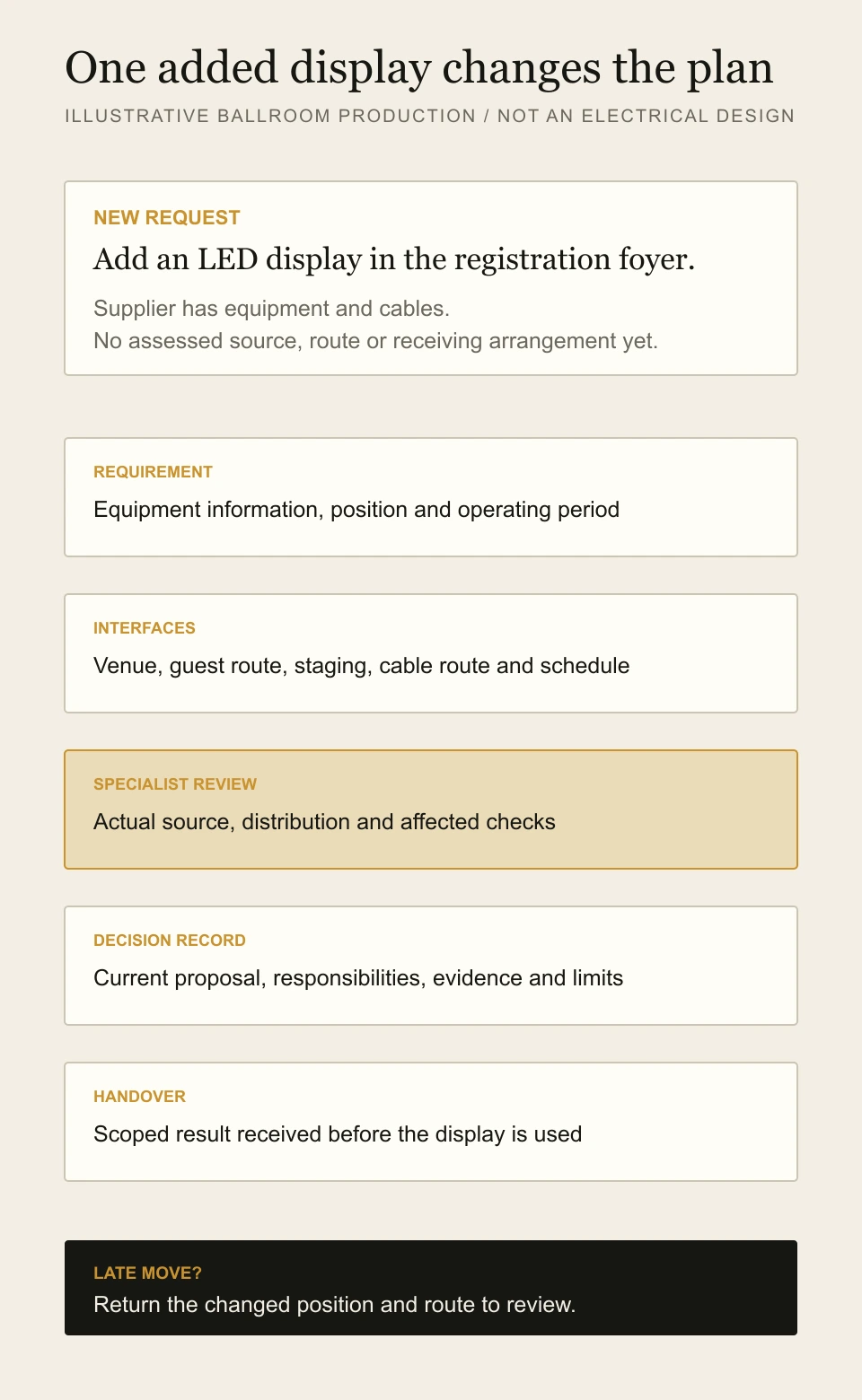
Worked Example: A Ballroom Production Gains an Additional LED Display
A fictional conference is planned in a hotel ballroom. The original production includes presentation playback, room screens, sound, lighting, a confidence monitor and event control positions. The venue has supplied current electrical information to the appointed electrical contractor. Department requirements have been collected and the contractor has issued a reviewed arrangement.
Two days before load-in, the organizer adds a large LED display in the registration foyer. The display supplier says the equipment will arrive with its own cables. That statement does not establish where it can connect, whether the existing plan can support it or who is responsible for the new route and checks.
| Requirement or claim | Current evidence | Decision needed | Assigned follow-through in this example |
|---|---|---|---|
| The foyer display needs electrical supply during registration and the opening session. | Display supplier provides current manufacturer information, intended position and operating period. | Electrical contractor assesses the changed requirement against the actual source and distribution plan. | Display supplier supplies equipment information; electrical contractor assesses the electrical arrangement. |
| The proposed position is near a public entrance. | Current foyer plan shows guest circulation but no approved cable route. | Venue, production and responsible specialists review position, access and route interfaces. | Production coordinator records the interface; venue and specialists confirm only their assigned scopes. |
| Registration must continue if the ballroom system is being checked. | Programme and schedule show overlapping operation. | Treat simultaneous operation as part of the declared requirement. | Production schedule and department records are updated. |
| The supplier says a spare cable is available. | No recovery method, authority or tested receiving arrangement has been established. | Do not record backup power as confirmed. | Backup status remains open until a responsible proposal is reviewed and checked. |
| The revised arrangement is ready to use. | Previous inspection and test evidence covered the original plan only. | Establish what affected checks and authorization are required for the change. | Responsible electrical people complete and record the required work before use. |
First review
The production coordinator records the change and sends the display information, position and operating period to the appointed electrical contractor and venue contact. The contractor does not simply add the supplier's stated requirement to a total. The actual supply, distribution, route, environment and applicable rules need specialist assessment.
The venue confirms that the proposed foyer position affects a public circulation area. The staging and cable-route contacts review the physical interface, while the electrical contractor retains responsibility for the electrical arrangement. Nobody treats a venue comment about position as electrical approval.
Agreed response
The team accepts a revised display position that preserves the required guest route. The electrical contractor issues the current electrical proposal and identifies the affected installation, inspection and test work. The schedule is revised so that this work and the receiving display check occur before registration opens.
The display supplier confirms its equipment information and receives the agreed connection boundary. Production records which evidence is expected, who can provide it and what remains outside the display supplier's authority.
Late change
On load-in day, the organizer asks to move the display to the opposite side of the foyer. The previous result is not transferred automatically. Position, route, source and operating conditions have changed. The request returns to the venue, production and responsible specialists for review.
The explained decision: Production made the new requirement, interfaces and evidence route visible. The electrical contractor retained design and verification authority. The display was not described as ready until the required scoped handover had been received.
ILLUSTRATIVE SCENARIO
What Evidence Is Needed Before Use?
The evidence depends on the system, venue, jurisdiction and responsible specialists. It may include current drawings, schedules, inspection or test records, certification, equipment information, identified limitations and authorization from the people assigned to provide it.
This Article does not prescribe a test sequence, instrument, reading or certificate. Those decisions belong to competent or licensed people under the applicable requirements.
The HSE states that competence depends on the task's complexity, training and relevant experience. Safe Work Australia likewise places inspection and testing within competent-person and jurisdictional requirements. In India, the Central Electricity Authority publishes national safety regulations; applicability, licensing and inspection requirements for an actual event require local professional confirmation.
Changes Return to the Responsible Review
Changes that can affect the electrical arrangement include different equipment, quantity, position, source, route, environment, operating time or recovery expectation. A revised stage layout, additional screen, changed catering area or new outdoor position may all matter.
The person requesting the change does not decide its electrical feasibility. Record the proposed change, identify the affected people, obtain the required specialist assessment and update the current plan and handover. Repeat the checks that the responsible specialist identifies as affected.
A change that appears small to production may alter a condition on which the previous result depended.
What Should Production Hand Over?
A useful production-facing power record should show:
- the current event and space; - the current requirement by department or function; - intended positions and operating periods; - the source of venue and equipment information; - the responsible electrical provider and agreed interfaces; - decisions, open questions and approval status; - expected inspection, test or completion evidence; - operating and recovery responsibilities; - the current revision and date; - changed conditions that require review.
This record helps production coordinate the work. It is not an electrical design, completion certificate or declaration that a system is safe.
Key Takeaway
Event power is planned by connecting production requirements to a specialist-designed, checked and authorized electrical arrangement.
The useful production question is not only How much power do we need? It is What needs power, where and when, who is responsible for each interface, and what evidence is required before use?
Related questions
How is power planned for a live event?
Identify what needs electricity, where and when it will operate, the available venue information, responsible suppliers and unresolved conditions. Qualified electrical specialists then design, deliver and verify the arrangement under the applicable requirements.
What information is needed to plan power for a live event?
Useful information includes equipment and manufacturer data, position, operating period, overlapping demand, environment, venue supply information, responsible parties, critical functions, expected evidence and possible changes. The responsible specialist determines what else is required.
Who is responsible for event power?
Responsibility is usually shared across the organizer, venue, electrical contractor and equipment suppliers. The event should record who provides information, design, installation, connections, checks, authorization, monitoring and response. Titles alone do not establish competence or authority.
What should be confirmed about a venue's power supply?
Confirm current information for the exact space through the venue's authorized contact, then have the responsible electrical specialist assess suitability for the actual requirement. A photograph, outlet label or previous event does not establish suitability.
How do production departments communicate their power requirements?
Each department provides current equipment information, positions, operating periods, continuity needs and changes to the agreed coordinator or electrical specialist. The information should remain traceable to its owner and revision.
Does having a generator mean an event has backup power?
No. A workable recovery plan also needs an appropriate source and receiving arrangement, defined critical functions, switching authority, operating responsibilities, compatible distribution and relevant testing. These are specialist decisions.
What should happen when event power requirements change?
Record the changed equipment, position, source, timing or operating condition and return it to the responsible venue, production and electrical people. Update the current plan and repeat the checks identified as affected.
What must be checked before production equipment is connected or used?
The required inspection, testing, records and authorization depend on the actual system, venue, jurisdiction and responsible qualified people. Production should confirm that the expected scoped evidence and handover have been received, not invent a universal test sequence.
Sources & references
- IEC 60364-7-711:2026International Electrotechnical Commission / industry standard
- Electrical safety at eventsHealth and Safety Executive / technical reference
- Work on electrical equipment, machinery or installationsHealth and Safety Executive / technical reference
- Electrical safety frequently asked questionsHealth and Safety Executive / technical reference
- Guide to Temporary Electrical Systems, second editionInstitution of Engineering and Technology / technical reference
- Electrical safety dutiesSafe Work Australia / technical reference
- Central Electricity Authority safety regulationsCentral Electricity Authority, India / industry standard
- Using Portable Generators SafelyOccupational Safety and Health Administration / technical reference
Continue learning