13 min read
EXPLAINER / Event Production
What Is Event Lighting?
Event lighting is the planned use of light to make people, spaces and programme moments visible and visually appropriate during a live event. It can direct attention, shape how a stage or room appears, support cameras and change with the programme. A working event-lighting system may include fixtures, positions, supporting infrastructure, power, control data, a lighting console or controller, programmed states or cues and the people responsible for designing, preparing and operating it. The exact arrangement depends on what the audience, performers, presenters and cameras need to see. Electrical work, suspended equipment and work at height require competent people and the relevant venue or specialist authority.
On this page
Understand event lighting as a connected production system that turns programme, audience and camera requirements into a checked visual result.
Event Lighting Starts With What People Need to See
A conference presenter, a touring performer, an awards stage and an audience entering a room do not need the same visual result.
Before choosing equipment, establish what is happening, where people and objects will be, who needs to see them and how the programme changes. The audience may need a clear view of a speaker. A camera may need a usable picture of the same person. Performers may need safe and understandable stage conditions. A scenic surface or screen may need to remain visually distinct.
Those requirements can interact. Raising every lighting level may make a presenter brighter while reducing contrast around a screen or changing the intended atmosphere. Adding fixtures does not resolve an unclear requirement.
Event lighting begins with the required result, not the equipment list.
Use What Is Live Event Production? for the wider system in which sound, video, staging, lighting, people and schedules must work together.
What Does Event Lighting Do?
Lighting can serve several functions at once.
Visibility. People need to see the relevant presenter, performer, object, route or stage area.
Attention. Differences in brightness, direction, colour and contrast can help direct attention towards the current action.
Form and separation. Direction and contrast can help people, objects and scenic elements remain visually distinct rather than appearing as one flat surface.
Appearance and atmosphere. Lighting contributes to how a stage, room or performance feels. Colour does not create one universal emotion, and the same choice can appear different when the venue, surfaces, costumes, cameras or displays change.
Programme information. A change of lighting state can support an entrance, a film, a panel, a performance or another transition. It should agree with the event's programme and cue structure.
Camera support. A result that appears acceptable to an audience in the room may not produce the intended camera image. Where recording, streaming or image magnification is required, the actual camera and display result needs its own agreed check.
ETC's educational lighting material describes controllable properties including intensity, colour, distribution and movement. BTS uses those ideas as part of a broader live-event explanation, not as a claim that four terms completely define every lighting design. ETC educational resources
Event Lighting, Stage Lighting and Decorative Lighting
These terms overlap, and usage varies between markets and production sectors.
Stage lighting usually refers to light concentrated on a stage or performance area. Event lighting can include that work while also addressing audience areas, entrances, scenic or branded surfaces, room architecture and camera requirements. Production lighting is another overlapping term for lighting integrated with a produced programme. Decorative lighting may contribute to the visual environment, but it does not automatically satisfy presenter, performer, camera or cue requirements.
House, work and emergency lighting have different purposes. Venue and life-safety systems must remain under their applicable controls and requirements. Entertainment lighting is not a substitute for required emergency lighting, exit signs or escape-route illumination.
What Makes Up an Event-Lighting System?
The exact equipment and staffing vary, but a useful conceptual model includes:
- the programme and visual requirements;
- the people, objects and areas that need lighting;
- fixture positions, directions and coverage;
- fixtures or luminaires performing the required functions;
- supporting, electrical and control infrastructure;
- a console, controller or another agreed control method;
- programmed states, looks or cues where required;
- operators, decision-makers and specialist responsibilities;
- checks of the visible result in the actual venue conditions.
Fixture, luminaire, lantern and instrument are all used for lighting equipment in different sectors and regions. This Article normally uses fixture while acknowledging those alternatives.
Teaching diagram: from requirement to checked result
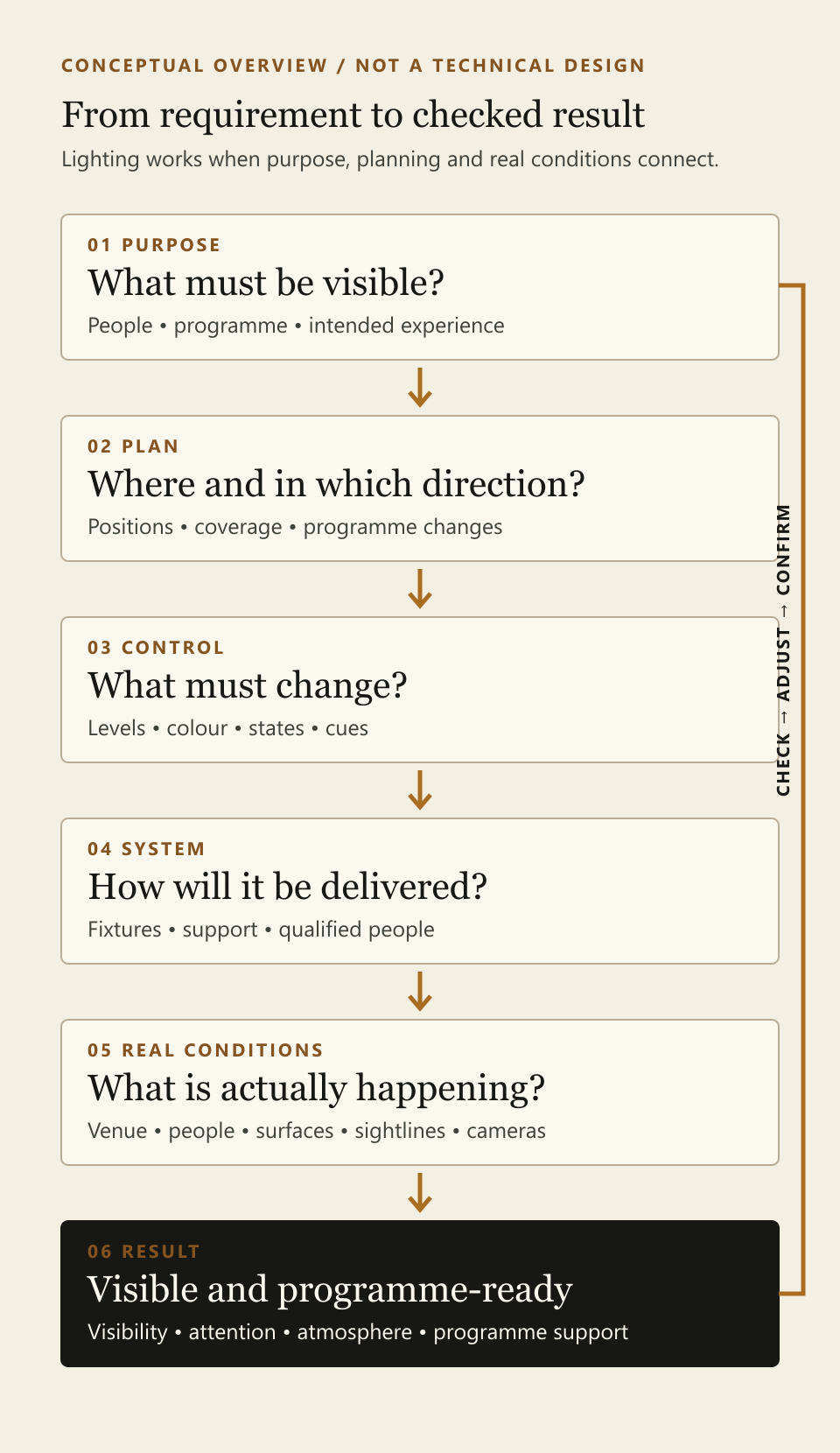
The figure should show six connected layers:
- PURPOSE: people, programme moments and intended experience.
- PLAN: positions, direction, coverage and intended changes.
- CONTROL: levels, colour choices, states and cues.
- SYSTEM: fixtures and supporting infrastructure delivered by qualified people.
- REAL CONDITIONS: the venue, people, surfaces, sightlines and cameras.
- RESULT: visibility, attention, atmosphere and programme support.
A feedback route returns from RESULT to PLAN and reads CHECK → ADJUST → CONFIRM. The diagram must be labelled CONCEPTUAL OVERVIEW / NOT A TECHNICAL DESIGN.
Accessible text equivalent: An event-lighting requirement begins with its purpose, such as making a presenter visible, directing attention or supporting a performance. That purpose informs a lighting plan covering position, direction, coverage and changes. A control system communicates levels, colour choices and cues to the lighting system. Fixtures then interact with the real venue, people, scenery, sightlines and cameras to create the visible result. The result must be checked in the actual space, adjusted where necessary and confirmed before it is treated as ready.
The figure must not depict wiring, electrical distribution, suspension hardware, load values, working-at-height methods or engineering tolerances.
Fixtures Perform Different Jobs
A beginner does not need a shopping list to understand the system. It is more useful to ask what function a fixture must perform.
Some fixtures provide broad illumination. Some create more controlled or shaped areas. Some can reposition or change several attributes during a programme. Others illuminate scenery, architecture or visible scenic sources. A followspot may be used to follow a person where that function and its operation have been planned.
Terms such as wash, profile, ellipsoidal, spot, beam, moving light and automated fixture overlap across manufacturers and markets. A familiar label does not establish the output, coverage, control needs or suitability for a particular event.
Selection therefore depends on the required result, available positions, venue conditions, control arrangement and specialist assessment. This Article does not recommend a fixture type, model or quantity.
Position, Direction and Coverage Matter
A fixture count does not describe a lighting result.
Position and direction affect which areas can be reached, how faces and objects appear, where shadows fall, whether glare reaches the audience and whether light spills onto screens or scenic surfaces. The physical layout also affects sightlines, cameras and the work of other departments.
Use the Stage Plot explainer for the intended physical arrangement of performers and stage equipment. A stage plot is not a lighting plot, but changes to people, furniture or performance positions can affect the lighting plan.
Control Data and Electrical Power Are Different Requirements
Lighting control communicates intended values and changes to the equipment. Electrical power supplies the equipment. One does not replace the other.
DMX512-A is a widely used entertainment-lighting control-data standard. Control may also be transported or organised through other wired, networked or wireless arrangements. The selected system, fixture modes, addressing and documentation belong to the responsible lighting team. USITT overview of ANSI E1.11 DMX512-A
This explainer does not teach patching, addressing, networking, connector use or electrical installation. Those subjects require system-specific documentation and competent technical judgement.
Lighting for the Room and Lighting for Cameras Can Differ
The audience sees the real stage from many positions. A camera sees a framed electronic image through its own complete chain. The two results are related but not identical.
Where cameras are in scope, check the relevant lighting state through the actual camera arrangement and intended viewing destination. Do not infer the camera result solely from the room view, or treat one camera preview as proof of every recording, stream or screen output.
Use What Is Event Video Production? for the relationship between sources, control and agreed viewing destinations. Use Recording and Live Streaming Requirements when room presentation, recording and streaming need different pictures or audio.
Detailed claims about flicker, frame rates, colour reproduction and camera settings remain outside this foundational Article unless reviewed by the relevant specialists.
From a Lighting Requirement to a Working State
The work may involve several connected stages:
PROGRAMME + PEOPLE + VENUE → LIGHTING REQUIREMENT → PLAN → PREPARATION → PROGRAMMING / FOCUS → CHECKS → AGREED OPERATING STATE
This is a conceptual workflow, not a compulsory supplier process. Different productions divide the work differently.
The Production Advance explainer develops how requirements, responsibilities, decisions and unresolved questions become visible before load-in. Technical Direction explains the integration function across lighting, video, staging, audio and other systems without replacing their specialist responsibilities.
How Lighting Changes During the Programme
A lighting state or look describes an intended visual condition. A cue identifies an agreed action or change. The terminology and control method vary, but the programme still needs to identify when a change is expected, who confirms readiness and who can instruct the action.
A planned time is not always the actual trigger. A presenter may finish early, a film may be held or a stage transition may remain incomplete. The person operating lighting needs the agreed cue reference and communication route.
Use What Is a Run of Show? for the programme sequence and What Is Show Calling? for the coordination of agreed cue instructions.
Who Is Responsible for Event Lighting?
The functions can include:
- interpreting the creative and programme requirement;
- developing the lighting approach;
- coordinating venue positions and restrictions;
- preparing equipment and documentation;
- handling electrical, structural and suspension responsibilities;
- programming and focusing the system;
- operating the agreed states and cues;
- checking the room and camera results;
- accepting programme or visual changes within assigned authority.
One person may combine several functions on a small event. A larger production may divide them among a lighting designer, lighting director, programmer, console operator, technicians, electricians, riggers, venue personnel and production management. Job titles do not establish universal authority.
The lighting operator does not automatically approve programme content, structural changes or venue exceptions. A production coordinator does not become authorised to alter electrical distribution or suspended equipment by coordinating the schedule. Responsibilities and decision routes must be agreed for the actual event.
Worked example: one stage, several visual requirements
A fictional business forum uses one stage for a keynote presenter, a short film and a seated panel. An upstage LED display shows the event content. The event is viewed in the room, recorded and streamed. The production has assigned a lighting lead, video lead, stage lead, show caller and programme approver for the relevant functions. These are this example's allocations, not universal job titles.
The approved requirements are:
- the presenter is visible at the lectern;
- the panel is usable across the agreed chair positions;
- the LED content remains visually understandable;
- the relevant camera receives a usable picture of faces;
- the film and panel transitions use the agreed lighting states;
- audience Q&A uses a separately agreed state.
First review: the room and camera disagree
The presenter appears acceptable from the room review positions. On the production camera, the face is too dark relative to the display. Raising the whole stage level changes the intended screen relationship and adds unwanted light to the first audience rows.
The team does not record the issue merely as “more light needed”. It compares the actual speaker position, the audience view, the camera return, the current screen content and the approved keynote state.
| Requirement | Evidence observed | Decision boundary |
|---|---|---|
| Presenter visible in the room | Presenter is readable from the agreed audience review positions. | This does not prove the camera result. |
| Presenter usable on camera | The relevant camera image shows insufficient facial detail for the agreed result. | Video reports the image; lighting assesses the lighting response. |
| Screen remains visually distinct | Raising the complete stage state reduces the intended balance around the display. | A global level increase is not accepted merely because it brightens the face. |
| Programme transition remains workable | The keynote state must still move into the film state on the agreed cue. | A proposed change must be checked through the affected transition. |
Proposed response and second review
The lighting lead proposes an adjustment to the controlled presenter coverage instead of raising every stage fixture. The venue confirms that the proposal remains within the approved installed arrangement. Video checks the camera result. Programme confirms that the lectern remains the approved presenter position.
No unassigned person moves, rigs, powers or reconfigures equipment.
The revised keynote state is checked from the representative audience positions, through the actual production camera, with the current LED content and through the transitions into the film and panel states. The agreed reviewers confirm the defined room and camera results. Any remaining limitation stays recorded.
Late change: the presenter leaves the checked position
The programme team later asks the presenter to move downstage for the closing section. That changes a condition on which the earlier result was based.
The stage and lighting teams do not assume the earlier state covers the new position. They review the changed mark, repeat the affected room and camera checks and update the operating information. The show caller receives the confirmed state and cue reference before the change is used.
The explained decision: The answer was not simply to make the stage brighter. The accepted result belonged to a defined person, position, programme state and viewing destination. When one of those conditions changed, the affected result needed another check.
ILLUSTRATIVE SCENARIO
What Should Be Checked Before the Event Begins?
A production check can establish whether the lighting arrangement performs its agreed event function. It may confirm:
- the current plan, fixture information, patch and cue references agree;
- required equipment responds through the intended control path;
- intended people and areas are covered from the reviewed positions;
- states are observed with relevant scenery, screens and reflective surfaces present;
- audience sightlines, unwanted spill and glare are considered;
- camera-dependent results are viewed through the actual camera chain;
- cue order, timing and transitions agree with the current programme;
- substitutions, failures, moved equipment or changed addressing are recorded;
- affected checks are repeated after material changes;
- each responsible person reports what is ready and what remains unresolved.
These production checks do not certify electrical safety, structural capacity, rigging, access equipment or legal compliance. Temporary electrical systems, suspended equipment and work at height require the competent people and controls applicable to the venue, production and jurisdiction. HSE electrical safety at events and HSE common work-at-height tasks at events provide relevant UK guidance; local requirements still apply.
What Information Does the Lighting Team Need?
Provide the current programme, event purpose, presenter and performer positions, stage and scenic arrangement, screen locations, audience layout, camera requirements and venue information. Identify expected transitions, access windows, rehearsal time, control responsibility and any installed lighting that may be available.
Mark unknown information instead of allowing it to become an assumption. Ask the responsible supplier or lighting lead to identify exclusions, venue dependencies and unresolved decisions.
The production-briefing guide explains how to describe the event without pretending to design every technical system yourself.
Event Lighting Is a Designed Production System
Lighting equipment is only one part of the result. The useful system connects programme purpose, physical positions, visual decisions, control, specialist delivery and checks in the real space.
Plan what people and cameras need to see, then confirm the result under the conditions in which it will be used.
Related questions
What is event lighting?
Event lighting is the planned use of light to make people, spaces and programme moments visible and visually appropriate during a live event. It can support audiences, performers, cameras and programme changes.
What does event lighting do at a live event?
It can provide visibility, direct attention, shape the appearance of people and spaces, support cameras and communicate changes between programme states. The required functions depend on the event.
Is event lighting the same as stage lighting?
The terms overlap. Stage lighting usually concentrates on a stage or performance area, while event lighting may also include audience areas, entrances, architecture, scenic surfaces and camera requirements. Usage varies.
What equipment is part of an event-lighting system?
It may include fixtures, mounting positions, supporting and electrical infrastructure, control data, a console or controller and the equipment needed to create and operate the agreed result. The exact system varies.
Who plans and operates event lighting?
The functions may be divided among designers, lighting leads, programmers, operators, technicians, electricians, riggers, venue teams and production management. Titles and authority vary by production.
How does event lighting work with video and cameras?
Lighting affects what cameras and displays receive, while screens and scenic surfaces affect the lighting result. Check the room and camera destinations separately where both are required.
What information does a lighting team need before an event?
It needs the programme, people and positions, stage and scenic layout, screens, audience areas, camera requirements, venue information, access, rehearsal time, responsibilities and unresolved conditions.
When should event lighting be checked or rehearsed?
Check the relevant states and transitions after the working arrangement is prepared and before they are relied upon. Repeat affected checks when positions, equipment, content, patch, scenery, cameras or programme conditions materially change.
Sources & references
- Educational Resources and A Guide for Lighting the StageETC / manufacturer
- Lighting and Electrics: ANSI E1.11 DMX512-A overviewUSITT / industry standard
- Electrical safety at eventsHealth and Safety Executive / technical reference
- Common work at height tasks at eventsHealth and Safety Executive / technical reference
Continue learning