7 min read
GUIDE / Production Management
How to Build an Event Risk and Contingency Plan
Build an event risk and contingency plan by identifying what could disrupt delivery, recording its consequences and assigning someone to monitor it. Agree what you can do now to reduce the risk, what fallback you can prepare and what observable condition should prompt a decision. Name who can authorise each change, what they need to check and who must receive the resulting instruction.
On this page
Decide what to monitor, when to switch plans and who can authorise the change.
Find the assumptions your plan depends on
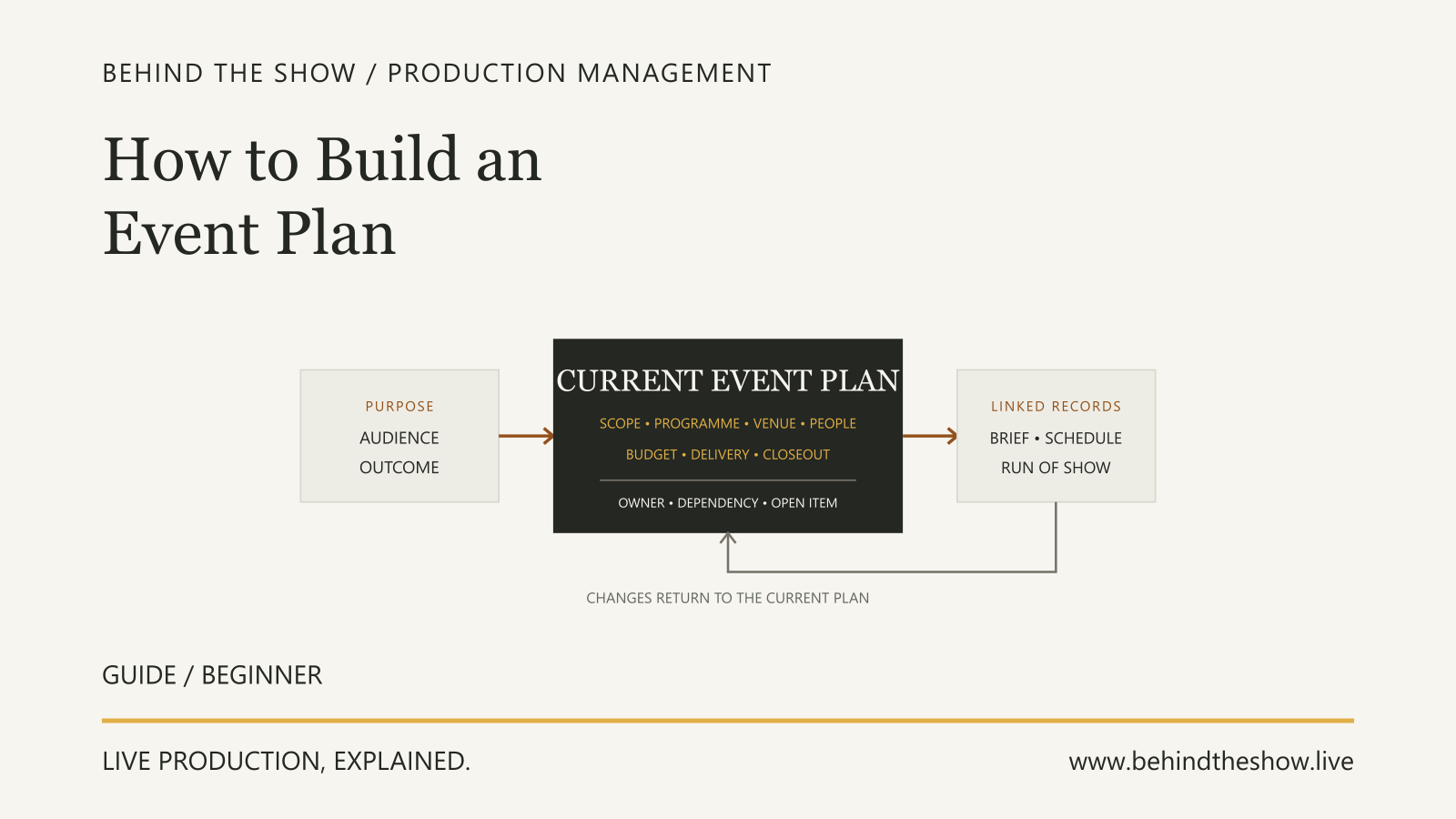
Start with the current event plan. Ask the venue, programme and supplier leads which dates, people, services and handovers their work depends on. Pay particular attention to assumptions shared by several teams. A single loading window can affect supplier arrivals, build, rehearsal and doors.
Describe the uncertainty and its consequence together. “Venue access” is a topic. “If the venue cannot release the loading bay at 08:00, the build and rehearsal may run past the planned doors time” is something a team can investigate. Record the current evidence, including the person or document that can confirm the assumption.
Give each risk a practical record
Keep the record as simple as the event allows. A row should tell the next person what to monitor, when action is needed and where the decision goes.
| Field | What to record |
|---|---|
| Risk and consequence | The uncertain condition and the activities, people or commitments it could affect |
| Evidence and owner | The current evidence, who monitors it and when they check again |
| Action now | What can reduce the likelihood or impact before the problem occurs |
| Trigger and latest decision time | The evidence or missed confirmation that calls for a decision, and the deadline that leaves time to act |
| Fallback and prerequisites | The alternative, its dependencies and what the relevant teams must confirm before use |
| Authority and communication | Who confirms feasibility, who authorises the change and who issues the agreed instruction |
| Status and next check | The current decision, any unresolved condition and when the record will be reviewed |
Prioritise risks that would have serious consequences or leave little time to respond. Give the people closest to the work a chance to challenge the assumptions before recording a fallback as available.
Prepare a fallback people can deliver
Agree the resources, access, time and handovers needed for the alternative. If a revised timetable depends on a supplier staying later, obtain a commitment for that window and check what the venue and receiving teams can accommodate. The Event Suppliers guide explains how to record conditional commitments and agree how delivery will be checked.
Set a trigger that someone can observe. A revised access time confirmed by the venue may trigger an immediate decision. A missed confirmation deadline can also trigger review while there is still time to use the fallback. Work backwards from the time needed to obtain approvals, mobilise people and inform attendees. Use event-specific lead times.
Agree a route for escalation when the fallback depends on an unconfirmed resource or permission. If the team cannot establish a workable option by the decision deadline, record the affected milestone as unresolved and refer it to the named authority for a hold or a further decision.
Assign decision authority before the trigger is reached
Name who monitors the risk, who confirms feasibility within each area, who can authorise the operational or programme change and who communicates it. One person may hold several of those roles. Record the allocation for the event.
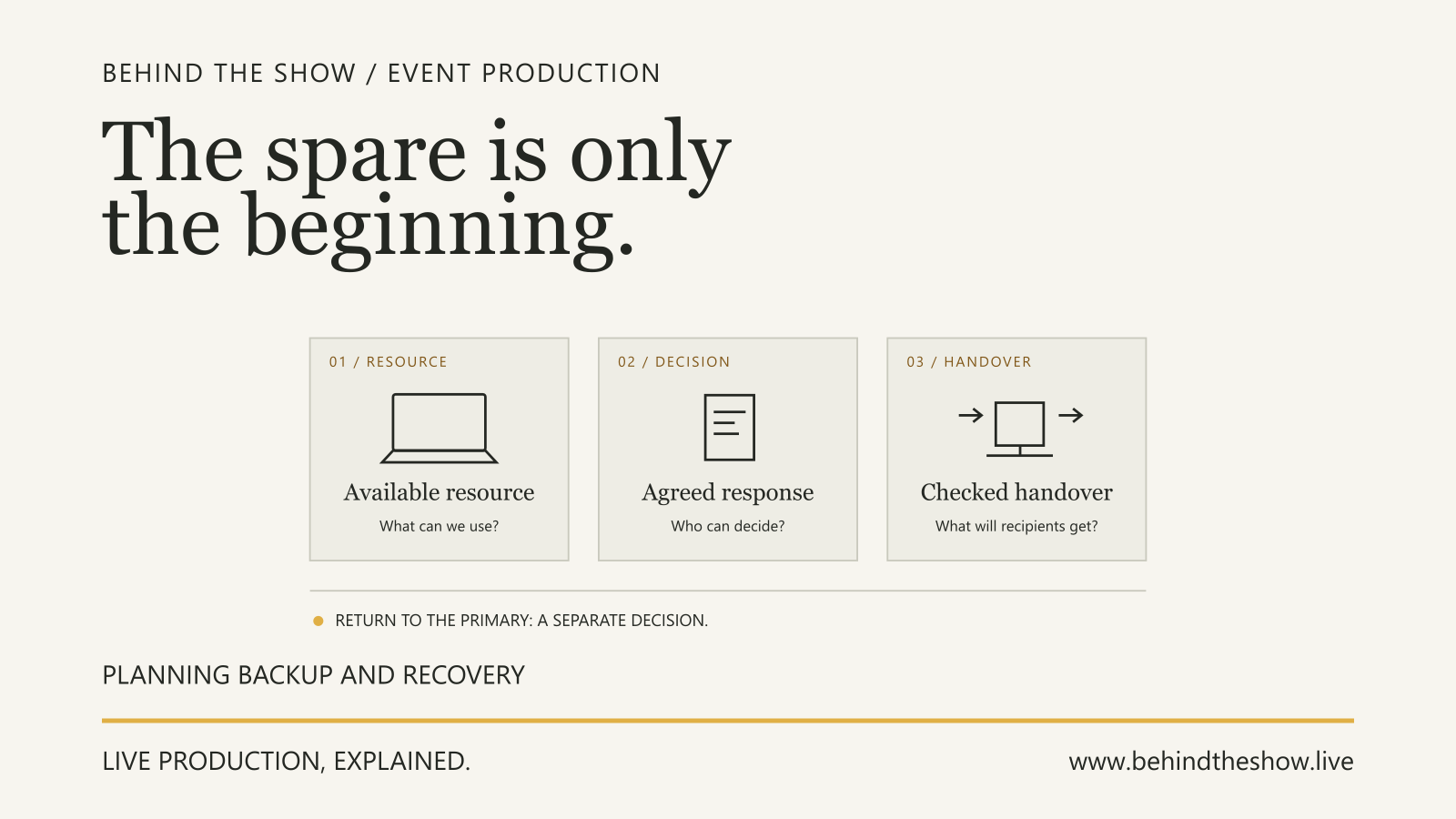
Ask the venue to confirm its access and operating conditions, the supplier lead to confirm resources and delivery, and the programme authority to decide any programme change. Route additional spend to the authorised buyer. For technical recovery during an event, detail the switch, checks and authority in the Backup and Recovery guide workflow.
For health and safety risks, follow the applicable venue and event procedures and obtain competent input for the work. UK Health and Safety Executive guidance covers assessing hazards, putting controls in place and reviewing them. Its event guidance also calls for emergency planning proportionate to the risks. Keep the relevant assessments and emergency procedures linked from the planning record. If an emergency occurs, staff follow the applicable emergency procedures immediately, without waiting for the programme owner’s decision on timings.
Worked example: Venue access moves by an hour
A conference plans to start its build at 08:00. The agreed build takes two hours, followed by a 30-minute rehearsal. Doors are planned for 10:30 and the first session for 11:00. The venue warns that an earlier booking could delay access. The production coordinator owns the risk record and asks the venue duty manager to confirm the loading window in writing.
The team prepares a delayed opening. If access moves to 09:00, the unchanged build and rehearsal sequence finishes at 11:30. The fallback proposes doors at 11:45 and the first session at 12:15. For this event, the programme owner can authorise those revised timings after checking speaker availability. The venue confirms the revised access and operating window. Supplier leads confirm crew coverage, and front of house confirms it can manage the revised arrival arrangements and receive the opening instruction.
| Condition or deadline | Action and authority |
|---|---|
| Venue confirms access will move to 09:00 before 16:00 the day before | The coordinator brings the delayed-opening plan to the programme owner for a decision as soon as the confirmation arrives. |
| 08:00 access is still unconfirmed at 16:00 the day before | The coordinator escalates at 16:00. The team can use the delayed-opening plan only once its access, coverage and arrival arrangements are confirmed. |
| The venue cannot confirm 09:00 access or another fallback prerequisite fails | The programme owner keeps opening time unresolved and decides the next escalation with the venue and responsible leads. Front of house gives the agreed holding message to people already at the venue through its designated contact. |
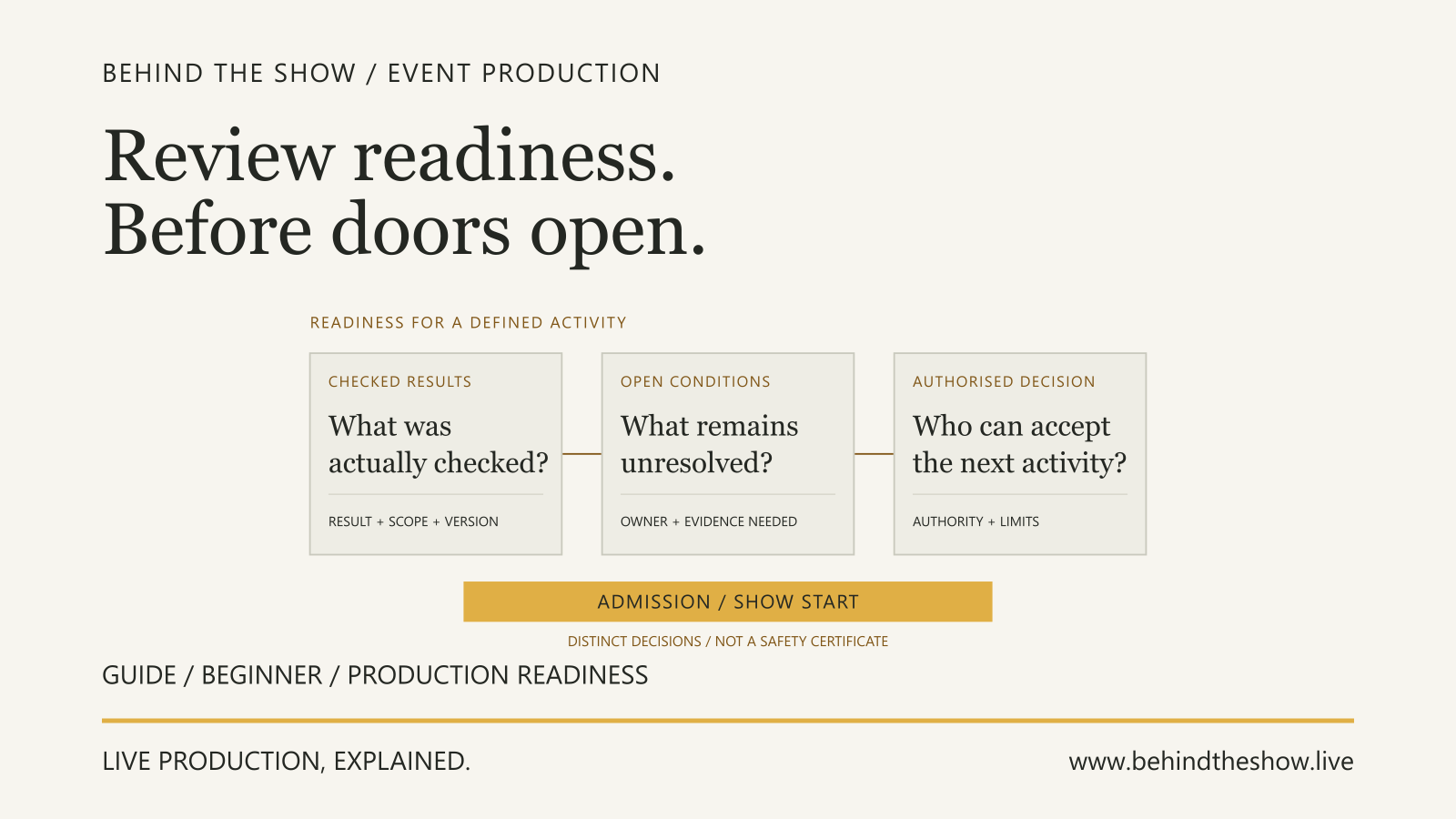
| Before doors on the revised schedule | The designated admission decision-maker reviews actual preparation, open conditions and receiving checks through the event’s readiness process. |
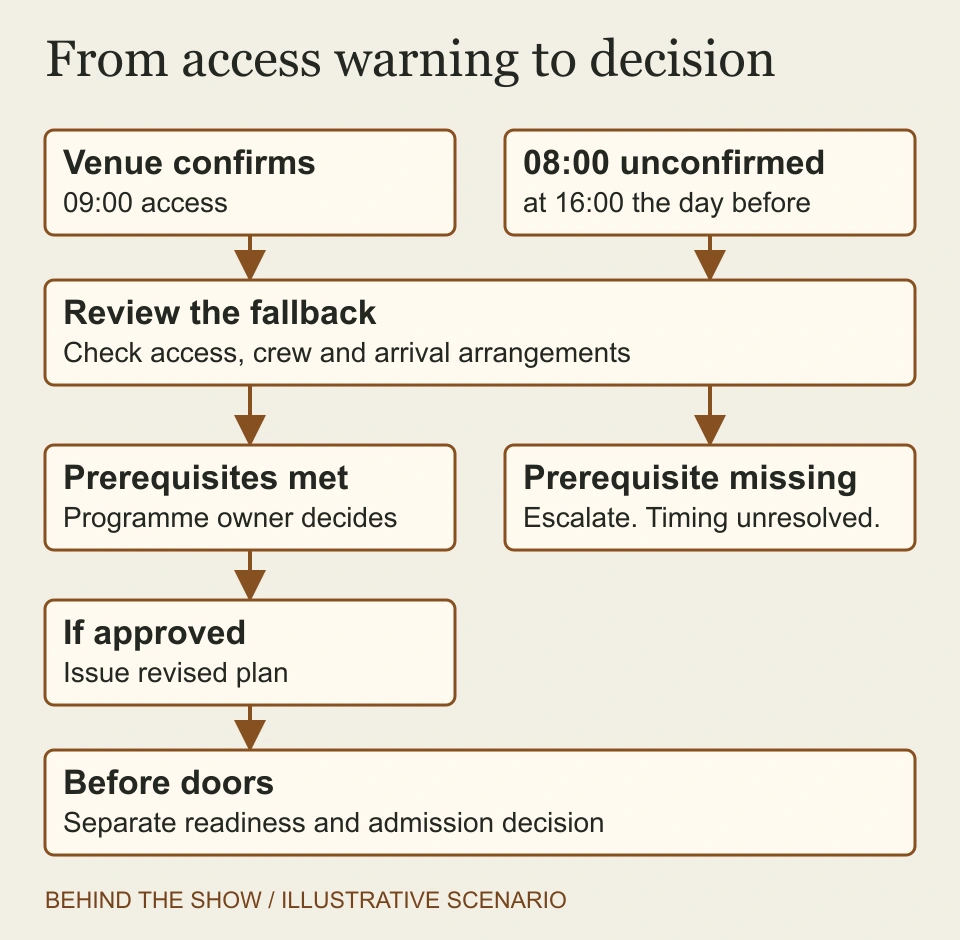
A confirmed delay or missed confirmation deadline prompts review. If access, crew and arrival arrangements are confirmed, the programme owner can approve revised timing. If a prerequisite is missing, the coordinator escalates and opening stays unresolved. Front of house awaits the designated admission decision.
For this conference, the programme owner must approve revised timings by 17:00 the day before. The coordinator briefs affected teams and the communications lead issues approved timings to speakers and attendees by 17:30. The team set those deadlines around supplier notice and the time needed to update arrivals. If approval is still open at 17:00, the coordinator escalates and the communications lead issues the agreed holding message by 17:30. Revised times stay pending until authorised.
At 15:20 the venue confirms 09:00 access in writing. The coordinator records that the trigger has been met and gathers the fallback confirmations. The programme owner authorises the revised timetable at 15:45. The coordinator records the evidence and decision, updates the production schedule and run of show, and briefs the supplier leads and stage team. The named communications lead issues the approved timings to attendees and speakers. Front of house receives the revised plan and the instruction to await the admission decision.
The revised timings preserve the confirmed build and rehearsal sequence. The designated admission decision-maker completes the readiness review before 11:45. Doors open at 11:45 at the earliest, subject to that person’s authorisation. If preparation slips again or the agreed checks are incomplete, record the actual position and follow the event’s admission decision procedure.
ILLUSTRATIVE SCENARIO
Keep the record current and close the action
Review the risk at agreed points, such as a venue confirmation, supplier appointment, schedule revision or pre-doors review. If a trigger is met, record the evidence, the time, the decision-maker and the version issued. Ask affected teams to confirm receipt and flag any new dependency their work introduces.
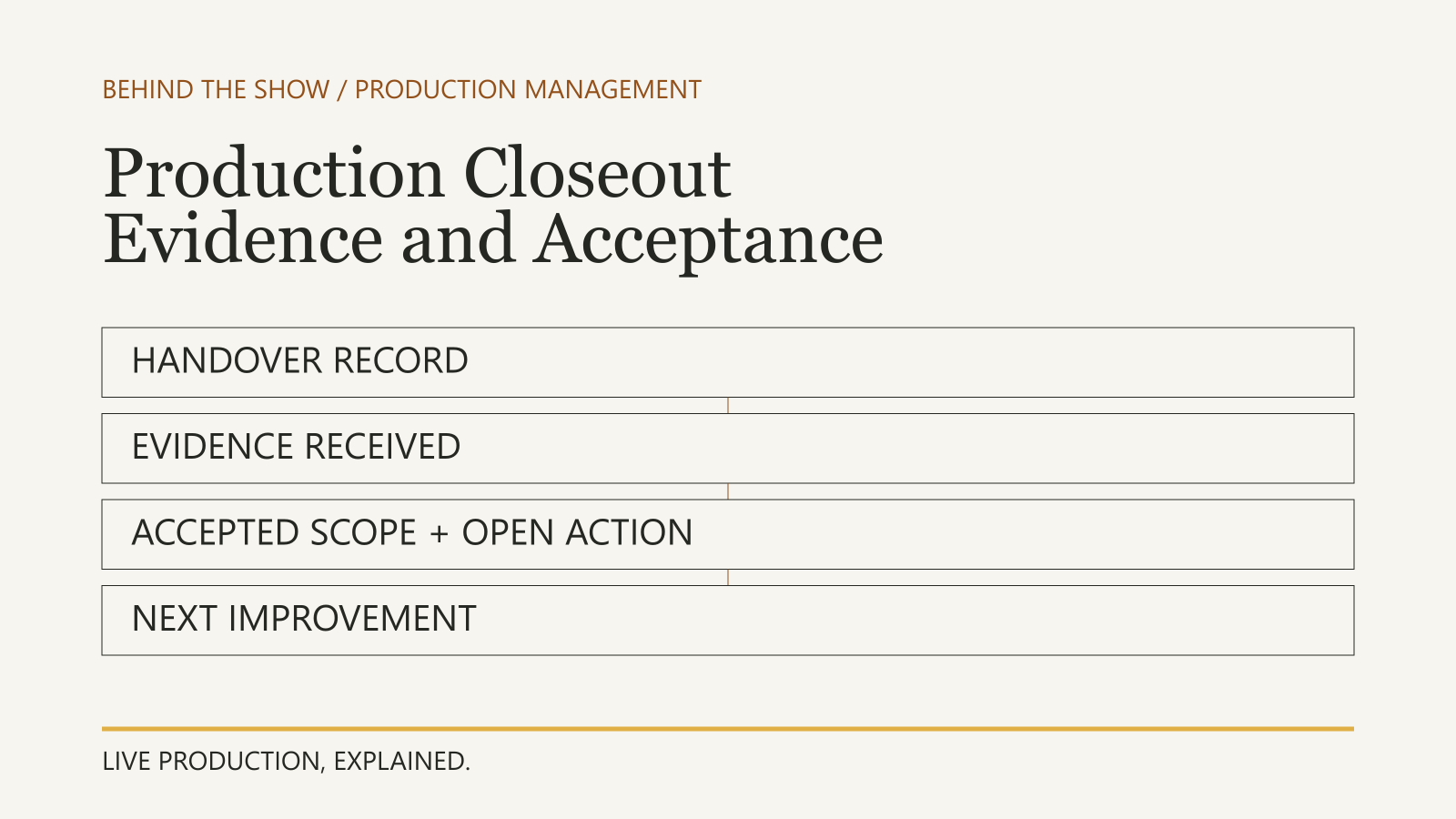
Carry unresolved actions into the production closeout record. After the event, record what the team learned and the specific change to bring into the next plan.
Related questions
How do you build an event risk and contingency plan?
Record what could disrupt delivery, who monitors it, the action to take now, and the fallback, trigger and authority for a later decision. Review the record when dependencies change.
What should an event risk register include?
Record the risk and consequence, current evidence, owner, controls, trigger, decision deadline, fallback prerequisites, approval authority and next check.
What makes a fallback trigger useful?
A useful trigger is observable, has someone responsible for reporting it and leaves enough time to decide and act. A missed confirmation deadline can trigger escalation.
Who decides whether to activate an event contingency?
Use the authority agreed for that event. Venue and supplier leads confirm feasibility in their areas, and the named decision-maker authorises the change within their scope.
What happens if a contingency plan is still unconfirmed at the decision deadline?
Keep the affected milestone unresolved, record the missing prerequisite and escalate to the named authority for a hold or further decision.
Does activating a fallback authorise opening the doors?
Admission follows the event’s agreed readiness process. The designated decision-maker reviews actual preparation, checks and unresolved conditions.
Sources & references
- Steps needed to manage riskUK Health and Safety Executive / primary document
- Planning for incidents and emergenciesUK Health and Safety Executive / primary document
Continue learning