7 min read
GUIDE / Production Management
How to Select and Coordinate Event Suppliers
Select event suppliers by defining the work, checking who can deliver it within the event's constraints and confirming what the chosen supplier will provide. Coordinate them by agreeing what each team needs from the others, when those handovers happen, who can approve changes and what evidence the receiving team needs before accepting the work.
On this page
A practical guide to choosing event suppliers, recording commitments and checking where one team's work passes to another.
Start with the work the event needs
A supplier list tells you whom to call. To brief those suppliers, use the event plan to identify what has to happen and where the work meets the venue, programme or another team.
For each package, write down the result, where and when it is needed, the working window, and what the supplier is expected to provide. Include staffing, installation, operation, removal and final deliverables where relevant. A furniture hire package, for instance, might cover delivery to the loading bay or placement in three rooms and collection after the audience leaves. That difference changes who needs to be available and when.
Share the same current information with suppliers you are comparing. Mark unresolved items explicitly. If the venue has yet to confirm the freight lift window, ask each supplier what its plan depends on and when it needs an answer.
Check suitability for this event
Ask for evidence relevant to the work. A supplier may have delivered larger events and still be unavailable for your rehearsal. Check who would lead the job, what crew and equipment are actually available, what would be subcontracted and how the supplier would handle a change that matters to your programme. For specialist work, identify who can assess the proposed method and the competence needed for it. Ask the venue which site requirements apply and confirm who checks any required documents.
Use the quotation comparison guide to check scope, exclusions and working time before comparing totals. If a mandatory requirement is still unresolved, carry it forward as an open decision. Name who can resolve it and by when. This keeps an attractive price from obscuring a dependency the team cannot yet satisfy.
Record what the supplier has committed to
Keep the accepted scope and the supplier's confirmation together. Record the relevant revision, the supplier's named lead, the agreed working times, the included and excluded work, and any conditions that still have to be met. The person authorised to commit spend should know which proposal and scope they are approving. The supplier lead should confirm what their team will deliver against that same version.
If the appointment is conditional, record the open dependency, who must confirm it and by when, and what the parties have agreed will happen if it cannot be met. If that dependency could disrupt the wider event, use the event risk and contingency planning guide to set an escalation trigger and identify who can approve a fallback.
Distinguish a preferred supplier, a confirmed commitment and a checked delivery in the working record. If the preferred supplier is holding a date subject to crew confirmation, show the hold and the date it expires. Update the schedule when the commitment is confirmed.
Plan the work that crosses supplier boundaries
During the production advance, ask each team what it needs before it can start and who receives its work. Turn each important dependency into a handover with a provider, a receiving team, a time and a check. For example, “video provides the agreed session feed by 08:10; recording checks picture and sound on its own recorder before rehearsal” gives both teams something to confirm.
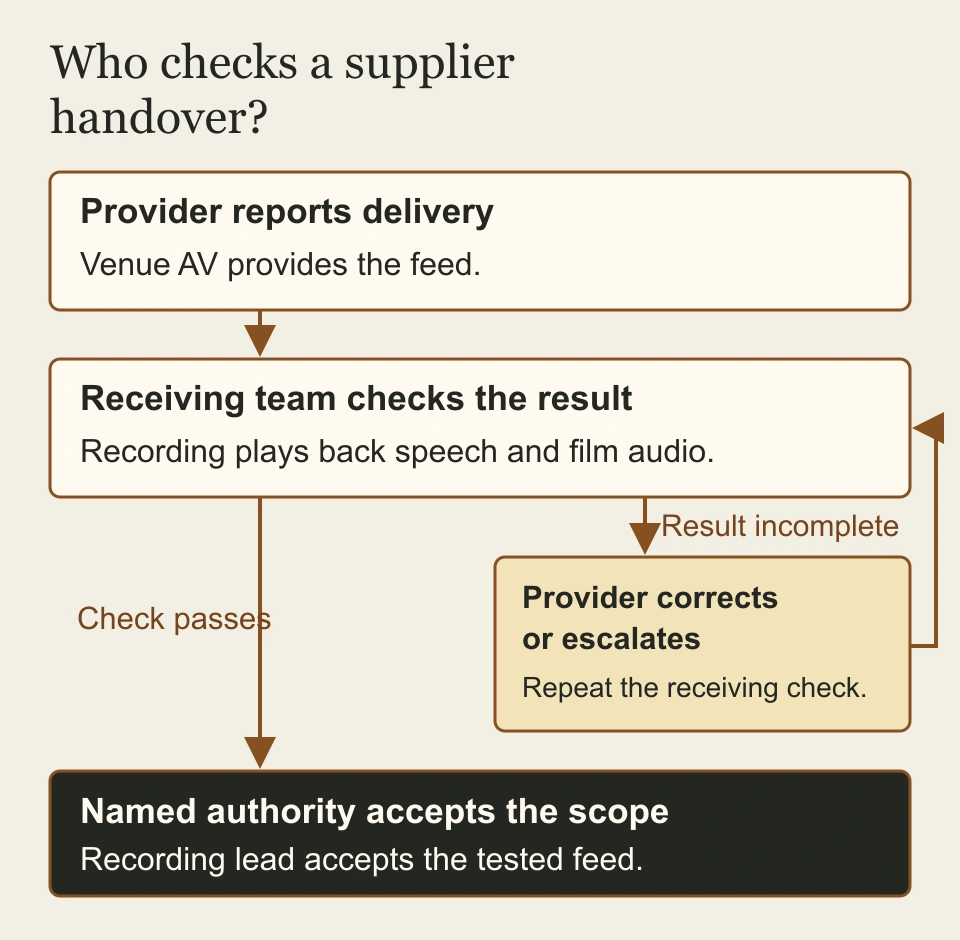
Venue AV reports that the feed is available. The recording operator tests it by recording and playing back speech and film audio. Missing film audio goes back to venue AV for correction or escalation. The recording lead accepts only the tested feed.
If the receiving team cannot confirm the result, record the limitation and who owns the next action. Keep the technical check separate from the decision to change the programme or approve extra spend.
Give each decision to someone who can make it
Roles vary by event. Record them against the actual scope rather than inferring authority from a job title.
| Decision or action | Who to identify |
|---|---|
| Compare proposals and recommend a supplier | The event or production coordinator and the specialists needed to assess the proposed work |
| Appoint a supplier or approve additional spend | The person authorised by the commissioning organisation |
| Confirm resources and carry out the agreed work | The supplier's named lead, with the people responsible for specialist tasks |
| Agree access and applicable site conditions | The relevant venue contact or other person controlling the site |
| Check a handover | The receiving team or designated specialist, for the defined scope |
| Accept the handover | The person authorised to accept the defined scope, using the receiving team's check |
| Decide how the event proceeds if the handover fails | The person authorised to decide how the event proceeds, with the programme owner deciding any programme change and the authorised buyer approving any additional spend |
The UK Health and Safety Executive's event guidance describes organiser responsibilities for coordinating activities and monitoring safety arrangements. Its contractor guidance covers selecting suitable contractors, sharing relevant information and managing the work. Identify the applicable local duties and competent decision-makers for your event. A commercial appointment or a check of a supplier deliverable covers only its own scope.
Worked example: The recording supplier needs a usable feed
A conference needs an edited recording of a panel, including the opening film and panel discussion. The venue's AV package operates the room. Two recording suppliers quote against the same brief. Supplier A can record from a live feed but excludes a feed check with the venue before the doors open. Supplier B includes a pre-show check and confirms the availability of the operator who will run it. Neither supplies the venue's output.
The coordinator asks both suppliers how they would meet the same pre-show check requirement. Supplier A cannot staff the available window. The venue AV lead confirms it can provide the agreed feed and assigns an operator for the test. The authorised buyer approves Supplier B against the revised scope, and Supplier B confirms the named operator and reporting time.
| Time or condition | What happens | What the team records |
|---|---|---|
| Before appointment | The venue confirms who provides the feed. Supplier B confirms who receives and records it. | Named contacts, agreed scope and 08:10 check |
| 08:10 first check | The recording operator plays back a sample. The panel microphones are present but the film audio is missing. | Picture and speech checked. Film audio open. The venue AV lead owns the correction. |
| 08:20 second check | The venue AV lead confirms its revised output. The recording operator makes and plays back a new sample, confirming picture, speech and film audio. | Recording lead accepts the feed for the tested panel arrangement. |
| If a later change affects the feed | The receiving team checks the affected material again. If a limitation remains, the programme owner decides whether to proceed with a reduced recording scope, with any added spend handled by the authorised buyer. | Changed condition, evidence, decision, person and time |
The recording operator's playback revealed a gap that a “feed connected” update would have missed. After the event, the organiser's named contact checks the edited file against the agreed deliverable and accepts it if it meets that scope. That is a separate handover from the morning feed check.
ILLUSTRATIVE SCENARIO
Close the loop after delivery
Record what the receiving team accepted, any exclusions or limitations, and the owner and due date of remaining work. Send the current record to the people taking over. If an edit, collection or correction remains open, carry it into the production closeout record with the evidence needed to close it.
Related questions
Does an exclusion in a production quotation assign responsibility to someone else?
No. It identifies a boundary in that proposal; the excluded requirement still needs an agreed provider or an explicit not-applicable decision.
Is completing a production task the same as accepting its handover?
No. Reported completion, the required checks and acceptance for a defined scope are separate matters. Record what happened and who had authority to accept the relevant requirement.
Does an event manager control every supplier?
No. The Event Manager may coordinate supplier commitments and decision routes, but each supplier remains responsible for competent delivery within its agreed scope. Contracts and the recorded responsibility structure determine authority.
How do you select a supplier for an event?
Define the work and constraints, check the supplier's suitability and availability, compare offers against the same requirements and record the selected scope and supplier commitment.
What should an event supplier confirm before appointment?
Confirm the current scope, named lead, resources and working times, exclusions and conditions. Record dependencies that still need agreement and who will resolve them.
How do you coordinate handovers between event suppliers?
Name the provider and receiver, agree the result and due time, and specify what the receiver will check. Record who can accept the handover and what happens if the result is incomplete.
Sources & references
- Managing an eventUK Health and Safety Executive / primary document
- Using contractorsUK Health and Safety Executive / primary document
Continue learning