5 min read
GUIDE / Live Sound
How to Plan Wireless Microphones for a Live Event
Plan wireless microphones by mapping the programme to simultaneous microphone needs, confirming suitable equipment and assigning a competent person to coordinate the radio systems. Agree microphone handovers, battery management, testing and a practical fallback. A microphone quantity alone is not a complete plan: the radio link, audio route and operating responsibilities must work together.
On this page
Turn the microphone count into an agreed radio, audio and operating handover.
Start with simultaneous use
Use the run of show to identify who speaks or performs at each point. Distinguish the number of people appearing during the event from the number needing microphones at the same time.
Record introductions, panels, audience questions, performances and overlapping handovers. Ask whether the next participant needs a fitted microphone before the current segment ends. Include a backup arrangement as a separate requirement, with a defined purpose and readiness state. For the response around an agreed backup, the Backup and Recovery guide covers switching authority, receiving checks and programme handover. It does not replace wireless-system review or confirm that an additional radio channel is suitable.
These are BTS planning recommendations. They help the audio supplier understand the programme without implying that one universal microphone count suits every panel or event.
Choose the microphone form for the task
Agree whether each role calls for a handheld, lavalier or headworn microphone, or a wired alternative. Consider movement, clothing, hands-free use, fitting and handover time with the performer or presenter and audio team.
For body-worn microphones, attachment and clothing contact affect the practical arrangement. Manufacturer instructions should guide the actual model's placement and handling. The Shure BLX guide, for example, discusses avoiding clothing or jewellery rubbing against lavalier and headworn microphones. This is a model-family example, not a fitting prescription for every product. BLX guidance
Separate the radio link from the audio route
A conventional wireless microphone path includes a transmitter and receiver before the signal reaches the mixing system. For simultaneous independent conventional channels, the supplier must provide the corresponding receiving capacity and compatible coordinated radio channels. A multi-channel receiver may contain several receiving channels in one enclosure. Do not count rack boxes as microphone channels. Wireless coordination basics
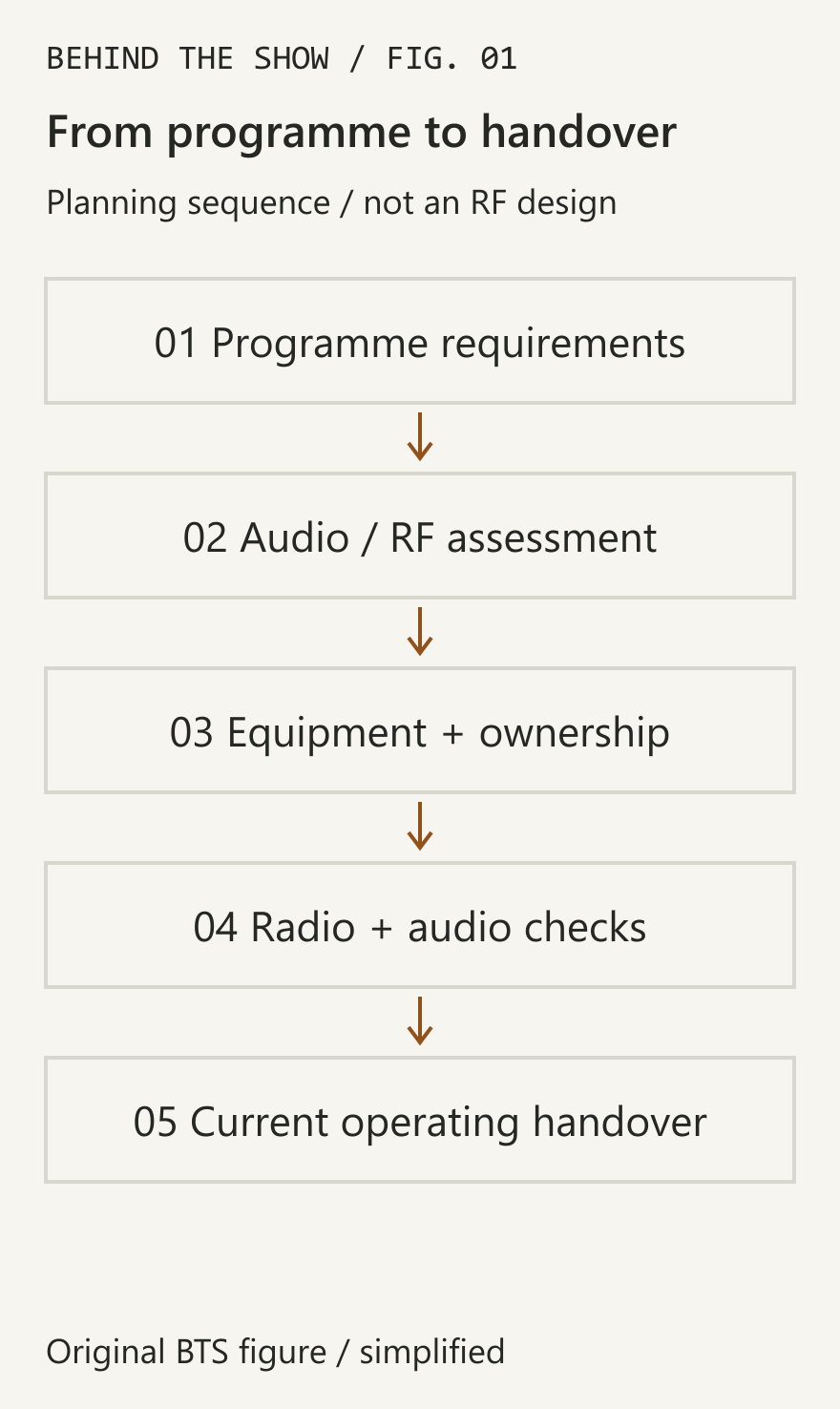
The technical figure separates programme requirements, specialist coordination and the audio handover. Follow signal flow to confirm where each received signal goes. A working radio indication alone does not establish that the audience or required recording destination receives the correct audio.
Give the specialist the complete wireless inventory
Collect equipment models and frequency variants from the venue, audio supplier and visiting artists. Include wireless in-ear monitoring and other relevant production radio systems in the discussion. Shure's coordination guide explains why different system types cannot simply be assumed compatible because their preset group labels match. Wireless coordination basics
Assign who assesses the RF environment and confirms the operating plan. Ask the supplier to confirm that the equipment and intended operation meet the applicable local spectrum and licensing requirements. This guide supplies no frequency allocation, licence exemption or universal channel-spacing rule.
Bring late equipment additions back to that person. Available hardware is not evidence that it can be added to the accepted arrangement without assessment.
Make battery and handover responsibility explicit
Agree the battery or charging method for the selected equipment, who checks readiness and when a replacement can occur. Use the manufacturer's current instructions rather than a generic runtime assumption. Shure's BLX guidance includes battery checks among the responses to wireless performance problems; that does not establish a runtime for a different transmitter. BLX guidance
Label units so the team can connect the physical microphone, receiver channel and mixing input. The input list records the audio requirement; the handover plan identifies who gives the correct unit to the next participant and who controls its use.
Test the actual operating conditions
The audio team should check radio operation and audio delivery in the intended positions and movement areas, with relevant production systems operating. Shure's BLX guide specifically identifies obstructions and trouble spots as things to consider. Its product-specific distances are not universal venue rules. BLX guidance
Distinguish that work from a connection-only line check. Include the microphones and actual handovers in rehearsal. Wireless transport also does not prevent acoustic feedback.
Worked example: the panel grows
Illustrative scenario, not a documented BTS event.
A four-person panel becomes a six-person panel shortly before the event. The coordinator records the additional simultaneous users and asks the audio team to review radio capacity, microphone form, receiver channels, mixing inputs, fitting, batteries and checks. The team also reviews the proposed backup rather than silently consuming it as an extra show channel.
The accepted decision might be additional coordinated systems or a revised wired or shared-microphone arrangement agreed with the organizer. The response remains open until the affected requirements are confirmed. This is a production decision sequence, not a claim that a particular substitute suits every programme.
Keep one current operating record
- Role, segment and simultaneous requirement.
- Microphone form, equipment identification and provider.
- Coordination owner and unresolved technical questions.
- Mixing input and required listening destinations.
- Battery, fitting and handover responsibility.
- Check time, fallback and who authorizes its use.
This BTS checklist supports a workable handover. The RF specialist's technical plan and the applicable equipment instructions remain separate records.
Sources & references
- Shure Whiteboard Session: How to Coordinate a Wireless SystemShure / technical reference / 10 Dec 2015
- BLX User GuideShure / technical reference
Continue learning