5 min read
EXPLAINER / Live Sound
What Causes Microphone Feedback in Live Sound?
Microphone feedback happens when sound from a loudspeaker returns to an open microphone, passes through the sound system and comes out of the loudspeaker again. If that loop reinforces sound sufficiently at a particular frequency, it can produce a sustained ringing, howl or squeal. The cause involves the complete sound path, including placement and operating levels, rather than the microphone alone. S1
On this page
Follow the sound back to the microphone to understand the ringing, howl or squeal.
Follow the sound back to the microphone
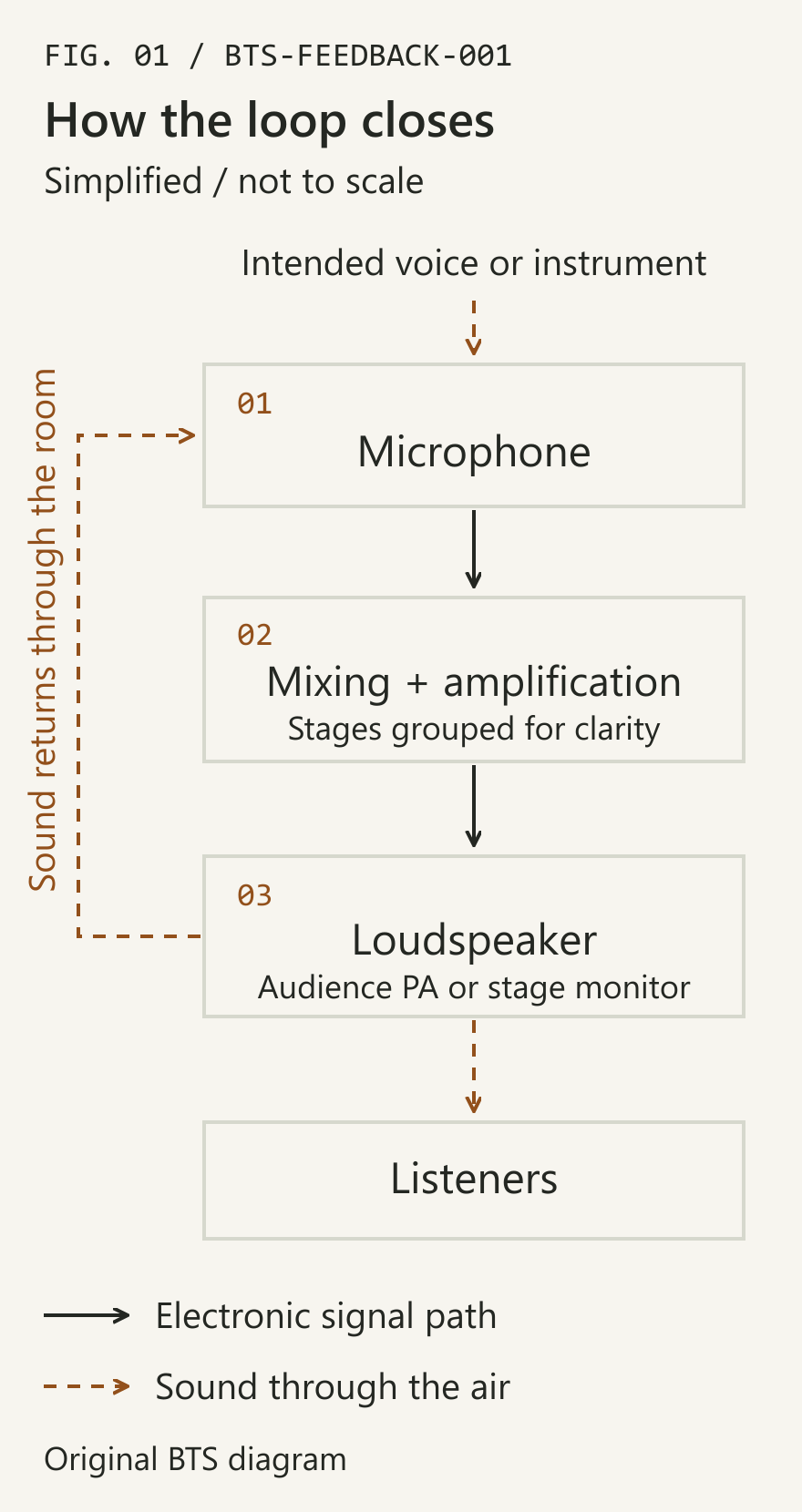
A microphone captures the intended voice or instrument. The mixer routes its signal to a loudspeaker, which reproduces it for listeners. Sound from that loudspeaker can also reach the microphone. The return journey through the air closes the feedback loop. S1
The diagram follows one simplified path. It is a relationship diagram, not a stage layout or a complete system design.
For the wider source-to-destination model, read What Is Signal Flow?.
Placement and microphone technique affect the loop
The engineer considers where the loudspeaker sends sound, what the microphone picks up and the level needed by listeners. Microphone distance from the intended source matters too: a voice captured weakly may need more amplification, making unwanted sound more significant. Covering the grille can change a directional microphone's behaviour. S1, S2
A microphone's polar pattern describes sensitivity from different directions. Cardioid and supercardioid microphones have different rejection patterns, so a monitor position that suits one may not suit the other. Check the actual model's documentation and test the working arrangement. There is no single monitor angle for every microphone. S2
Moving a loudspeaker is also a production decision. Its position must still serve the required listeners and work with the stage layout. An organizer should agree proposed changes with the audio team rather than moving equipment independently.
Feedback can involve the PA or stage monitors
The audience system and performer monitors serve different listening needs. An open microphone may feed either or both, creating more than one possible return path. Knowing which destination is involved helps the engineer choose an effective response. S2, S3
Read What Is FOH? for the audience-mix role, What Is a PA System? for audience reproduction, and What Are Stage Monitors? for performer listening.
More open microphones change the conditions
Microphones that remain open when unnecessary can reduce the level available before feedback. Yamaha recommends managing unused channels, while remembering to restore them when needed. S4
For a panel discussion, BTS's planning approach is to agree which microphones must be available, who operates them and how handovers happen. The aim is reliable participation, not a blanket rule that only one microphone may be open. Share the programme with the audio team so its operating plan matches the event.
EQ helps, but it does not replace the arrangement
Equalization, abbreviated EQ, can reduce troublesome frequency regions. Its location in the system matters: processing the audience output and processing a monitor output affect different paths. Changes also affect the reproduced sound, so adjustments require listening and technical judgement. S3
A feedback suppressor is another control tool. It does not make microphone technique or placement irrelevant. S1 This guide does not prescribe a frequency, filter depth or procedure for deliberately provoking feedback. Have a competent audio engineer assess and test the actual system.
If feedback occurs during the event
The responsible audio operator should promptly reduce or mute the affected path to stop sustained feedback, then assess the cause. Lowering a control that does not affect that path will not necessarily solve the problem. S3 (Response sequence: BTS coordination methodology.)
The organizer can help by keeping communication clear and allowing the team to resolve the issue. Do not ask a presenter to continue through loud feedback while settings are guessed. Agree how the programme will pause or continue and who authorizes the return to use. These are BTS coordination recommendations, not a substitute for the engineer's operating procedure.
Worked example: a changed presenter position
Illustrative scenario, not a documented BTS event.
A presenter rehearses at an agreed position. During the event, they move towards an audience loudspeaker while carrying an open microphone, and ringing starts. The operator first stops the feedback. The team then checks the changed position, routing and required listening level before resuming. The location change is a clue, not proof that every other condition is correct.
The production lesson is to include intended presenter movement in soundcheck and rehearsal. If that movement changes, tell the audio team and confirm what needs checking again. A check at one position does not establish that every possible movement has been assessed.
What to agree before the show
Use these questions with the audio team:
- Where will presenters and performers use their microphones?
- Which microphones feed the audience system, monitors or both?
- Who operates each mix and manages microphones between uses?
- Have the intended positions, movement and required combinations been checked?
- Who handles a feedback interruption and confirms readiness to continue?
This is a BTS coordination checklist. It records responsibilities and operating conditions; it does not certify the system or specify safe exposure levels.
Key takeaway
Understand the return path before treating feedback as an isolated microphone fault. The practical task is to coordinate the system arrangement, microphone use, listening requirements and operation, then check the conditions the show will actually use.
Sources & references
- How to Control Feedback in a Sound SystemShure / technical reference / 25 Jan 2013
- How to Fight Feedback, Part 1Yamaha / technical reference / 17 Aug 2018
- How to Fight Feedback, Part 2Yamaha / technical reference / 14 Sept 2018
- Top Five Tips for Better Live SoundYamaha / technical reference
Continue learning