8 min read
GUIDE / Production Management
How to Coordinate a Touring Artist With Local Production
Coordinate a touring artist with local production by confirming the current performance requirement, naming the artist-side and receiving contacts, and separating artist-carried equipment from committed local supply. Agree who prepares and receives each part, sequence the work around its dependencies, and check the combined arrangement with the relevant people. Record what was actually checked, who accepted that result and what remains unresolved. An agreed advance, an arrival report and a checked performance arrangement establish different things.
On this page
Bring the touring team's requirement and local delivery together in a handover the operating team can use.
Start from the current agreement
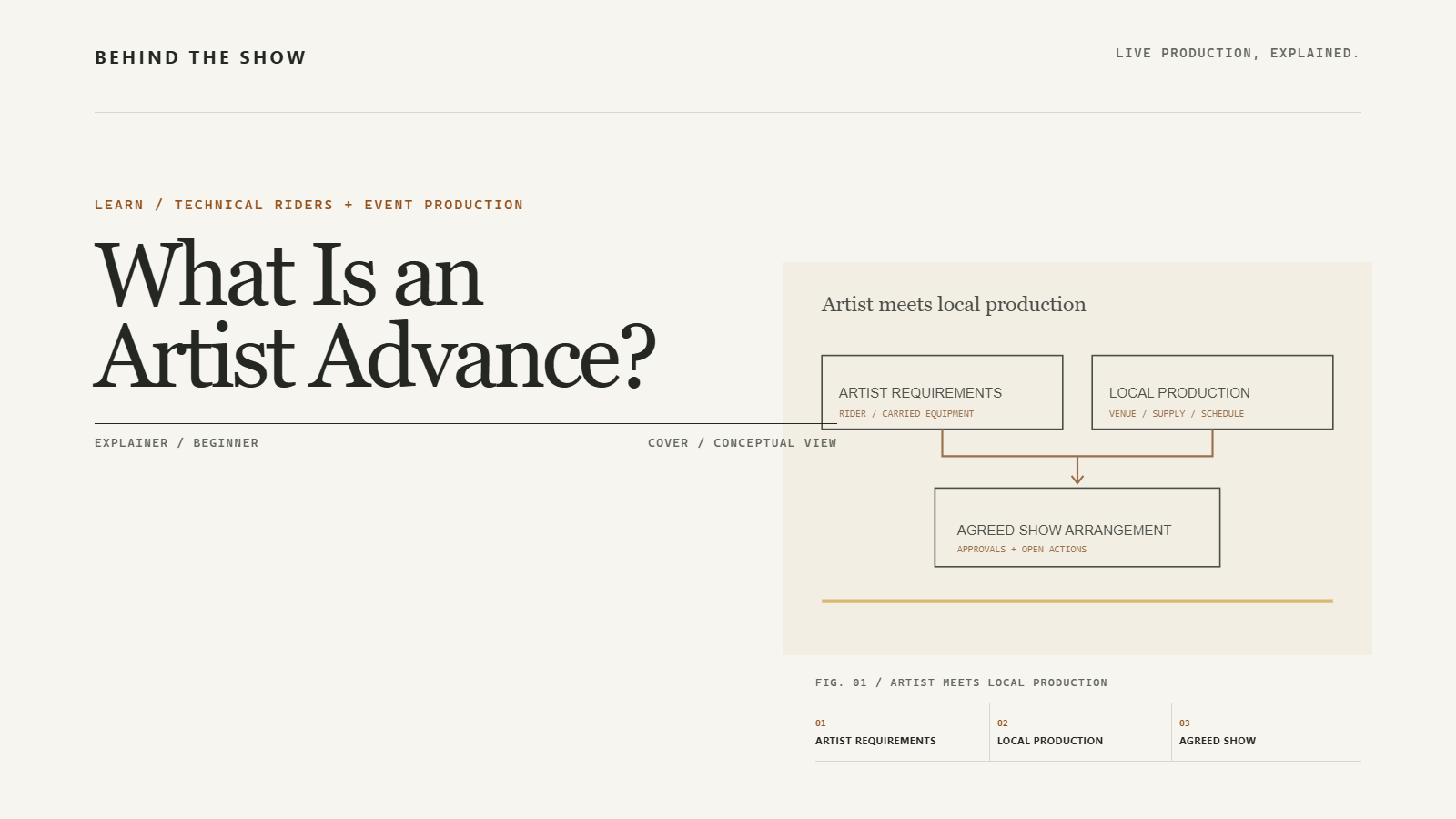
The artist's team and the receiving production need the same description of this performance: the current lineup, documents, carried equipment, local supply, operating roles and schedule. Identify the issue they are preparing from and any decisions still open.
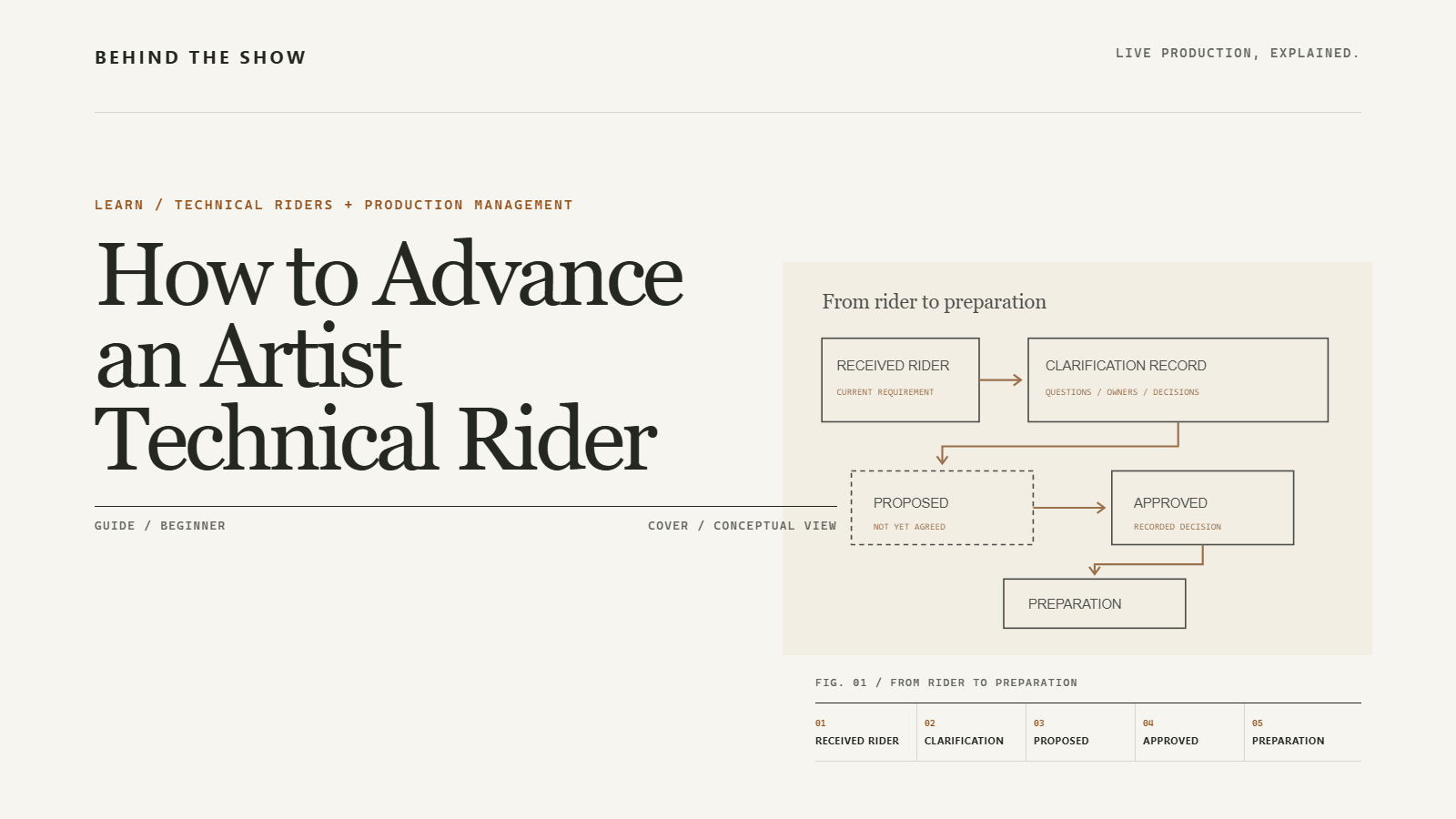
Use artist advance to establish that shared requirement. Where a rider still needs clarification or an alternative needs approval, follow How to Advance an Artist Technical Rider.
Then take the next step: establish how the people arriving at the venue will receive the agreed work. A supplier may have committed its items and the artist may have accepted a proposal while preparation and joint checks remain ahead.
The advance is the reference for preparation. The handover records what was actually received and checked.
Name the people on both sides of each handoff
Identify the artist-side technical contact and the person coordinating receiving production. Then name the relevant supplier, department and operating contacts who must prepare, receive or act on each requirement.
Ask separately who can clarify the artist's need, approve a proposed alternative, commit local supply, report a technical result and decide an affected programme change. One person may hold several functions; forwarding an answer does not establish all of those authorities.
The Tour Manager may coordinate the touring party's daily arrangements, while a Technical Manager on Tour or another assigned technical contact works with local departments. Stage management coordinates its agreed stage and backstage scope. Confirm the actual appointments rather than making the titles interchangeable.
Give the receiving person something specific to accept: which arrangement, which revision, what has been prepared, what has been checked and which condition remains open. “Tour is happy” or “local production is ready” is too broad when only one requirement has been discussed.
Separate carried items, local commitments and completed work
Confirm what the artist is bringing and what the local suppliers have committed to provide. Include the supporting provision and operating work that the agreed setup needs, with the responsible contacts.
Artist acceptance of an alternative and a supplier's commitment to provide it should remain identifiable. Neither is evidence that the item has arrived or that the arrangement works at the intended positions.
At receipt, compare the actual items and relevant information with that agreement. If carried equipment differs, keep the affected requirement open while the appropriate contacts review it. Do not transfer an approval or check result from the earlier arrangement to a changed one by assumption. Update the affected input list, stage plot or other working information where necessary.
Sequence preparation around what the next team needs
Artist arrival, equipment delivery, stage access, preparation and readiness for soundcheck are separate milestones. Put their dependencies into the current production schedule, with the people whose work and availability are affected.
Some local work may be possible before the touring party arrives. Other work depends on its equipment, operators or performers. Ask the responsible leads to identify that division and confirm when the next activity can actually begin.
The Crew Calls and Department Handoffs guide develops the reporting and receiving arrangements. Do not compress required checks silently when an earlier activity finishes late. Put the affected schedule and programme decision back to the assigned contacts.
Worked example: the playback arrives, but the performer handover is incomplete
A fictional two-person act has a vocalist and guitarist. The artist team carries its playback device and provides the operator. Both performers need to hear the agreed playback and vocal cues during the relevant passage. Local production supplies the agreed audio provision and performer-monitoring arrangement.
The artist technical contact has accepted the documented local proposal, including the intended performer positions. The supplier's authorised contact has separately confirmed that provision and its operator. The current source identities and positions are recorded in the working input list and stage plot. This example starts after those agreements; it does not prescribe equipment models, connections, signal levels or a monitoring design.
For this date, the Tour Manager communicates the touring party's arrival. The artist Technical Manager coordinates its technical handover with the local audio lead. Stage management coordinates the agreed positions and movement arrangements. An assigned programme contact decides any requested timetable change. These are the functions assigned for this example, not compulsory separate jobs on every production.
First check: several reports describe different results
| Requirement | Actual report or observation | Receiving decision still needed |
|---|---|---|
| Touring equipment and operator are present | The artist technical contact identifies the arriving device and operator against the current agreement | Record receipt within that scope; presence does not establish the prepared system or performer result |
| Agreed local provision is supplied | The local audio lead confirms the supplied items against the committed revision | Keep this delivery confirmation separate from the checks of the combined arrangement |
| Playback reaches its identified local audio inputs | The audio team reports the identified sources at its agreed check point | This result does not establish what either performer hears at their position |
| Both performers receive the agreed cues | During the attempted passage, the vocalist confirms the required playback and vocal cues; the guitarist reports that the needed vocal cue is not usable at the agreed position | Keep the guitarist's requirement open and obtain the audio team's assessment; the successful source check does not close it |
The artist Technical Manager records the guitarist's observation and identifies the passage and position involved. They do not mark the entire performance arrangement accepted because the device arrived, the supplier delivered its scope or the audio team confirmed the sources.
This is where soundcheck contributes evidence about the actual performers and programme. A line check answers a different question. The guitarist's report also does not diagnose a particular faulty device, setting or missing item.
Review the response with the people it affects
The local audio lead assesses the unmet cue requirement and proposes an adjustment using the agreed provision. The artist technical contact confirms what the performers need. Stage management checks whether the proposal changes the reviewed positions or movement arrangements. The relevant supplier contact confirms the proposed work is within its committed scope.
For this example, those contacts confirm that the existing positions and supply scope can be retained. Additional check time is still needed. The receiving coordinator obtains the programme contact's decision on that window and confirms the affected people's availability. A revised time in the schedule alone would not establish those commitments.
If the proposal required more equipment, a different position or a changed programme, the affected people would need to review and approve those consequences before the response was treated as agreed. The coordination record does not authorise a specialist adjustment or programme change on someone else's behalf.
Second check: accept the result that was demonstrated
After the audio team's agreed work, the relevant people repeat the passage. At the retained positions, the vocalist and guitarist each confirm that the playback and vocal cues required for that passage are usable. The local audio lead records its relevant checks, and the artist technical contact accepts the performer requirement within this example's assigned authority.
Record the arrangement, document issue, positions, passage checked, responsible contacts and any limits. This establishes the checked result for that arrangement and passage. It does not declare every later song, future content revision or whole-event condition ready.
The receiving coordinator passes that scoped result and the current operating information to stage management, the relevant operators and the person coordinating the performance cue. A checked handover is not itself the instruction to start the act, and it does not override a venue or specialist restriction.
If a position changes after the check
Before the performance, the guitarist asks to move to another position. Keep the previous result attached to the position actually tried. Ask the audio and stage contacts to review the changed requirement and identify the affected rechecks, preparation and programme consequences.
Do not quietly carry the earlier acceptance onto the new position. If the necessary review or checks cannot be completed in the available window, the assigned contacts must decide the permitted next step under the event's actual arrangements.
ILLUSTRATIVE SCENARIO
Leave the operating team with one current handover
The handover should identify the performance and current documents, the artist-carried and local provision, the people operating each part, the relevant checked results and the scope of acceptance. Keep untested passages, changed conditions and other open items explicit, with an owner and a next decision point.
Confirm that the people taking over understand what they are receiving. Receiving a message or being named on a list does not establish acceptance of the work or its operating responsibilities.
For a wider pre-doors decision, use Production Readiness. The local artist arrangement is one part of that picture. Its handover should make the accepted scope and remaining limits easier for the next decision-maker to use.
Related questions
How do you coordinate a touring artist with local production?
Start with the current artist requirement and committed local provision. Name the preparing and receiving contacts, sequence dependent work, compare actual arrivals with the agreement, and record the checked result, acceptance scope and owned open items before handing over.
Who coordinates an artist advance?
An agreed artist-side and receiving-production contact coordinate the process, involving relevant departments and approvers. Roles vary by production.
Does artist approval confirm that local equipment will be supplied?
No. Artist acceptance of a proposal and a supplier's commitment to provide it are separate confirmations. Identify the agreed revision, authorised contacts, provision and conditions; then keep delivery and completed checks separate from both.
What should a department handoff confirm?
Identify the defined output or work condition, relevant checks, receiving owner, acceptance scope and remaining limitations. Confirm what permits the dependent activity to begin without treating one department's result as whole-event readiness.
What if the equipment arriving with an artist differs from the advance?
Identify the difference and affected requirement, obtain review from the appropriate artist and receiving specialists, and update the relevant commitments and working information. Earlier approval or check results do not automatically cover the changed arrangement.
What should be ready before soundcheck?
Current requirements, backline, inputs, connections, monitoring, audience system, playback and a workable schedule should be prepared as far as the production permits.
Who approves changes to a live production?
Approval depends on the decision and agreed authority. Identify the relevant client, artist, venue or specialist approver and communicate the result to affected teams.
What should the artist advance handover contain?
The current agreed arrangements, relevant documents, local and carried equipment responsibilities, approved alternatives, schedule, contacts and open actions.
Continue learning