9 min read
EXPLAINER / Live Sound
What Is a Line Array?
A line array is an arrangement of loudspeaker elements designed to work together along a line to shape how sound reaches listeners. At live events, it is often seen as a vertical, sometimes curved group of cabinets beside the stage. Its coverage depends on the loudspeaker design, array geometry, frequency and listening area. A line array is one possible part of an audience PA system, not a guarantee of suitable sound throughout a venue.
On this page
The curved loudspeakers beside the stage are part of a coverage design. Start with where people will listen.
In brief
- A line array combines purpose-designed loudspeaker elements into an arrangement serving the audience.
- Shape, position and the listening area matter alongside the equipment itself.
- A changed audience layout needs review. A louder system is not automatically a wider one.
- The installed arrangement needs checking against the current design and agreed listening requirements.
Why are the speakers arranged in a line?
The tall group of loudspeakers beside a concert stage is often a line array. Its elements are designed to combine acoustically. That makes their relationship to one another part of the system's behaviour, rather than simply a way to store more cabinets in one place.
Electro-Voice's Line Arrays: History and Theory explains how source spacing and array dimensions relate to wavelength. Placing unrelated loudspeakers above one another does not establish the same controlled result.
Begin with What Is a PA System? if the audience-reproduction function is unfamiliar. The array is part of that arrangement; the complete event still needs the other agreed audio functions.
What does the curve do?
In a typical curved vertical array, the angles between elements help shape vertical coverage. These angles are often called splay angles. Array length, aiming and the particular loudspeaker design also matter. Their influence changes with frequency.
Meyer Sound's MAPP 3D design reference distinguishes the effect of inter-element angles at higher frequencies from the influence of array length and overall orientation at lower frequencies. The visible curve is only part of the explanation.
For a production brief, describe the near and distant listening areas, seating slopes, balconies or other relevant geometry. Let the responsible audio designer establish an appropriate arrangement. A photograph of a curved hang does not provide the information needed to copy it into another venue.
Low-frequency system arrangement is a separate part of the wider plan; Subwoofer Placement develops that subject.
Width and distance are different questions
A front row, a distant seating block and an audience section off to one side present different listening requirements. Reviewing one of those areas does not establish the others.
A wider audience area is a new coverage question, even when its farthest seat is no farther away.
That is why an audience count alone is an incomplete brief. Mark where people will actually be, including side seating and any areas added after the original plan. Ask the audio team to review that layout rather than assume the existing arrangement will cover it.
Conceptual diagram: depth is not width
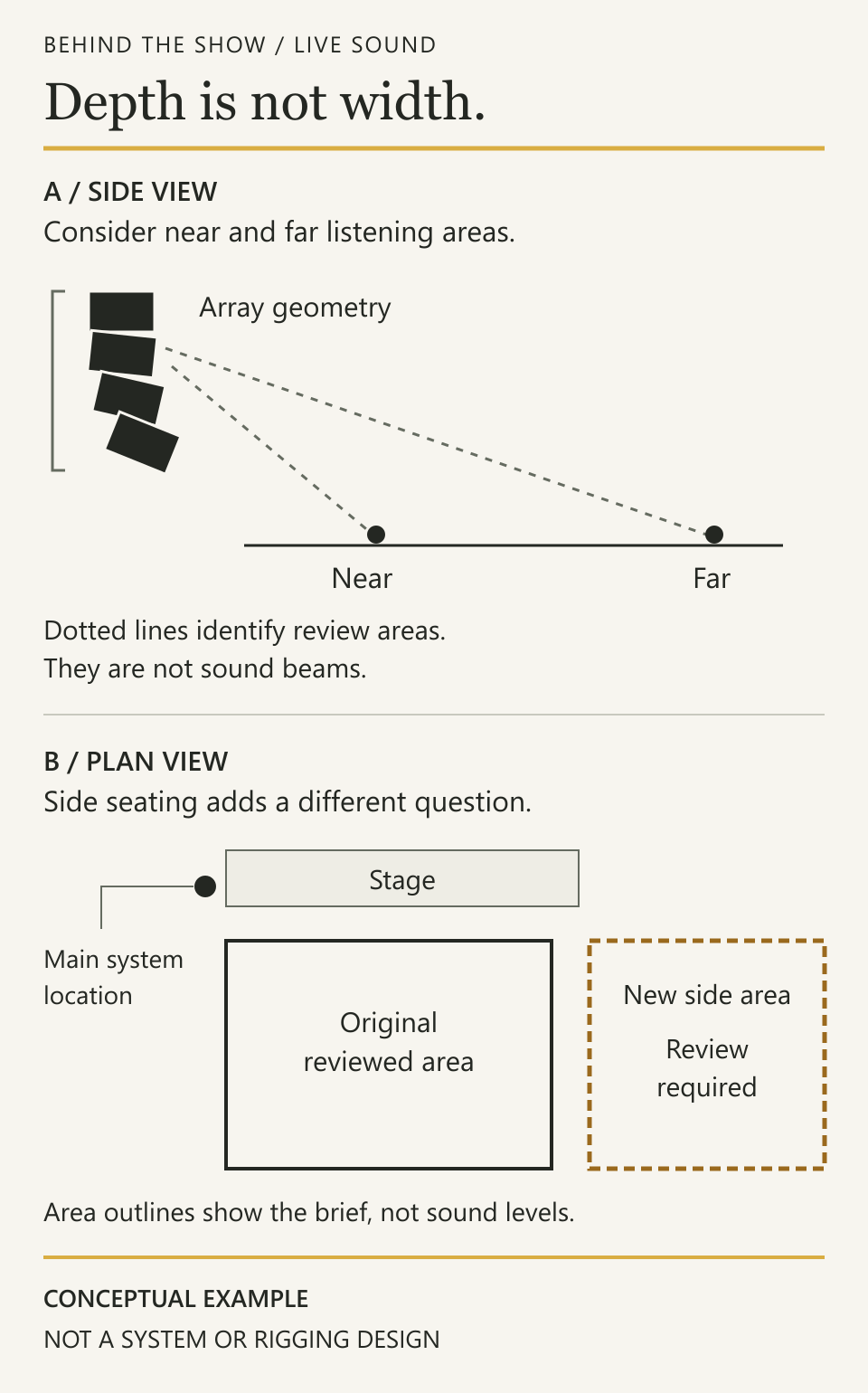
In the side view, array geometry is considered against near and far listening areas. In the plan view, a new side audience block sits beyond the area included in the original review. These are different views of the requirement, not a prediction of sound levels. The connecting lines identify areas to consider; they are not sound beams or coverage boundaries.
What can prediction software establish?
The designer can model a proposed arrangement against a representation of the venue. For example, d&b ArrayCalc represents audience listening areas and predicts system behaviour for supported loudspeakers. It helps the designer compare proposals using the layout and configuration entered into the model.
Ask which audience-plan revision the proposal uses and which areas were included. A model of yesterday's layout does not answer a question about seating added today.
Keep the prediction and the installed result distinct. The prepared system still needs the responsible team's checks. d&b's Array verification explanation provides one manufacturer-specific example: checking actual loudspeaker order and connections against the planned configuration. That feature is not a universal procedure or a complete acoustic acceptance test.
Worked example: seating is added beside the original audience area
A fictional outdoor event has a central audience area in the agreed plan. Its audio proposal includes a line-array system reviewed for that layout. Before the event, the organiser proposes an additional seating block to the right of the original area. It is beside the existing seats, not behind them.
The organiser asks whether the audio supplier can add a few cabinets or turn the system up. The production lead first sends the marked-up audience plan to the person responsible for system design. No equipment change has yet been agreed.
First review: what does the existing evidence cover?
| Information available | What it establishes | What remains unresolved |
|---|---|---|
| A proposal based on audience plan A | There is a proposed arrangement for the original central area. | Whether it serves the new side block in plan B. |
| The same programme and audience-system inventory | Some briefing information is unchanged. | Whether the arrangement remains appropriate for the revised geometry. |
| A centre-area listening check, if already completed | A result at the checked position under those conditions. | The side block, its boundary with the original area and any affected original positions. |
| A request for more level or more cabinets | A proposed response to discuss. | Its suitability, feasibility, approval and checked result. |
The unchanged distance to the rear seats does not close the width question. The audio designer reviews plan B, the system configuration and feasible options. The production team confirms which areas the organiser intends to use and when a decision is needed.
Proposed resolution: serve the revised area without assuming a setting
For this example, the audio designer proposes an additional audience loudspeaker arrangement for the side block. The proposal identifies its intended area, how it relates to the existing system, the installation conditions to resolve and the checks needed. This is one fictional choice, not a recommendation that all side extensions need extra loudspeakers.
The production lead coordinates the proposal with the organiser, venue and supplier. Any proposed equipment position or support arrangement goes to the people responsible for that work. An audio coverage proposal does not approve structural support, public routes, electrical work or venue use.
The supplier confirms the agreed supply and operating scope. The authorised event representative accepts any scope, budget or programme consequences. The audio lead remains responsible for the technical recommendation and affected system checks. Those functions may be held by different people; agree them rather than infer them from job titles.
Second review: the new section is still unresolved
The proposed arrangement is prepared. A check in the central audience area remains satisfactory for that checked position, but the team has not yet checked the added seats or the transition between the two areas.
The production lead keeps the side-block audio requirement open. Equipment being present and the central-area result do not establish the new result. The responsible audio team completes its agreed checks in the side area, the transition and affected original positions before reporting the outcome.
Suppose those checks support the agreed listening requirement for plan B. Record the layout revision, arrangement reviewed, checked areas, responsible people and any remaining limitations. If the requirement cannot be met, escalate the available options to the authorised decision-maker. The added area remains unresolved until an acceptable arrangement or a revised audience plan is agreed and checked as required.
What closes this example?
Closure is a recorded result against the current audio requirement, with the necessary decisions accepted by the responsible people. It is not a claim that every seat has identical sound, that later layout changes are covered or that the event has received safety certification.
If seats move again, identify what changed and reopen the affected review. The Delay Speakers guide follows a different case: a new audience area farther behind the original one. The same discipline applies, but the geometry and technical response need their own assessment.
ILLUSTRATIVE SCENARIO
Does every event need a line array?
The useful briefing question is what listeners need, where they will be and what conditions the system must work within. A line array is one possible response. A compact room, an irregular listening area and a large outdoor audience do not automatically call for the same arrangement.
Give the supplier the programme, current audience plan, venue information, constraints and expected responsibilities. Ask how the proposed system addresses those requirements. A familiar silhouette or a large cabinet count is not an explanation of suitability.
Who checks the system, and who mixes the show?
Agree who owns system design, preparation, verification and operation. The FOH engineer may hold several of those functions or work alongside a system engineer. A title alone does not assign all of them.
System checks and soundcheck have connected purposes. The prepared audience system must work with the actual programme, while performers may also need separate monitoring. Hearing a source in a performer mix does not establish its audience result.
No generic explainer can supply the approved mechanical arrangement for a suspended array. Manufacturer instructions, competent personnel and the relevant venue and engineering requirements govern that work. This article provides no rigging method, load assessment, aiming settings or permission to change installed equipment.
What to ask about an array proposal
Ask which listening areas it serves, which audience-plan revision it uses, who owns the design and checks, and what remains unconfirmed. If the layout changes, give the responsible team the revision before treating the earlier proposal as current.
Start with the listening area. Confirm the proposed arrangement. Check the result.
Related questions
What is a line array?
An arrangement of loudspeaker elements designed to work together along a line to shape sound radiation. Its suitability depends on the system and listening requirement.
Why are line-array speakers curved?
In a typical curved vertical array, the angles between elements help shape vertical coverage. The result also depends on the loudspeaker design, array geometry and frequency.
Is a line array the same as a stack of speakers?
No. A line array relies on elements and their arrangement being designed to work together. Stacking unrelated cabinets does not establish the same behaviour.
Does adding more line-array cabinets solve a wider audience area?
Not automatically. The responsible designer needs to review the revised listening area and system arrangement before selecting a response.
Does every event need a line array?
No. Start with the programme, audience layout, venue and constraints, then have the responsible audio team propose an appropriate system.
Does a coverage prediction replace checks of the installed system?
No. A prediction represents the entered model and configuration. The prepared arrangement and affected listening requirements still need the responsible team's checks.
Who is responsible for line-array design and checks?
Assign those functions explicitly. They may be held by the FOH engineer, a system engineer or other agreed competent people; the job title alone does not establish the scope.
What should be reviewed if the audience area changes?
Review the new listening areas, current system arrangement, feasible positions, responsibilities and affected checks. An earlier result does not establish coverage for an unreviewed extension.
Sources & references
- Line Arrays: History and TheoryElectro-Voice / manufacturer
- User Guide: MAPP 3DMeyer Sound / manufacturer
- ArrayCalcd&b audiotechnik / manufacturer
- Array verificationd&b audiotechnik / manufacturer
Continue learning