6 min read
EXPLAINER / Live Sound
Why Does Subwoofer Placement Matter at a Live Event?
Subwoofer placement matters because the position and arrangement of low-frequency loudspeakers affect how their sound combines across the audience and reaches the stage or other areas. The same equipment can produce different coverage when its layout and processing change. The audio team needs to review those choices with the venue, programme and main sound system, then check the installed arrangement rather than judging it from cabinet count or one listening position.
On this page
An equipment count does not describe where the bass will go.
The equipment list does not show the listening result
A proposal lists the subwoofers for an event. That tells the receiving team something about the equipment, but not how bass will be distributed across the audience.
A subwoofer is a loudspeaker intended to reproduce the low-frequency part of the programme. It is one part of the audience PA system. Its job is different from the bass instrument or amplifier a musician performs with.
Ask what the arrangement is intended to achieve, where the audience will be, and what still needs review. A neat row in a photograph does not answer those questions.
Why the same boxes can give different results
Where multiple loudspeakers reproduce the same frequency, their sound can reinforce or reduce one another at different listening positions. The result depends on the frequency, arrangement and relative arrival of the sound.
For example, Fulcrum Acoustic's discussion of subwoofer placement explains how separated left/right sources can produce uneven bass across a listening area. This is a reason to assess an arrangement, not a rule that every left/right layout is unacceptable.
An equipment count is not a coverage plan.
The person mixing from FOH hears the result at their operating position. That position is useful, but it does not describe every audience location. A concern reported elsewhere should be identified by location and programme condition so the responsible team can investigate it.
Audience coverage and stage spill are different questions
The production may want useful bass reproduction for the audience while limiting unwanted low-frequency sound on stage or elsewhere. A directional subwoofer system is intended to control radiation; its result depends on the actual equipment and configuration.
Fulcrum describes directional systems in that context. A manufacturer example from d&b's Muse application describes a sub array using physical spacing and time alignment to address audience coverage and unwanted rear radiation together. It is an example of that particular system, not a design to copy.
Do not assume that a curved layout necessarily sends more bass onto the stage, or that a row pointing forward establishes rear rejection. Appearance alone does not identify the processing, cabinet characteristics or achieved result.
Arrangement and processing belong together
Terms such as end-fire, cardioid and arc describe aspects of array techniques or radiation behaviour. They are not three mutually exclusive equipment packages, and they do not establish the settings for an unfamiliar system.
d&b's ArrayCalc documentation describes modelling audience areas and the interaction of active sources, including subwoofers and their relationship to other loudspeakers. This illustrates why the layout is considered as a system. It does not mean that one software product is required for every event.
The useful production question is whether the proposed physical arrangement and the corresponding system configuration have been reviewed together. Signal Flow explains the wider source-to-destination path; neither a working feed nor a spacing value copied from a reel establishes the acoustic result of an array.
Worked example: the proposed space changes
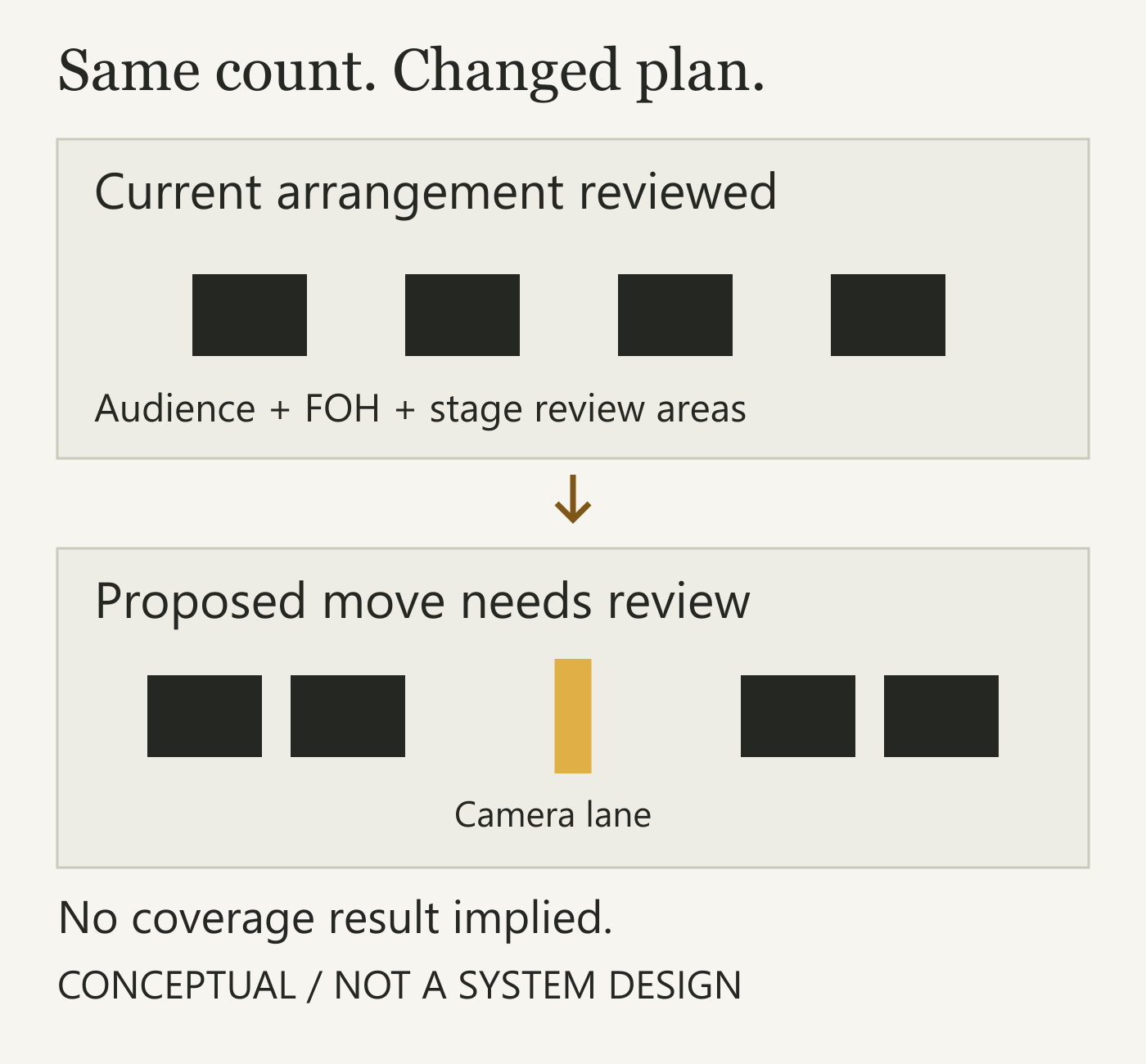
A fictional outdoor concert has a reviewed ground-based subwoofer arrangement in front of its stage. During a production review, the organiser requests a central camera lane through the space occupied by part of that arrangement.
The first suggestion is to move the affected cabinets to the sides and keep the same equipment count. The production lead records this as a proposed layout change, not an equivalent arrangement already accepted by the audio team.
Review what the move affects
The audio lead receives the revised audience and camera plan, the proposed equipment positions and the current system information. They review the audience requirement, unwanted stage sound, relationship to the main loudspeakers and the feasibility of the proposed configuration. The camera requirement is also checked with the relevant production and venue contacts.
In this fictional case, the audio lead does not accept the suggested cabinet move without further design work. A revised arrangement and matching configuration are prepared. The production lead coordinates the camera lane, permitted equipment footprint, cable routes and work sequence with the responsible teams.
This example does not select the revised array type or promise that the same equipment is sufficient. The decision is that the proposed move must be reviewed before installation proceeds on that basis.
Check more than the FOH position
Once the agreed arrangement is installed, the audio team carries out its appropriate system checks and reviews the agreed audience and stage listening areas with relevant programme material. The review is coordinated with the people working in those areas.
The first report says the result is useful at FOH, while a side audience position and a stage position still raise concerns. Record those observations without deciding that the cause must be polarity, delay, placement or a mix setting. The responsible audio lead investigates, makes an appropriate change and repeats the affected checks.
The team does not resolve the report by asking the organiser to choose a tuning value, or by moving another cabinet without review.
Record the checked arrangement and the open condition
After the repeat review, the audio lead records the checked arrangement, relevant configuration, results and any remaining limitations. The production lead confirms that other affected teams have the current layout and responsibility information.
A proposed audience extension beyond the checked side area remains open. The organiser and production lead obtain the further review needed before treating it as served. The earlier result is evidence about the arrangement that was checked, not every possible audience layout.
ILLUSTRATIVE SCENARIO
What should an organiser tell the audio team?
Share the actual programme, current audience plan, stage and camera requirements, permitted equipment footprint, venue restrictions and available setup and checking time. Identify changes while they can still be reviewed.
You do not need to turn that information into a subwoofer layout. The people responsible for the system should propose the arrangement and explain what they need from the venue and production.
Production Advance provides the coordination process. Soundcheck checks the wider system with performers and programme; it does not make unreviewed layout changes automatically acceptable.
A visual idea is not a deployment instruction
A conceptual diagram can show which areas need review. It cannot demonstrate the measured response of a real array unless it is supported by the actual system model or measurements.
This introduction does not provide cabinet spacing, polarity, crossover, delay or level settings. Physical placement must also comply with the relevant installation, structural, electrical, access and venue requirements through the people responsible for them. A coverage decision does not replace those approvals.
The useful question is not simply how many subwoofers are present. It is what the arrangement is intended to deliver, what has been checked, and what a proposed change would invalidate.
Related questions
What is a subwoofer in a live sound system?
A loudspeaker intended to reproduce the low-frequency part of the programme. It forms part of the audience sound system and is distinct from a musician's bass instrument or amplifier.
Why does subwoofer placement matter?
Arrangement affects how sound combines across the audience and reaches the stage or other areas. The same equipment count does not establish the same coverage.
Can the same subwoofers produce different coverage in different layouts?
Yes. Physical arrangement and processing affect the result, so a proposed layout change needs review and affected checks.
Does an arc of subwoofers automatically provide even coverage?
No. The shape alone does not establish the cabinet behaviour, configuration, frequency-dependent result or unwanted radiation. The actual design needs assessment.
Is a good bass result at FOH enough to confirm the whole audience area?
No. It is evidence about that listening position. The responsible audio team needs to review the other agreed listening areas and relevant system conditions.
What should happen before installed subwoofers are moved?
Have the responsible audio lead review the proposed change, coordinate affected production and venue requirements, update the agreed information and repeat the relevant checks.
Sources & references
- Controlling SubwoofersFulcrum Acoustic / manufacturer
- Musing with degrees of speed.d&b audiotechnik / manufacturer
- ArrayCalcd&b audiotechnik / manufacturer
Continue learning