7 min read
GUIDE / Event Production
How to Align a Production Schedule and Run of Show
Align a production schedule and run of show by agreeing shared milestones, identifying what must be ready for each programme segment and allocating the preparation, checks and handovers those requirements need. When the programme changes, review the affected preparation tasks and issue consistent revisions rather than changing a timestamp in only one document.
On this page
Two working documents, one production. Check that the time allowed for preparation supports what the programme asks the team to deliver.
Begin with the shared milestones
The production schedule covers the working timeline. The run of show describes programme delivery. They need to agree at the points where that work meets the audience programme: relevant readiness checks, doors, show start and show end.
A shared milestone is not proof that every department is ready. Confirm what must have happened before it can be reached, who coordinates that check and which questions remain open.
Work back from what each segment requires
A panel may need participants, furniture, microphones and an agreed transition. A video needs the intended file, playback readiness and a clear start cue. These requirements belong in preparation as well as in programme delivery.
Ask the responsible teams what needs to be prepared, checked or rehearsed. Do not invent a standard duration for those tasks. Where an answer is unknown, record the assumption and who will confirm it.
Read the two documents together
Consider a fictional event with a welcome, a video and a panel. The times below are illustrative only. They are not recommended task durations or a complete production plan.
Production schedule extract:
| Planned time | Milestone | Readiness question |
|---|---|---|
| 14:00 | Venue access | Are the agreed room and movement routes actually available? |
| 17:30 | Programme rehearsal | Are the relevant people, systems and approved content ready together? |
| 18:30 | Doors | Has the agreed readiness check happened before audience entry? |
| 19:00 | Show starts | Does the current run of show use the same starting milestone? |
| 20:00 | Planned show end | What conditions must be met before strike and equipment movement begin? |
Run of show extract:
| Planned time | Segment | Preparation or handover dependency |
|---|---|---|
| 19:00 | Welcome | Presenter and agreed microphone arrangement ready. |
| 19:05 | Video | Approved playback file checked; agreed cue follows the welcome. |
| 19:08 | Panel transition | Furniture and participants move under the agreed coordination plan. |
| 19:10 | Panel begins | Positions and required audio arrangements ready. |
The example is deliberately partial. It does not establish that the shown transition allowance is sufficient. The responsible team must assess and test the real arrangement.
Trace a change through preparation
Suppose the programme lead proposes opening with the panel instead of the welcome. Moving the panel row to 19:00 does not resolve the production requirement.
The stage arrangement now needs to be ready before the opening. The presenter entrance and video handover change. The rehearsal needs to test the revised opening and the transition that follows it. The people coordinating stage activity, audio, playback and programme delivery need the same current information.
In this fictional exercise, the production team records the proposed order and asks the affected teams to confirm the implications before it is issued as agreed. No equipment addition, shortened check or revised task duration is approved merely because the programme changed.
Annotate the proposed opening before issuing a revision
Continue the same fictional event. The request is to open with the panel at the existing 19:00 show-start milestone. The current run of show still opens with the welcome. The request has not been approved, and the order of the later welcome and video still needs agreement.
Keep the current milestones visible while reviewing what the proposed opening would require. The annotations below record questions against the existing plan; they do not issue a revised schedule.
| Current planned time | Current milestone | Annotation for the proposed panel opening |
|---|---|---|
| 14:00 | Venue access | Retain the current reference while the venue confirms the room and movement routes needed for the revised preparation. Earlier access has not been requested or approved in this record. |
| 17:30 | Programme rehearsal | Ask the relevant teams whether the revised opening and its following handover can be prepared and checked together. The existing slot does not establish that the revised work fits. |
| 18:30 | Doors | Review what must be ready before audience entry if panel positions are needed for the opening. No readiness result is recorded. |
| 19:00 | Show starts | Proposed opening: panel instead of welcome. Keep the current welcome instruction until the programme decision and coordinated revision are issued. |
The request crosses both documents. The production schedule needs a reviewed preparation and rehearsal arrangement. The run of show needs an agreed opening, subsequent order and cue handovers. Changing the segment beside 19:00 settles neither of those requirements.
| Affected work | Question or proposed change | Responsible response | State before issue |
|---|---|---|---|
| Venue access | Can the revised preparation use the current room and movement arrangements? | Venue contact confirms the applicable access; affected teams assess their preparation within it | Confirmation outstanding; no new access window agreed |
| Rehearsal | What needs to be rehearsed for the panel opening and the segment that follows? | Stage, audio, playback and programme teams identify their inputs; schedule owner reviews the working opportunity | Revised rehearsal arrangement open; no standard duration assumed |
| Crew availability | Do the people performing the changed preparation and handovers need different calls or duties? | Affected delivery leads review availability and agree any changes with the schedule owner | No crew-call time is specified in this partial extract; no extra crew or revised call approved |
| Cues and programme order | Which readiness reports, opening instruction and later welcome/video handovers would change? | Programme owner decides the order; caller and affected operators agree the resulting cue references, triggers and responses | Programme decision and cue revision pending; moving a row is not an execution instruction |
The coordinator carries these responses to the programme decision and records any conditions attached to it. If the opening is approved, the document owners issue the agreed schedule and run-of-show revisions together, identifying which versions they replace and which preparation or checks remain outstanding. Programme approval does not establish that preparation or rehearsal has been completed.
At the end of this annotation, the access confirmation, rehearsal arrangement, crew review and cue revision remain open. The current welcome opening remains the delivery instruction. The next step is to obtain the responsible responses and the programme owner's decision before circulating a changed instruction to affected teams.
ILLUSTRATIVE SCENARIO
Keep planned times and triggers distinct
A planned start time helps coordination. An operational cue may still depend on a presenter finishing, a participant being ready or an agreed clearance. Record the relevant trigger and communication route rather than treating every timestamp as an automatic instruction.
This is where a run of show supports delivery, while the wider schedule ensures the preparations needed for those handovers have a workable opportunity to happen.
Issue a coordinated revision
Agree who maintains each document and how changes reach affected teams. Identify what changed, which preparation decisions were confirmed and what remains open. Update the working schedule where its milestones or tasks are affected, not only the programme sequence. Where the revision affects calls or duties, the Crew Calls and Department Handoffs guide explains how to reconfirm personnel availability and receiving responsibilities. Issuing the revised documents does not, by itself, commit the affected crew.
If the team cannot yet confirm a workable revised plan, keep the proposal visible as unresolved. Reformatting a spreadsheet does not resolve a production dependency.
The documents align when preparation supports the programme, not merely when their show-start times match.
Related questions
What should a production schedule include?
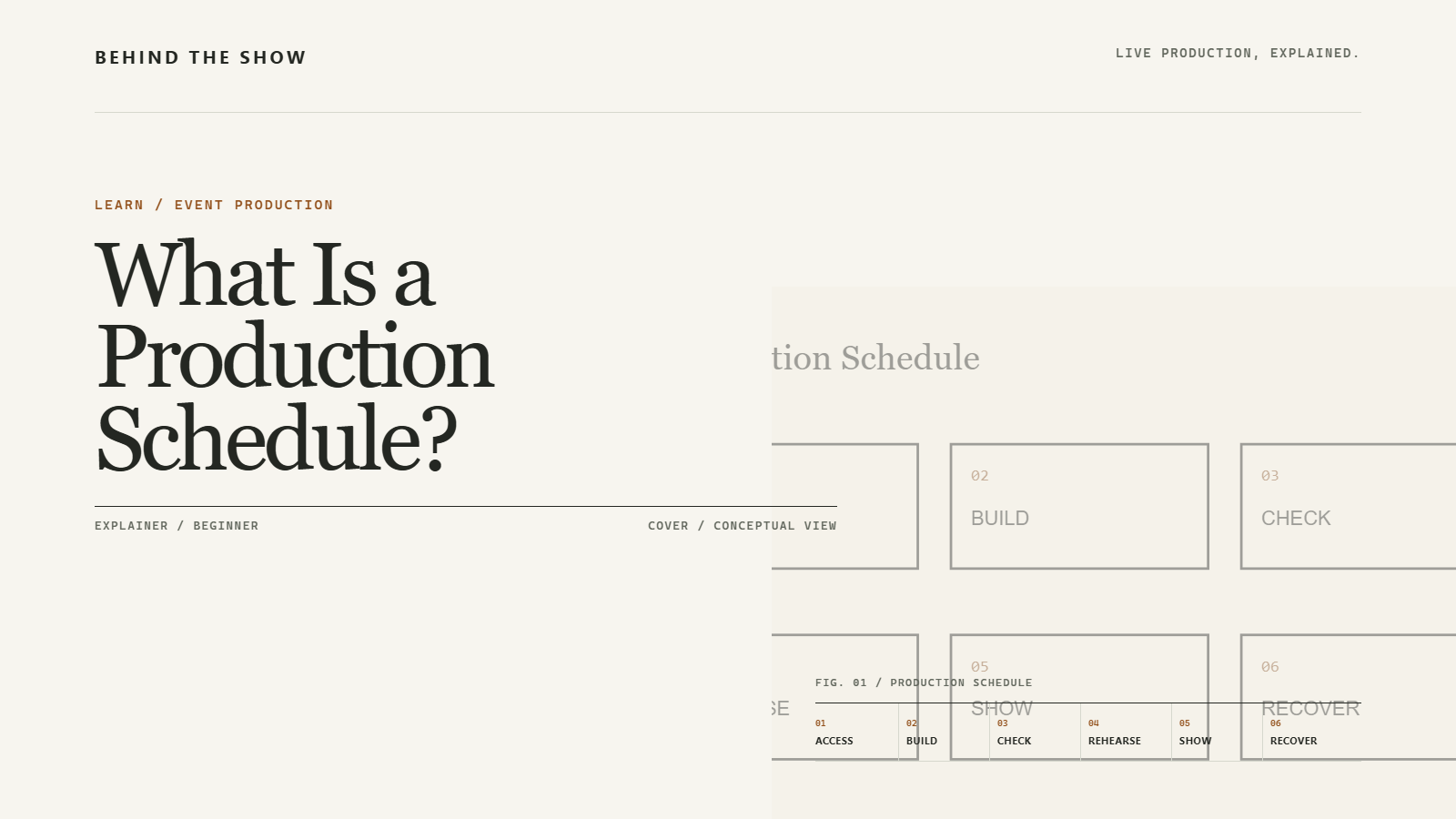
Relevant access, load-in, build, checks, rehearsal, soundcheck, doors, show, strike and load-out milestones with responsibilities and dependencies.
What should a run of show include?
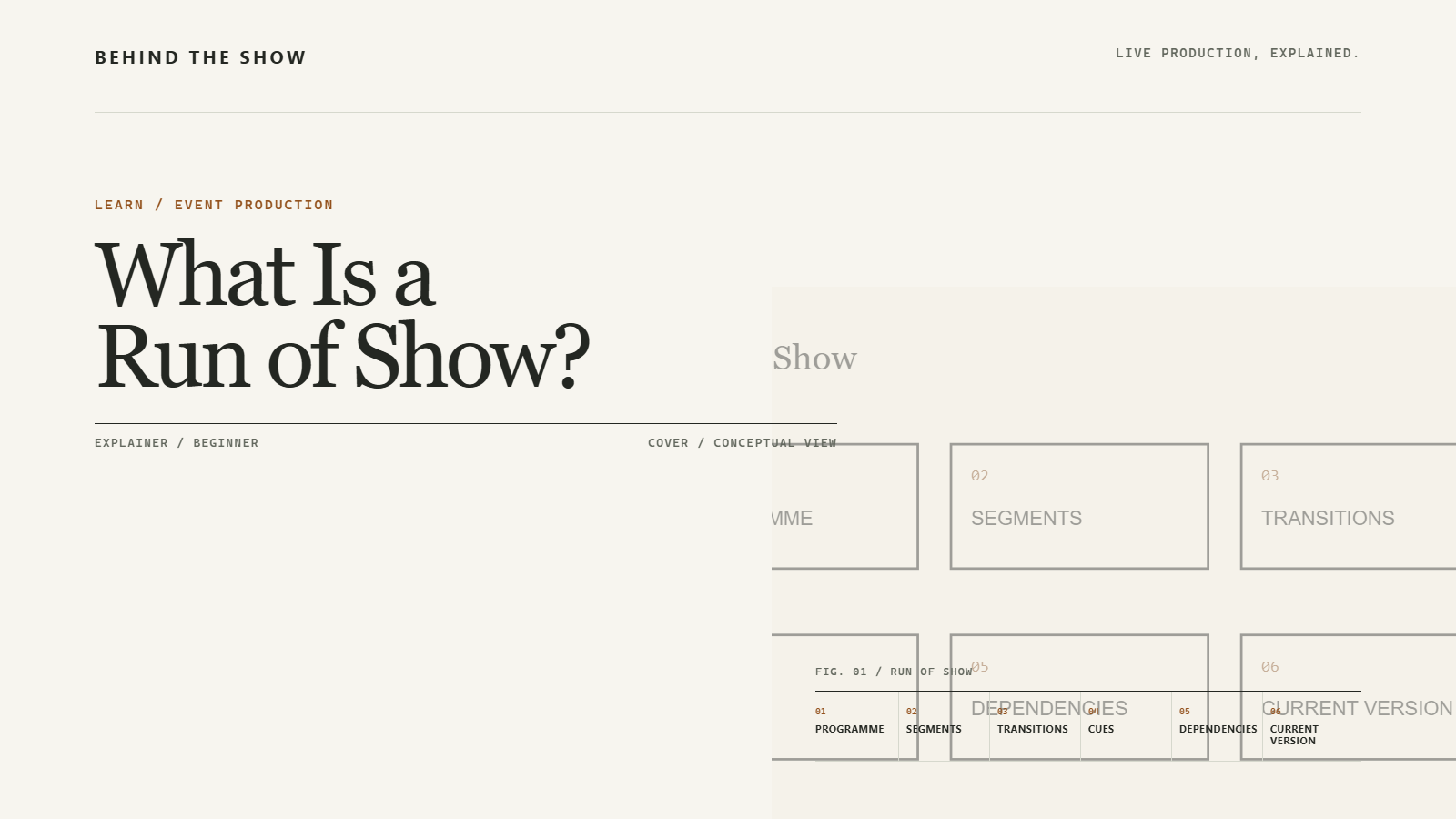
The information needed to deliver each segment and its handovers, including timings, participants, content, cues and dependencies where relevant.
What is the difference between a run of show and a production schedule?
A run of show focuses on programme delivery. A production schedule covers the wider operational timeline before, during and after the show.
Put the knowledge to work
Check your understanding
Three questions from this guide, with an explanation after each answer. Optional, untimed and just for you. Answers and scores are not saved.
Continue learning